
World Cup 2026: Iran Faces Unprecedented Protests and Tensions in Los Angeles
The World Cup has seen hostility before. It has never seen this.
In Los Angeles tonight, Iran open their 2026 campaign against New Zealand under a weight that has nothing to do with tactics or form. Their captain talks about tension. Protesters promise “hell”. Their head coach has been instructed by a government at war with the host nation to stop the game if dissent spills from the stands onto the pitch.
Football has staged some surreal occasions. This one is on another level.
Taremi’s warning: “It undermines the joy”
Mehdi Taremi did not sound like a man on the eve of a normal World Cup opener. Iran have already had to move their base to Mexico because of the war with the United States. Visa problems have hit members of the delegation. Travelling supporters have had tickets stripped away.
“I have felt the tension from the first moment we arrived at this World Cup,” the captain said. “This kind of tension, it undermines that joy and it undermines the message of Fifa and our people, which is that football brings about peace. I feel like this World Cup could have provided a better atmosphere than it has.”
This is supposed to be the stage where players briefly escape the chaos of the outside world. For Iran, the outside world has followed them into the tunnel.
Protesters promise “hell” at SoFi Stadium
Outside and inside SoFi Stadium, the mood will be anything but neutral.
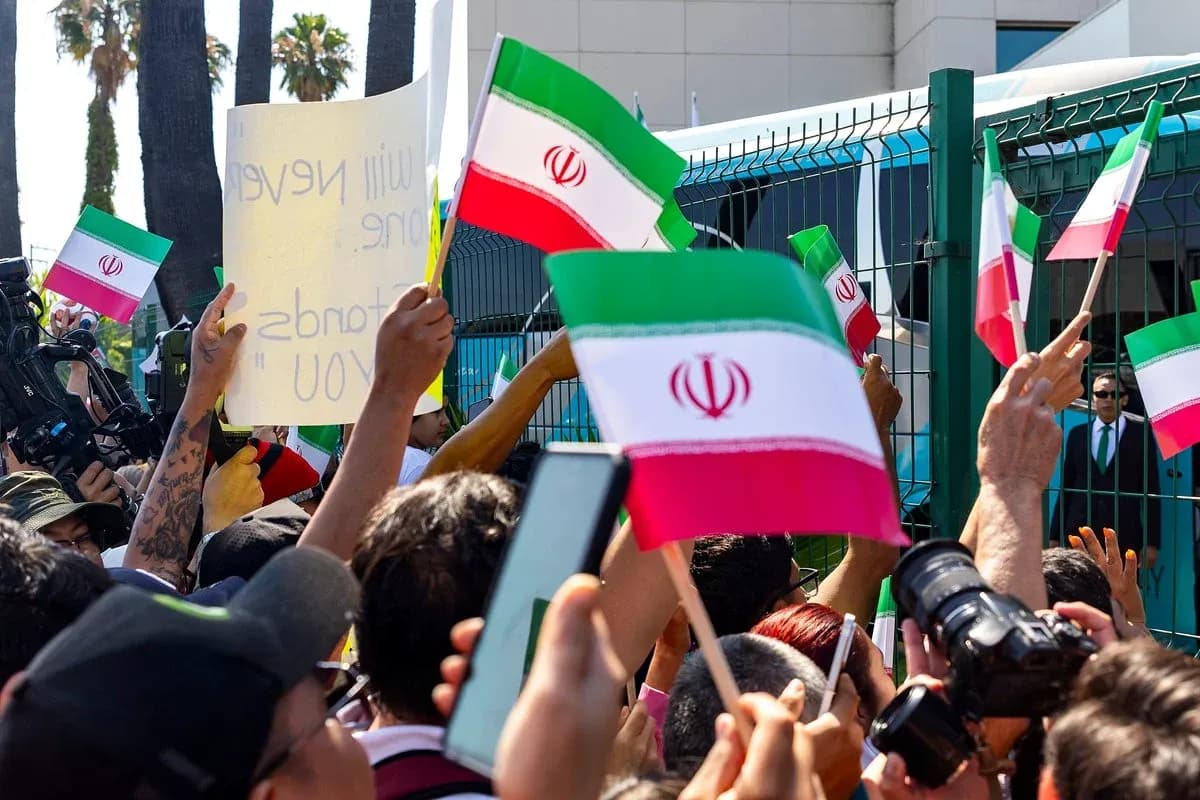
Iranian protesters, many of them emigrants, have organised a coordinated show of defiance against the regime. Buses are set to roll in from San Diego, Orange County and across Los Angeles. Their plan is simple and incendiary: boo the anthem, turn their backs, and unfurl the pre-revolutionary flag that Fifa has banned from stadiums.
“We’re going to make it hell,” one activist told the Daily Mail. She described a choreographed act of resistance: the anthem rings out, the players line up, and thousands of fans turn away, backs to the pitch, banned flags suddenly filling the camera frame instead of the state emblem.
“We’re going to boo the anthem that is going to play. We're going to turn our backs during the anthem so we will have our flags showing.
“I know Fifa banned it [the flag] but we will make a way to get it in. So we're going to see this flag, not the terrorist regime’s flag.”
It is a direct challenge not only to Tehran, but to Fifa’s attempts to sanitise the World Cup’s visuals and keep politics at arm’s length. Tonight, arm’s length will not be possible.
A coach under orders
In the middle of this stands Amir Ghalenoei, a head coach trying to prepare a team while operating under explicit political instruction.
He has been told by the Iranian government to halt the match if pre-revolutionary flags appear or if “negative chanting” against the regime can be heard. In other words, to take an active role in policing dissent from his own countrymen in a World Cup stadium.
On Friday, sat behind a microphone, Ghalenoei tried to draw a line between the football and the fury.
“We don’t pay attention to any of the hype and anything that goes on around us,” he said. “We are here to represent the respectful people of Iran, be it the Iranians inside Iran or the Iranian diaspora.
“We are not political people... football is separate from politics.”
The words are familiar. They ring hollow against the reality. When your instructions include the possibility of walking your players off the pitch because of what your fans are chanting, football and politics are no longer separate. They are welded together.
The surreal possibility hangs there: a World Cup match stopped not for a power cut, a pitch invasion or a thunderstorm, but because a coach acts on orders from a government battling its own people and its host.
A World Cup like no other
The hard facts are stark. For the first time in the World Cup’s 96-year history, a host nation is at war with one of the competing teams. The tournament’s slogan talks about unity; its reality is a geopolitical fault line running straight through Group fixtures.
Iran’s campaign has become a test of what the World Cup can and cannot absorb. Protests are planned. The governing body has set rules on what can be shown and said inside stadiums. The Iranian state has set its own rules on what its representatives must do if those lines are crossed.
Players, as always, stand in the middle. Taremi speaks of joy being undermined. Ghalenoei insists he will not look to the stands. Yet the stands may decide how long this match even lasts.
All of it unfolds tonight in Los Angeles, under the lights of SoFi Stadium, with New Zealand waiting for a game that could turn into a global flashpoint.
The World Cup sells itself as the place where football rises above everything else. In this most perilous of campaigns, the question is brutally simple: what happens when everything else refuses to step aside?




