Valencia vs Barcelona: A Clash of Strategies and Structures
Under the late-summer glare at Estadio de Mestalla, this was billed as a stress test of identities. Valencia, rooted to 20th in La Liga with 1 point and a goal difference of -8, leaned into a survivalist 5-4-1. Barcelona, perfect at the summit with 12 points and a goal difference of +15, arrived as a machine already humming. The 0-5 full-time scoreline did not so much tell a story of surprise as of an imbalance ruthlessly exposed.
I. The Big Picture – Structures under strain
Carlos Corberan doubled down on structure. Valencia’s season to this point had been defined by resistance more than ambition: in total this campaign they had scored just 1 goal in 4 league matches, with an overall average of 0.3 goals per game. At home, that drought was brutal: 0 goals in 3 fixtures, failing to score in all three at Mestalla. Conceding 9 overall at 2.3 per match, including 6 at home (2.0 per home game), the 5-4-1 was less a tactical flourish and more a necessity.
The back five—P. Maffeo, A. Martinez, M. Diakhaby, Pepelu and J. Vazquez—sat narrow and deep in front of S. Dimitrievski. In front of them, D. Otorbi, F. Ugrinic, A. Dieng and J. Guerra formed a compact midfield band, with A. Danjuma marooned as the lone outlet. Corberan’s Valencia had used this shape in all 4 league matches; it is their default language.
Across from them, Hansi Flick’s Barcelona spoke in 4-3-3, but with a fluid, almost positionless edge. J. Garcia behind a back four of E. Garcia, P. Cubarsi, G. Martin and X. Espart gave a high starting block. The midfield triangle—Fermín, Rodri and Pedri—rotated constantly, while a front three of Lamine Yamal, Raphinha and A. Gordon stretched every seam. Heading into this game, Barcelona’s numbers were terrifying: in total 17 goals in 4 matches at an average of 4.3 per game, with 10 of those on their travels at a staggering 5.0 away goals per match. Defensively, they had conceded just 2 overall (0.5 per game) and none away.
II. Tactical Voids – Who was missing, and what that meant
Valencia’s squad list of absentees read like a spine that never made it onto the pitch. S. Canos (knee injury), J. Copete (ankle), J. De Haas (ankle), D. Foulquier, D. Lopez (knee), L. Rioja, G. Rodriguez (muscle), and U. Sadiq (muscle) all missed out. That stripped Corberan of rotation options in both full-back and forward zones, forcing Pepelu into a defensive role and leaving Danjuma, H. Duro and D. Raba as the main attacking cards.
Discipline has been a quiet concern. In total this campaign, Valencia’s yellow cards have clustered in two windows: 31-45 minutes and 76-90 minutes, each accounting for 33.33% of their cautions, with another 16.67% between 16-30 and 61-75. It paints a picture of a side that starts cautiously but becomes increasingly desperate as each half wears on. At the heart of that tension stands M. Diakhaby, already on 2 yellows in 4 appearances, a defender who has blocked 2 shots and made 6 interceptions but lives constantly on the edge.
Barcelona were not untouched by absences. R. Bardghji (knee), J. Bisiwu (ankle) and, crucially, F. de Jong (knee) were all missing. Yet Flick’s midfield depth meant Pedri and Fermín could absorb the creative burden, while Gavi and Dani Olmo waited on the bench to tilt the game further if needed. Discipline-wise, Barcelona’s yellows have been concentrated in the middle third of matches: 25.00% between 16-30 minutes, 50.00% between 46-60 and another 25.00% between 61-75, reflecting an aggressive press that spikes around transitions out of half-time.
III. Key Matchups – Hunter vs Shield, Engine vs Enforcer
Hunter vs Shield
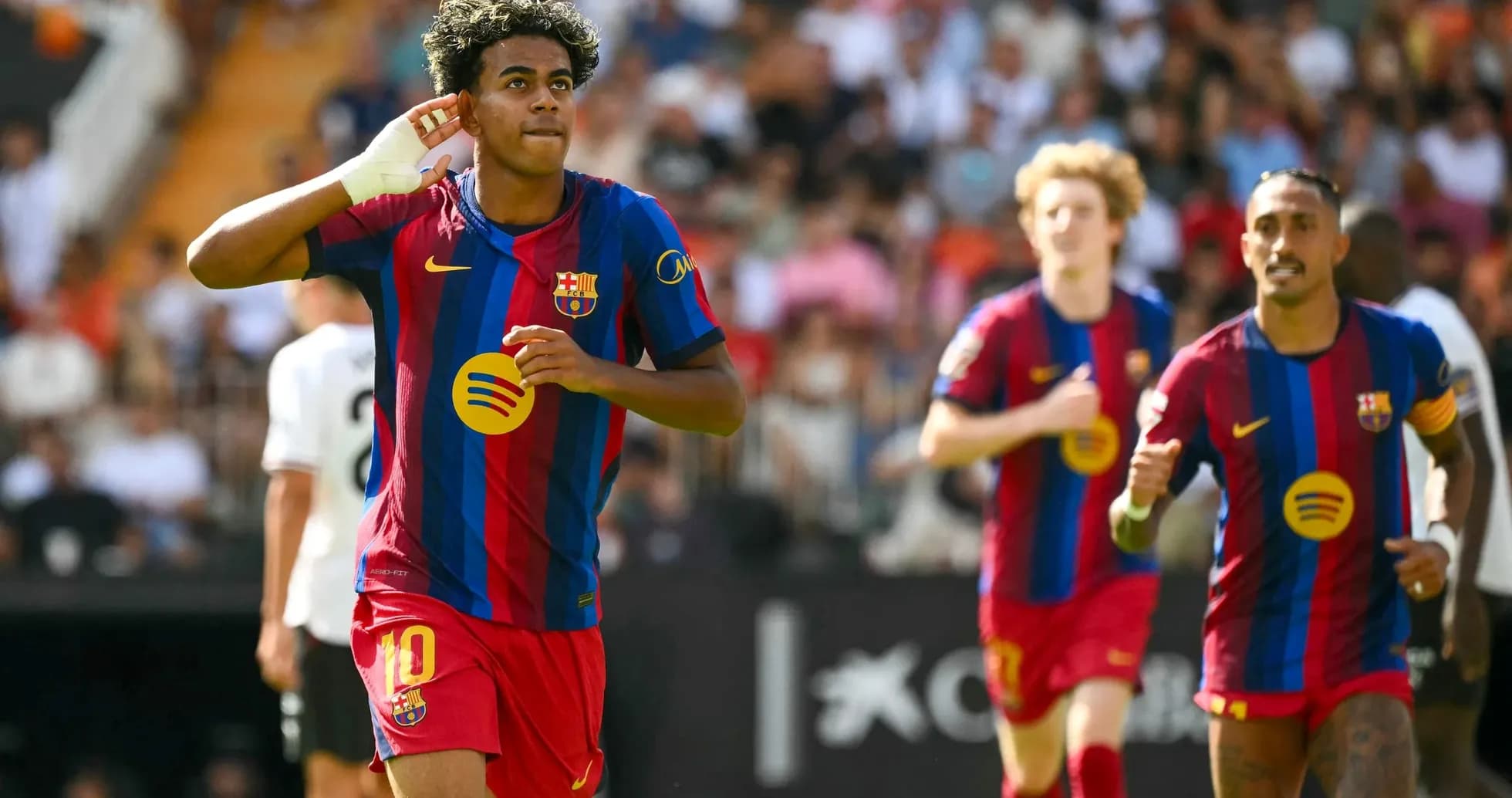
The headline duel at Mestalla was always going to be Barcelona’s devastating right side against Valencia’s left. Raphinha, La Liga’s leading scorer heading into this round with 6 goals and 1 assist in 4 appearances, had been operating at an 8.53 rating, with 9 shots (8 on target) and 7 successful dribbles from 7 attempts. Outside him, Lamine Yamal had added 4 goals of his own, with 17 shots and 19 key passes; together they are less a flank and more a storm front.
Tasked with withstanding that wave were J. Vazquez and Pepelu on Valencia’s left side of the back five, supported by J. Guerra drifting over from midfield. With Valencia conceding 6 goals at home already and recording only 1 clean sheet overall, the structural demand was enormous: deny the half-space to Raphinha, track Yamal’s diagonal runs, and still find a way to release Danjuma on the break.
On their travels, Barcelona had not conceded a single goal in 2 matches, while scoring 10. That away defensive record, combined with the form of X. Espart—who has 2 assists, 195 passes at 85% accuracy, 14 tackles and 7 interceptions in 4 games—meant that even when Valencia broke the first press, they ran into a full-back who defends like a centre-back and builds like a deep playmaker.
Engine Room
In midfield, the duel was as psychological as it was technical. For Valencia, the double responsibility fell on J. Guerra and A. Dieng. Guerra needed to be the outlet, the one to carry them up the pitch from a side that, in total, averages just 0.3 goals per match and has failed to score in 3 of 4 league outings. Dieng and F. Ugrinic had to compress space around Rodri and Pedri, preventing them from dictating the tempo.
But Barcelona’s interior trio were in imperial form. Fermín, with 4 goals and 2 assists already in the league, has combined late box arrivals with a relentless work rate: 9 shots, 8 on target, 137 passes at 83% accuracy, 4 tackles and 1 interception. He is both runner and finisher. Around him, Rodri and Pedri provided the metronome and the knife, constantly rotating to drag Valencia’s narrow block out of shape.
The bench only tilted things further towards the visitors. Dani Olmo, with 2 assists and 5 key passes in limited minutes, plus Gavi’s intensity and the vertical threat of K. Adeyemi and Gabriel Jesus, meant Barcelona could escalate the tempo at will. Valencia’s substitutes—H. Elliott, H. Duro, D. Raba, A. Blazquez—offered energy but not the same level of proven end product.
IV. Statistical Prognosis – Why 0-5 felt inevitable
Heading into this fixture, the statistical currents all flowed one way. Barcelona’s attack, averaging 5.0 goals per away game and 4.3 overall, was colliding with a Valencia defence conceding 2.0 at home and 2.3 overall, while their own attack had not scored a single home goal in 270 league minutes. Barcelona’s defensive record away—0 goals conceded in 2 matches—suggested that once they went ahead, the contest would tilt irreversibly.
Valencia’s late-half yellow card spikes between 31-45 and 76-90 minutes intersected ominously with Barcelona’s tendency to ramp up aggression in the middle phases of each half. As the home side’s legs and concentration faded, Flick’s side had the depth and structure to keep adding layers of pressure.
The 0-5 full-time scoreline, with Barcelona leading 0-2 at half-time, became the logical conclusion of those trends. A Valencia side built to survive, stripped of key options and stuck in a goal drought, ran into a Barcelona team operating at near-peak efficiency, with elite individual form from Raphinha, Lamine Yamal, Fermín and X. Espart and a collective that has yet to drop a point or concede away.
Following this result, the trajectories feel set: Valencia must find a way to evolve their 5-4-1 from mere resistance into a platform for goals, while Barcelona leave Mestalla not just as league leaders, but as a side whose numbers and patterns already resemble a title-winning machine.