Spain's Tactical Mastery Over France in Semi-Final
France and Spain mirrored each other structurally in a 4-2-3-1 at Dallas Stadium, but the semi-final was ultimately defined by the sharpness and control of Spain’s possession game against a French side that never translated territory into genuine threat. Spain’s 2-0 win, with a 1-0 lead at half-time and a controlled second period, was tactically underpinned by superior spacing around the double pivot, cleaner progression between the lines, and a more coherent use of the No. 10 and wide playmakers.
Both sides finished with 10 total shots, yet the expected goals split — 1.63 for Spain to 0.3 for France — captures the real tactical gap: Spain consistently accessed high-value zones, France were kept at arm’s length.
Spain’s 4-2-3-1 was built around Rodri and Fabián Ruiz as the double pivot, with Dani Olmo as a central playmaker and Lamine Yamal and Alex Baena starting between the lines and half-spaces. Out of possession, it resembled a compact 4-4-2, with Olmo stepping up alongside Mikel Oyarzabal to screen France’s first line. This structure limited France’s ability to play through Aurélien Tchouaméni and Adrien Rabiot in the first phase, forcing more direct balls into Kylian Mbappé and the wide trio.
France’s own 4-2-3-1, with Ousmane Dembélé, Michael Olise and Bradley Barcola behind Mbappé, was theoretically aggressive. However, the double pivot struggled to dictate. France completed 473 passes (396 accurate, 84%), marginally fewer but also less incisive than Spain’s 500 (428 accurate, 86%). Spain’s slightly higher possession (51% to 49%) was not about volume but about where they held the ball: repeatedly in the French half, with Rodri orchestrating circulation and Cucurella and Pedro Porro providing width.
Turning Points
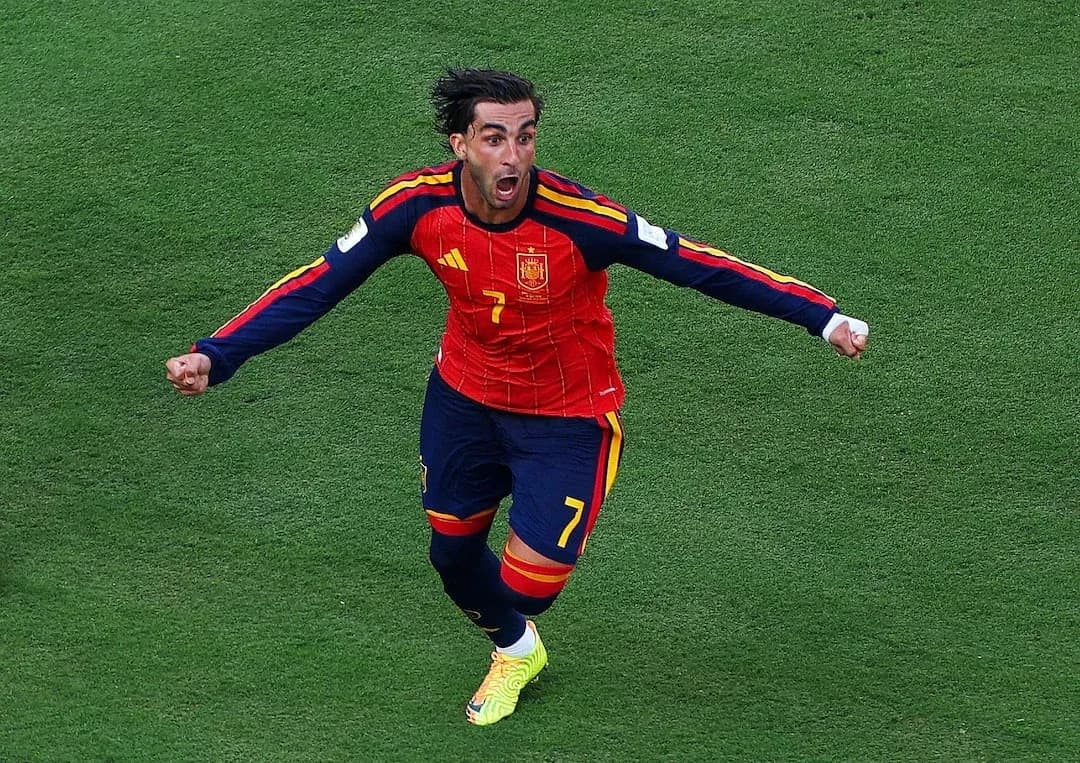
The first turning point came with the 22nd-minute penalty converted by Mikel Oyarzabal. Tactically, it rewarded Spain’s early insistence on vertical combinations through Olmo and Yamal, which stretched France’s back four and exposed the spaces between full-backs and centre-backs. From that moment, Spain could compress their block a few metres deeper, inviting France to carry more of the ball while retaining the more dangerous counter-attacking platform.
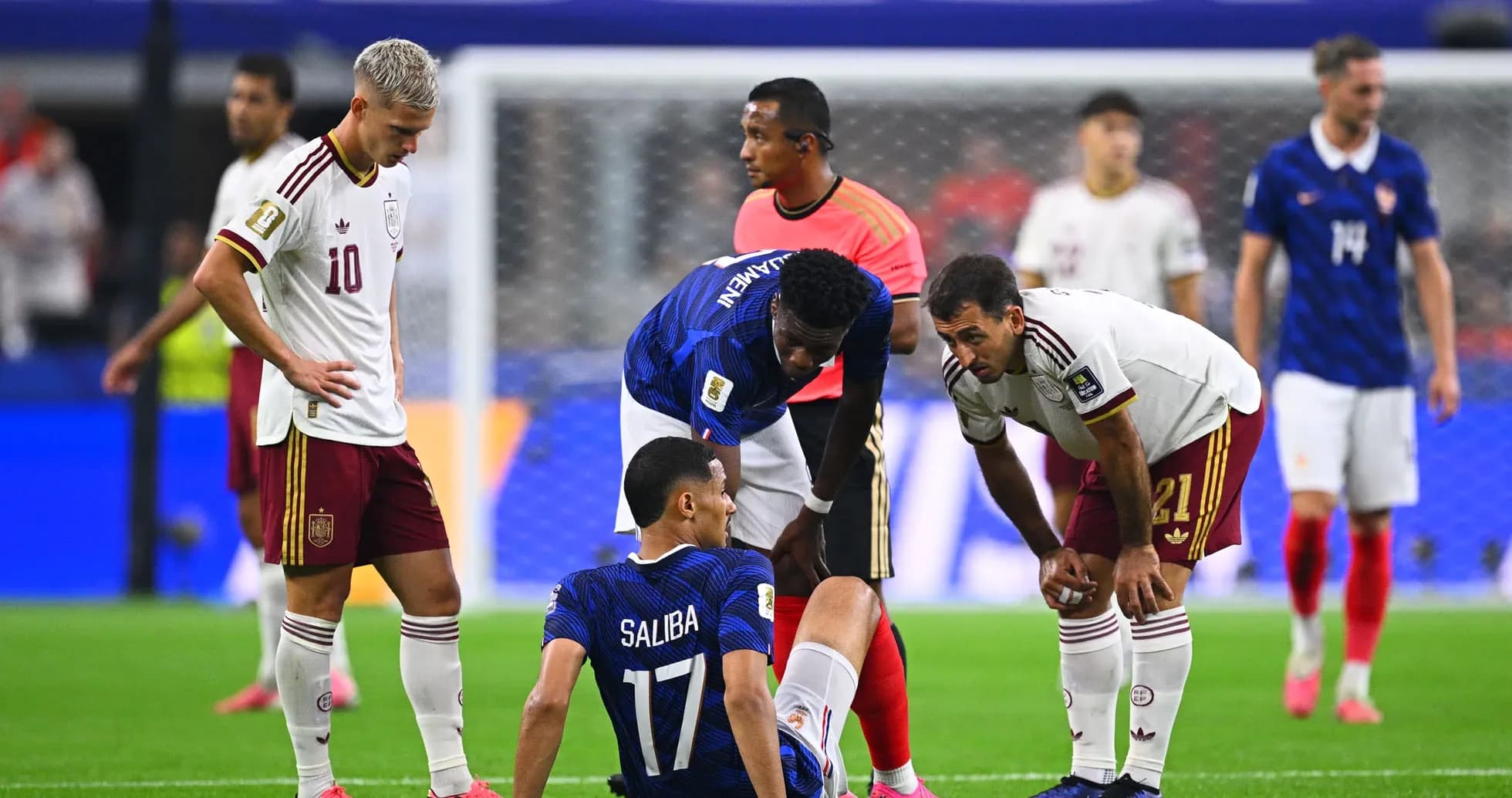
France’s response was disrupted by an early defensive reshuffle: at 30', Maxence Lacroix (IN) came on for William Saliba (OUT). This change altered the right side of the French back line and suggested either a physical issue or dissatisfaction with the defensive balance, but structurally France remained in a back four. The substitution did not significantly improve France’s access to Spain’s half-spaces, where Olmo and Yamal continued to find pockets.
Didier Deschamps’ second-half changes further underlined France’s struggle to crack Spain’s block. At 46', Manu Koné (IN) replaced Rabiot (OUT), adding ball-carrying from deep but sacrificing some of Rabiot’s positional experience. Later, Désiré Doué (IN) for Barcola (OUT) at 57' and the double full/wing change with Theo Hernández (IN) for Lucas Digne (OUT) and Rayan Cherki (IN) for Olise (OUT) at 72' were all attempts to inject dynamism and 1v1 threat in wide channels. Yet the underlying issue remained: France’s possession was too often in front of Spain’s midfield, with limited penetration inside the box — just 4 shots inside the area from 10 total, and only 3 on target.
Spain, by contrast, balanced control and incision. They matched France’s 10 total shots but generated 5 from inside the box and were more selective, with only 2 on target yet far higher shot quality. The second goal at 58' — Pedro Porro finishing from a Dani Olmo assist — was emblematic: Spain created an overload on the right, with Porro advancing high from full-back and Olmo drifting into the right half-space. The move punished France’s wide defensive rotations and the slight disorganisation following their substitution on the opposite flank.
Defensively, Spain were compact and disciplined. They conceded 7 corners to their own 1, yet their box defence was structurally sound: the back four plus Rodri collapsed centrally, funnelling crosses into zones where Laporte and Pau Cubarsí could attack the ball. Spain also defended the offside line aggressively, catching France offside 4 times, a reflection of their willingness to hold a high line when pressing.
On the other side, France’s back line was repeatedly asked to defend in transition and against well-timed Spanish runs. Spain were flagged offside 5 times, which shows their forwards and attacking midfielders constantly probing the depth behind the French defence. That stretching of the back line opened pockets for Olmo and Yamal to receive between the lines, contributing to Spain’s superior xG.
In goal, Mike Maignan (France) had a statistically stark evening: 0 saves recorded, a function of Spain’s efficiency — only 2 shots on target, both resulting in goals. That underlines how Spain’s few clean looks were of high quality. At the other end, Unai Simón (Spain) made 3 saves, matching France’s 3 shots on target and highlighting his role in preserving control when France did break through.
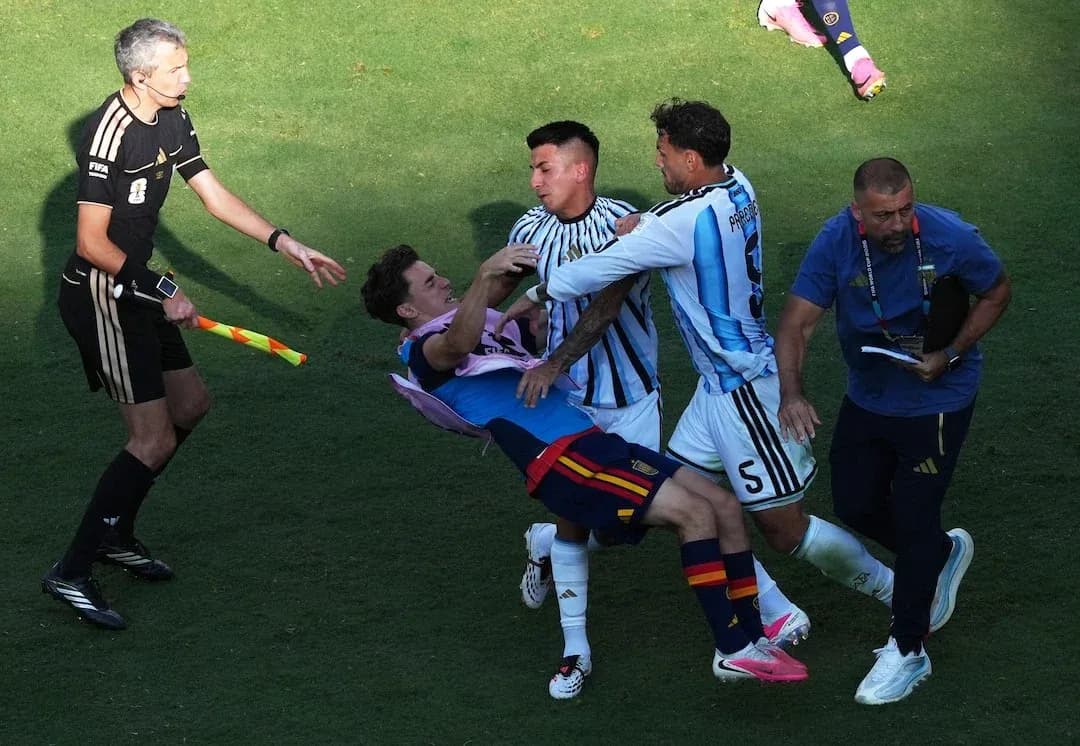
Discipline played a subtle tactical role. France committed 11 fouls to Spain’s 12, with France picking up 2 yellow cards (Adrien Rabiot for “Foul” and Mbappé for “Violent conduct”) to Spain’s 1 (Cucurella for “Foul”). The French bookings, especially Mbappé’s late card, hinted at growing frustration as Spain’s game management in the final phase — aided by a full set of attacking and midfield substitutions — suffocated French momentum.
Overall, the semi-final was less about sheer volume of chances and more about the quality and structure behind them. Spain’s slightly higher possession, better pass accuracy, stronger xG and more dangerous use of the half-spaces made their 2-0 win a logical tactical outcome, while France’s 4-2-3-1 never quite solved the puzzle of Spain’s compact 4-2-3-1/4-4-2 hybrid block.