Spain's Tactical Masterclass in World Cup Final Victory over Argentina
Spain’s 1-0 extra-time win over Argentina in the World Cup Final at MetLife Stadium was a clinic in territorial control versus deep defensive resistance. Across 120 minutes, Luis de la Fuente’s 4-2-3-1 systematically pinned Lionel Scaloni’s 4-4-2 into its own half, turning structural superiority and passing volume into a steady accumulation of chances that finally broke through in extra time.
Spain’s shape was textbook: a back four of Pedro Porro, Pau Cubarsí, Aymeric Laporte and Marc Cucurella, with Rodri and Fabián Ruiz as the double pivot behind an aggressive line of three – Lamine Yamal wide right, Alex Baena tucked inside from the left, Dani Olmo between the lines – supporting Mikel Oyarzabal up front. The structure produced exactly what the numbers suggest: 65% possession, 852 passes with 762 accurate (89%), and 20 total shots, 12 of them on goal. Spain’s circulation through Rodri and Fabián Ruiz allowed constant re-positioning of the ball from side to side, stretching Argentina’s 4-4-2 block and repeatedly isolating Yamal and Cucurella in wide 1v1s.
Argentina’s 4-4-2 was built to suffer without the ball. Gonzalo Montiel and Nicolás Tagliafico stayed narrow, tucking in alongside Cristian Romero and Lisandro Martínez to protect the box, while Rodrigo De Paul and Alexis Mac Allister shuttled laterally to close Spain’s half-spaces. Enzo Fernández and Mac Allister were key in trying to screen passes into Olmo and Baena, but Spain’s numerical superiority in midfield – a 4-2-3-1 against a flat 4-4-2 – meant Rodri often found a free man between the lines. As the match wore on, Scaloni’s substitutions – Nicolás Otamendi for Lisandro Martínez, Leandro Paredes for Nicolás González, Nahuel Molina for Montiel, Facundo Medina for Romero, and Giuliano Simeone for De Paul – gradually turned Argentina into an even deeper, more reactive unit, sacrificing progression for defensive density.
The defensive metrics underline that approach. Argentina finished with only 2 total shots (1 off target, 1 blocked, 0 on goal) and 463 passes (357 accurate, 77%), but committed 25 fouls and collected 6 yellow cards plus 1 red. Their compactness in the central lane forced Spain to work the ball into the box patiently – 9 shots inside the area, 11 from outside – and to rely heavily on wide overloads and cut-backs rather than direct penetrative passes through the middle.
The goalkeeping battle encapsulated the tactical story. Unai Simón (Spain) did not register a single save, a direct reflection of how completely Spain’s structure suppressed Argentina’s attacking threat and protected its own penalty area. In contrast, Emiliano Martínez (Argentina) was under siege: 11 saves, facing 12 shots on target, with his “goals prevented” figure at 1.81 – identical to Spain’s, but for Martínez that number came against sustained pressure. His shot-stopping, particularly from medium and long range, kept Argentina alive deep into extra time.
Spain’s pressing scheme was another decisive layer. From the front, Oyarzabal screened passes into Argentina’s double pivot, while Olmo and Baena jumped onto Enzo Fernández and Mac Allister when the ball went central. Yamal aggressively closed the full-back on his side, with Porro stepping high behind him. This mid-to-high block limited Argentina’s ability to progress cleanly and contributed to their low shot count and heavy foul tally, as they were often forced into late challenges after losing the ball in their own half.
De la Fuente’s in-game management sharpened Spain’s control phases. At 62', Pedri (IN) came on for Fabián Ruiz (OUT) and Ferran Torres (IN) for Mikel Oyarzabal (OUT), adding fresher legs and more vertical running against a tiring Argentine block. At 75', Nico Williams (IN) replaced Alex Baena (OUT) and Mikel Merino (IN) came on for Dani Olmo (OUT), further increasing Spain’s capacity to attack depth and win second balls around the box. In extra time, Martín Zubimendi (IN) for Rodri (OUT) and Eric García (IN) for Aymeric Laporte (OUT) at 99' ensured Spain maintained defensive control and energy in midfield while continuing to recycle possession.
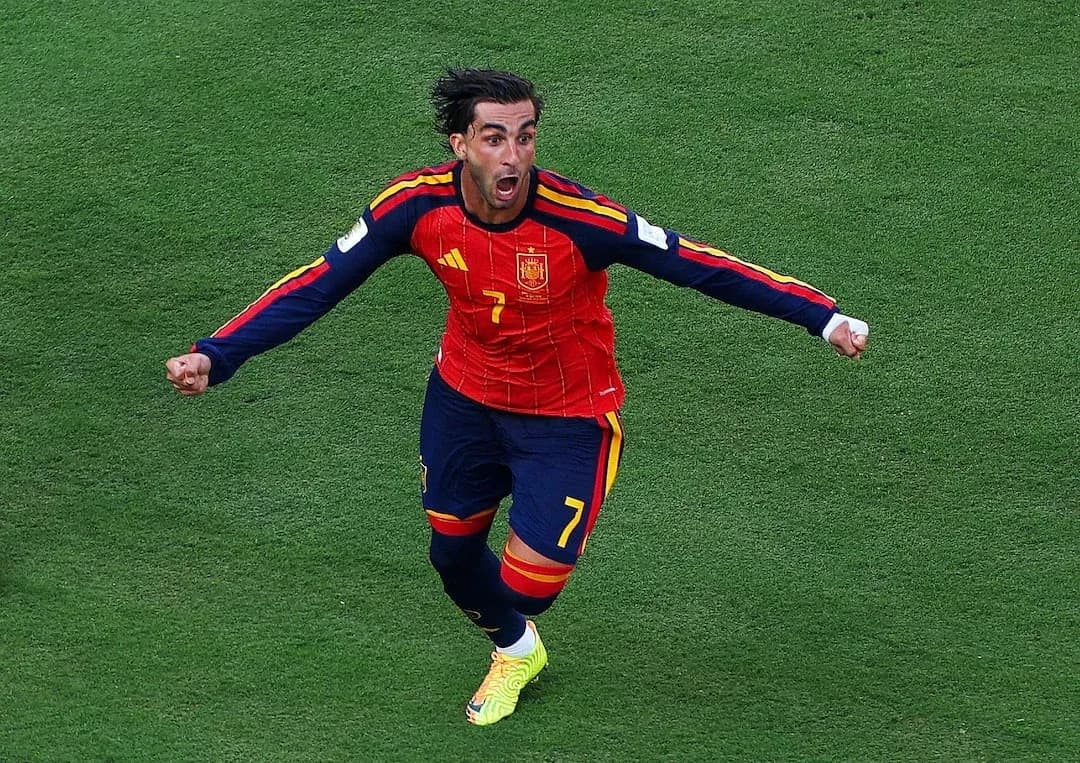
The decisive moment came in extra time, and its authors were both substitutes: at 106', Ferran Torres (Spain) scored with an assist from Nico Williams, a direct payoff of de la Fuente’s wing-focused adjustments. The pattern fit the broader tactical arc – Spain’s relentless wide pressure, fresh pace on the flanks, and the cumulative fatigue of an Argentina side reduced to ten men after Enzo Fernández’s dismissal at 90+3'.
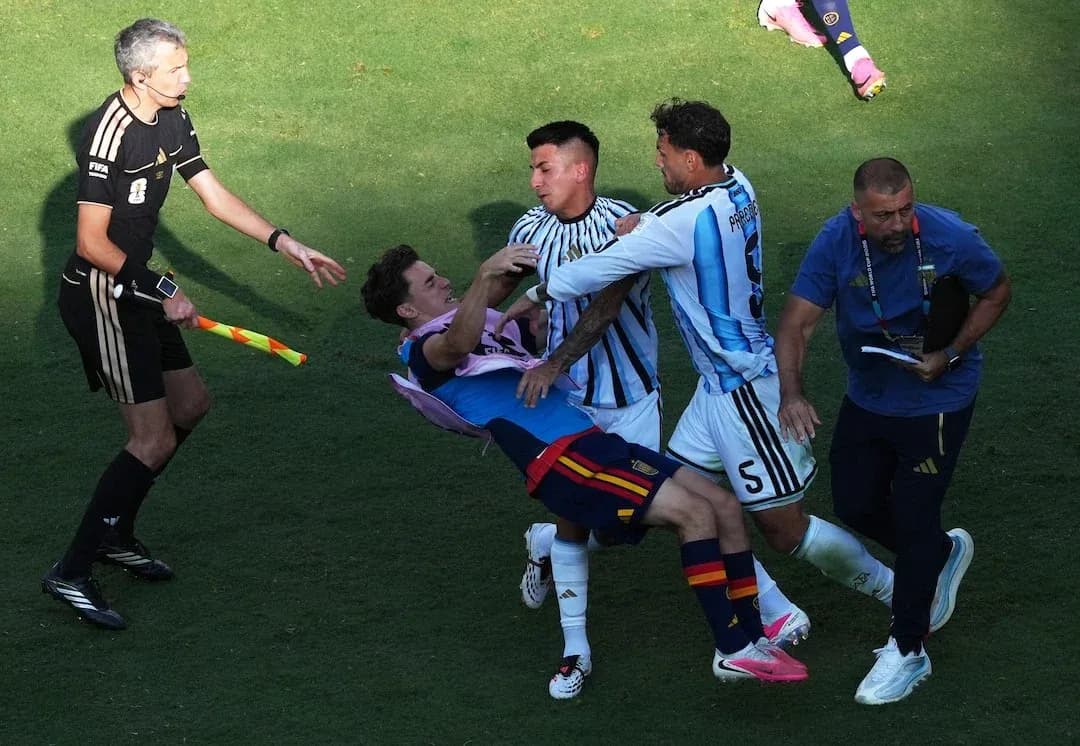
Fernández’s disciplinary collapse – yellow for “Argument” at 83', yellow for “Foul” at 90+3', immediately followed by a red card for “Foul” – crystallized the strain on Argentina’s midfield. Down to ten, they dropped even deeper, with Lionel Messi and Julián Alvarez increasingly isolated up front and unable to press Spain’s first line. Alexis Mac Allister’s late yellow card for “Foul” at 111' further illustrated a side surviving on emergency defending rather than structured resistance.
Statistically, Spain’s 1.94 xG against Argentina’s 0.22 xG matches the eye test: a final where one team controlled territory, tempo and chance creation, while the other tried to drag the contest into moments and penalties. Spain’s 9 corners to Argentina’s 4 and their 4 offsides to Argentina’s 1 speak to how consistently they played on the front foot and in behind the last line.
In tactical terms, this final will be remembered as a triumph of structural dominance and squad depth. Spain’s 4-2-3-1, with its passing security and positional rotations, systematically dismantled Argentina’s 4-4-2 over 120 minutes, and once the numerical advantage arrived, the breakthrough became almost inevitable.