Spain Edges Portugal 1-0 in Tactical Showdown
Portugal’s 0-1 defeat to Spain at AT&T Stadium in the World Cup Round of 16 was decided on fine tactical margins, with Spain’s control of space and rhythm eventually matching their superior chance creation. Across 90 minutes, Spain’s 55% possession and 15 total shots to Portugal’s 10 translated into a clear territorial edge, reflected as well in the xG split of 1.77 to 0.58. Yet it took a 90+1’ intervention from the Spanish bench to finally break a Portuguese block that had been structurally resilient for long stretches.
Without a formation field in the data, shape has to be inferred from roles. Roberto Martinez built Portugal around a back four of João Cancelo, Rúben Dias, Renato Veiga and Nuno Mendes shielding Diogo Costa, with Vitinha and João Neves as the central platform and an attacking band of Pedro Neto, Bruno Fernandes and João Félix behind Cristiano Ronaldo. The statistical profile suggests a mid-to-high defensive block that tried to compress central lanes: Spain were forced into a relatively even split of shots inside (8) and outside the box (7), and had 3 shots blocked, matching Portugal’s 3 blocked efforts at the other end. Portugal’s 45% possession and 426 total passes (357 accurate, 84%) indicate they were prepared to concede the ball for phases but still aimed to build through short combinations rather than pure counter-attacking.
Spain, under Luis de la Fuente, leaned on their traditional positional play: a back four of Pedro Porro, Pau Cubarsí, Aymeric Laporte and Marc Cucurella behind a midfield core of Rodri and Pedri, with Lamine Yamal and Dani Olmo operating between the lines, Alex Baena linking and Mikel Oyarzabal leading the line. Their 531 passes with 467 accurate (88%) show a stable circulation, and the 7 corner kicks to Portugal’s 3 underline sustained pressure in the final third. The higher shot volume (15 total, 6 on goal) and significantly greater xG (1.77) point to Spain repeatedly finding better shooting zones, especially as Portugal tired.
Second Half Substitutions
The substitutions framed the tactical story of the second half. Martinez’s first change at 56’ — Nélson Semedo (IN) came on for Nuno Mendes (OUT) — subtly rebalanced the right side. With Spain probing through wide overloads, Semedo’s more conservative profile likely aimed at tightening Portugal’s defensive transitions and giving extra security against Lamine Yamal and overlapping full-backs. The double change at 71’ — Diogo Dalot (IN) for João Cancelo (OUT) and Rafael Leão (IN) for João Félix (OUT) — sharpened the flanks in different ways: Dalot offering a more orthodox, defensively solid right-back, and Leão injecting verticality and 1v1 threat on the left. This aligned with Portugal’s need to stretch Spain on the break; however, the underlying numbers (only 2 shots on goal from 10 attempts) suggest those transitions rarely matured into truly dangerous final actions.
At 83’, Martinez added fresh legs in midfield and attack: Bernardo Silva (IN) came on for Vitinha (OUT), and Francisco Conceição (IN) came on for Pedro Neto (OUT). This was a clear attempt to raise the technical ceiling in tight spaces and to add late-game creativity, but the xG total of 0.58 shows Portugal still struggled to generate clear chances despite the added playmaking. Spain’s defensive structure, anchored by Rodri’s positioning and Laporte’s management of depth, limited Portugal largely to lower-quality efforts, many from just outside optimal zones.
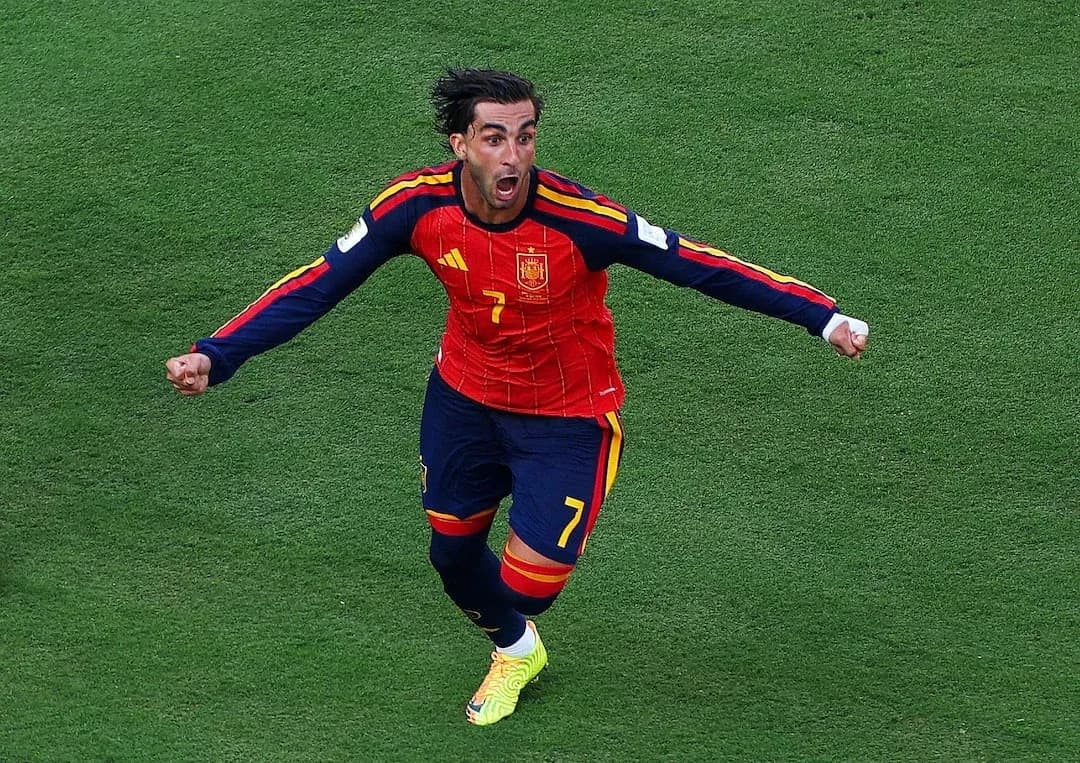
On the Spanish side, de la Fuente’s bench decisions were decisive. Ferran Torres (IN) came on for Alex Baena (OUT) at 75’, adding a more direct runner who could attack Portugal’s back line and, crucially, later provide the assist for the winner. The 85’ double substitution — Mikel Merino (IN) for Dani Olmo (OUT) and Fabián Ruiz (IN) for Pedri (OUT) — tilted Spain’s midfield profile towards more penalty-box presence and late-arriving runs from deep. That change is borne out in the decisive moment: at 90+1’, Mikel Merino (Spain) scored with an assist from Ferran Torres, turning Spain’s territorial dominance into a 1-0 lead precisely through two substitutes combining in the box.
Even after the goal, Spain continued to manage the game through control and fresh energy. Borja Iglesias (IN) came on for Mikel Oyarzabal (OUT) at 90’, providing a physical reference to help Spain defend from the front and contest clearances as Portugal chased an equaliser. Spain’s foul count (13 to Portugal’s 9) and their single yellow card — Ferran Torres booked for “Foul” at 90+9’ — reflect a side willing to break rhythm and disrupt transitions late on to protect the lead. Portugal’s two late yellows, Bernardo Silva for “Foul” at 89’ and Renato Veiga for “Foul” at 90+4’, underline how stretched they became as they pushed numbers forward and were forced into reactive defending against Spanish counters and ball retention.
In goal, Diogo Costa (Portugal) had a demanding night. Portugal’s statistics show 5 goalkeeper saves and 0.87 goals prevented, confirming that Spain’s 6 shots on target did test him repeatedly and that his interventions kept Portugal alive until stoppage time. Unai Simón (Spain), by contrast, was far less busy, with Spain’s figures indicating 2 goalkeeper saves and 0.87 goals prevented. This asymmetry matches the broader tactical pattern: Spain limited Portugal’s clean looks at goal while still needing their own keeper to be sharp on the occasional Portuguese break or set piece.
Statistical Verdict
The statistical verdict reinforces the tactical reading. Spain’s superiority in possession (55%), passing volume and accuracy (531 passes, 88%), and attacking output (15 shots, 6 on goal, xG 1.77) points to a game largely played on their terms. Portugal’s 45% possession, 10 shots with only 2 on target, and xG of 0.58 indicate a plan built around compactness and selective attacking bursts that never quite translated into sustained threat. Both sides registered 3 blocked shots, showing committed defending in and around the box, but Spain’s 7 corners to Portugal’s 3 again highlight who spent more time in advanced areas.
Discipline also mattered in the closing stages. The card count — Portugal: 2, Spain: 1, Total: 3 — all for “Foul”, emerged as the game opened up and legs tired. Yet the key differentiator was not discipline but the bench: de la Fuente’s introduction of Ferran Torres and Mikel Merino directly produced the winning goal, while Martinez’s attacking changes could not overcome Spain’s structural control. In a finely poised knockout tie, Spain’s superior control of space, ball and substitutions converted statistical dominance into a narrow but deserved 1-0 passage to the 1/8 final.