South Korea vs Czechia: Tactical Insights from World Cup Group Stage
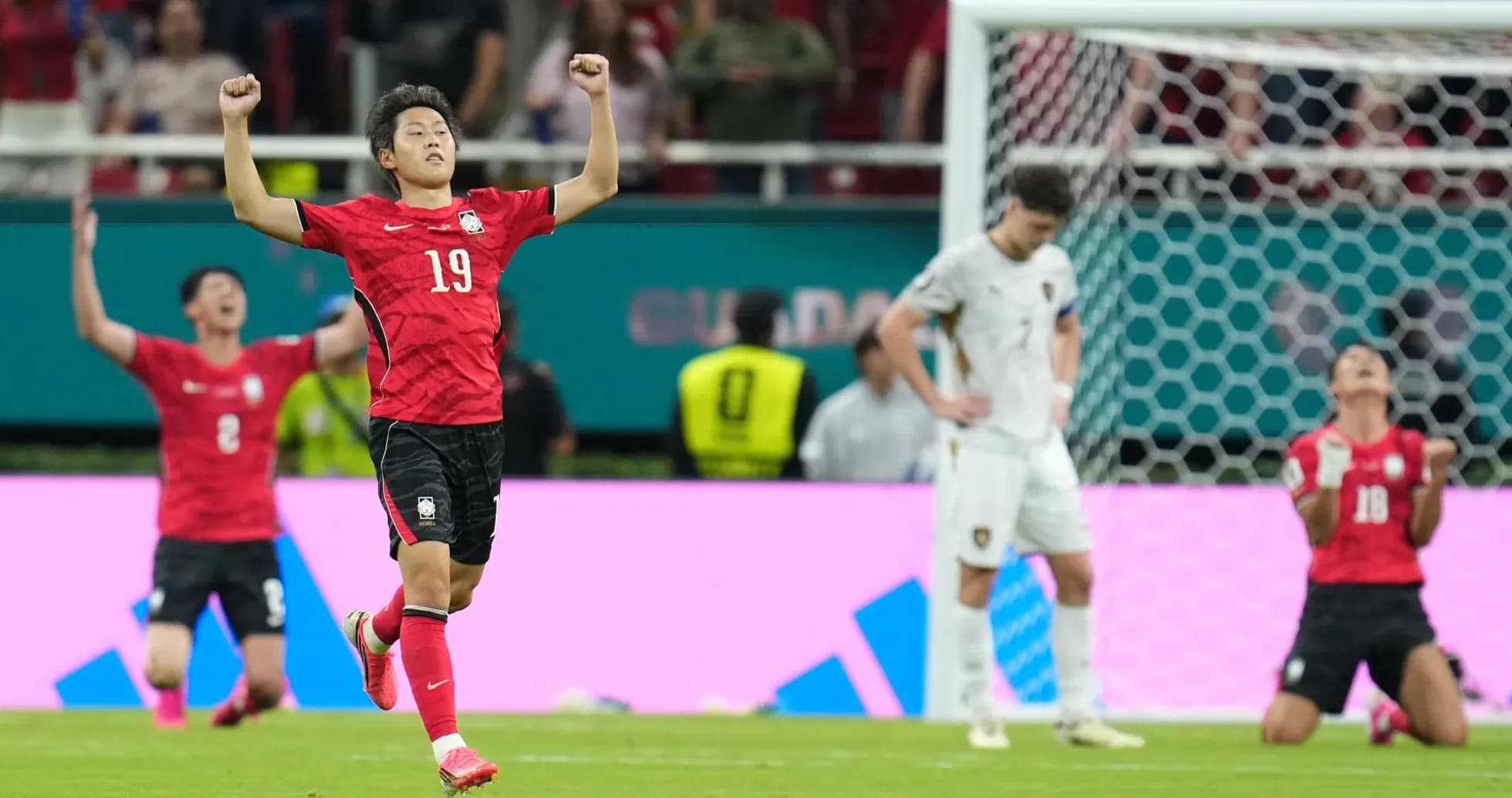
Under the Guadalajara night sky at Estadio Akron, South Korea 2–1 Czechia felt less like an opening group game and more like a tactical manifesto from Myung-Bo Hong. Following this result in the World Cup Group Stage – 1, South Korea sit 2nd in Group A on 3 points with a goal difference of +1, while Czechia are 3rd with 0 points and a goal difference of -1. The numbers are still small, but the identities of both sides already look sharply defined.
I. The Big Picture: Mirrored Shapes, Different Souls
Both coaches arrived with the same whiteboard sketch: 3-4-2-1. What unfolded, though, were two very different interpretations of that structure.
South Korea’s version was fluid and front-foot. With a 3-4-2-1 used in all of their fixtures so far, Hong clearly sees this as more than a one-off. The back three of Gi-Hyuk Lee, Kim Min-jae and Han-Beom Lee set a high line, protected by a busy central pairing of Hwang In-beom and Seung Ho Paik. Wide, Young-woo Seol and Lee Tae-seok stretched the pitch, allowing the trio of Kang-in Lee, Jae-sung Lee and Son Heung-min to constantly rotate between lines.
Czechia mirrored the formation on paper, but Miroslav Koubek’s side leaned into a more pragmatic, contact-heavy game. Ladislav Krejčí anchored the left of the back three, flanked by Robin Hranáč and Štěpán Chaloupek, with Vladimír Coufal and Jaroslav Zelený as wing-backs. In midfield, Tomáš Souček and Alexandr Sojka were tasked with compressing central spaces, while Lukáš Provod and Pavel Šulc floated behind Patrik Schick.
Heading into this game, the statistical canvas was blank; following it, the first strokes are telling. South Korea have, in total this campaign, scored 2 goals and conceded 1, both figures coming at home, giving them a home average of 2.0 goals for and 1.0 against. Czechia, on their travels, have scored 1 and conceded 2, for away averages of 1.0 for and 2.0 against. The symmetry of the scoreline reflects the broader story: Korea’s structure is already yielding a clear attacking return, while Czechia’s is still searching for balance.
II. Tactical Voids and Discipline: Edges of Control
There were no listed absences for either side, so what we saw was close to each coach’s ideal blueprint. The real voids came from in-game discipline and emotional management.
South Korea’s season card profile is unusual: the only recorded yellow in the campaign falls in the 91–105 minute window, a 100.00% concentration of cautions in added time. It fits the narrative of a team that plays aggressively to the end and occasionally flirts with the line. Gi-Hyuk Lee embodies that edge. Across his 97 minutes, he not only passed at 93% accuracy and made 3 interceptions, but he also collected both a yellow and a red card in this World Cup campaign, putting him at the heart of Korea’s disciplinary story. For a defender in a back three, that dual status – organiser and risk factor – will shape how Hong manages game states later in the group.
Czechia, by contrast, emerge from this fixture statistically clean: no yellow or red cards recorded in the competition so far. Yet their key duelists, particularly Krejčí and Coufal, walk a fine line through volume rather than rashness. Krejčí committed 3 fouls, Coufal another 3, each using tactical infringements to break rhythm without crossing the threshold into bookings. It is a disciplined cynicism that kept the game within reach even when Korea’s midfield threatened to run away with it.
III. Key Matchups: Hunter vs Shield, Engine Room vs Enforcer
The headline “Hunter vs Shield” duel in this match did not come from a classic striker, but from a deep-lying orchestrator stepping into the limelight: Hwang In-beom against the Czech back three.
Hwang’s World Cup so far is immaculate. In total this campaign he has 1 goal and 1 assist from 1 appearance, with 81 passes at 90% accuracy, 3 shots (2 on target) and 2 interceptions. Nominally a midfielder, he functioned as Korea’s primary offensive weapon, arriving late on the edge of the box, dictating tempo and exploiting gaps between Souček and the Czech centre-backs. For a defensive unit that has, on their travels, conceded 2 goals from 1 match, Hwang’s ability to shoot from range and slip passes into the half-spaces turned that vulnerability into a decisive fault line.
On the other side, the Czech “Shield” was personified by Krejčí. Listed as a defender, he offered both protection and punch: 1 goal from his only shot on target, 3 tackles and 13 duels with 7 won. His threat on set pieces and second phases gave Czechia a direct route back into the match whenever they could win territory. As a pure defensive unit, though, the back three were repeatedly stretched laterally by Korea’s rotations and vertical passing.
In the “Engine Room” battle, Tomáš Souček and Alexandr Sojka tried to clamp down on Hwang and Paik, but the Korean double pivot had the cleaner day. Paik’s positioning allowed Hwang to step higher, while Kang-in Lee’s drifting inside created overloads that Czechia struggled to track.
Kang-in’s numbers underline his influence: in total this campaign he has 1 assist, 37 passes at 100% accuracy, 3 key passes, 6 dribbles attempted with 5 successful, and 10 duels won out of 14. He was the chaos factor between the lines, repeatedly dragging Hranáč and Chaloupek out of their zones. Every time Czechia tried to squeeze central spaces, Kang-in would carry the ball into the half-space, forcing the back line to choose between stepping out or leaving Son isolated 1v1.
For Czechia, the creative “engine” was Coufal. His 1 assist and 1 key pass from 26 total passes at 65% accuracy highlight a more direct profile: fewer touches, but each one loaded with vertical intent. When Czechia broke, it was often Coufal’s early ball that tried to find Schick or the arriving Provod. Yet with only 2 duels won from 9, he spent more of the night reacting to Korea’s wide overloads than driving his own.
IV. Statistical Prognosis: What This Game Tells Us About the Road Ahead
The raw xG values are not provided, but the pattern of chances and the underlying numbers allow a reasoned verdict.
South Korea’s attacking framework looks sustainable. At home they average 2.0 goals for and 1.0 against, and they have yet to fail to score in this World Cup. Their biggest home win – 2-1 – is also their only result, but it shows a side capable of creating multiple high-quality opportunities from structured possession. Hwang In-beom and Kang-in Lee are already among the competition’s leading performers, with Hwang ranking near the top for both goals and assists, and Kang-in featuring prominently for assists and dribbling output. Add the impact of Hyeon-gyu Oh, who has 1 goal from 1 shot on target in just 28 minutes and won 3 of 4 duels, and Hong has a bench weapon who can tilt tight games late.
Defensively, the concern is discipline and game management. There are no clean sheets yet, and with their only yellow and red cards concentrated in late minutes through Gi-Hyuk Lee, Korea must ensure that their aggressive line does not become a liability in knockout-style pressure situations. Still, with Kim Min-jae marshalling the back three and the team conceding only 1 goal in total, the platform is solid.
For Czechia, the prognosis is more fragile but not hopeless. On their travels they average 1.0 goal scored and 2.0 conceded, with no clean sheets and no failures to score. That profile suggests a team that will always give opponents a chance but can hurt them in return, especially through set pieces and late runs from the back like Krejčí’s. The lack of cards so far speaks to a controlled aggression that can be an asset in a long group campaign.
However, the current defensive record – 2 goals conceded from 1 away match – aligns with the eye test: the 3-4-2-1 is leaving too much responsibility on Souček and the back three to cover horizontally. Unless Koubek tightens the distances between lines or introduces a more conservative wing-back, Czechia will continue to live on the edge against technically sharp midfields.
In tactical terms, this match felt like a preview of each side’s tournament arc. South Korea look like a team built for control and incision, with a clear spine in Hwang, Kang-in and Son, plus impactful depth in Hyeon-gyu Oh. Czechia resemble a side constructed around moments: Krejčí’s aerial dominance, Coufal’s direct service, Schick’s penalty-box instincts.
Following this result, the metrics lean toward South Korea as a side whose performances are more likely to be replicated than Czechia’s. If xG were to mirror the flow of chances and territorial dominance suggested by the passing and shooting data, Korea’s edge in structured chance creation would almost certainly show through. For Czechia to flip their trajectory, they will need to turn their disciplined physicality into a more cohesive block, or risk seeing this narrow 2-1 defeat become a recurring scoreline rather than a one-off warning.