
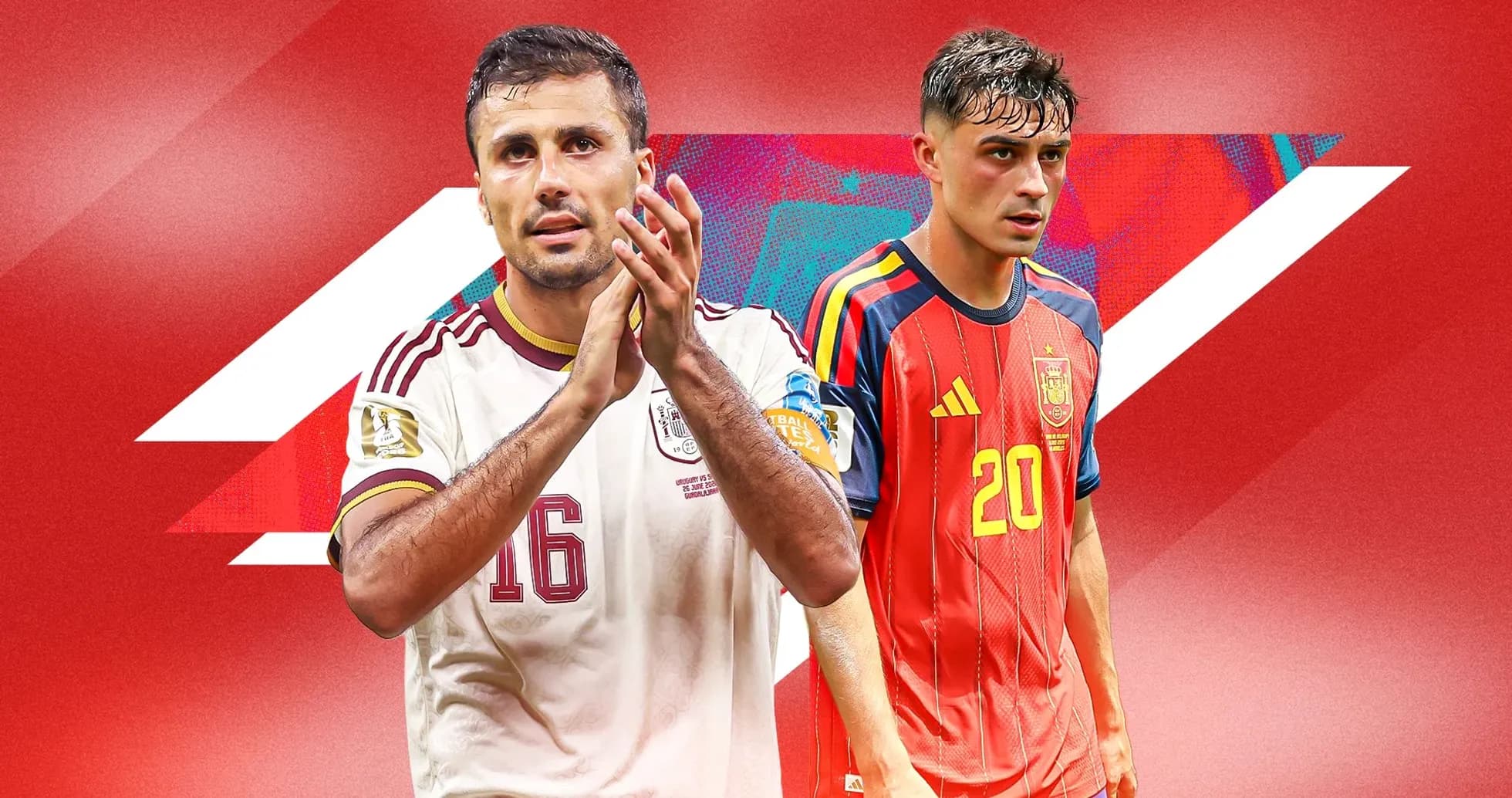
Rodri and Pedri: Spain's Midfield Dilemma in the World Cup
Rodri and Pedri. On paper, the partnership was supposed to be the beating heart of a Spain side chasing a world crown to sit alongside their European title from Germany. One anchoring, one orchestrating. One at the peak of his powers, the other expected to follow him there.
Only one half of that equation has truly landed in North America.
Rodri has moved through this World Cup like a Ballon d'Or winner in waiting, dictating games with the authority of a man who knows every tempo and every angle. Pedri, by contrast, has become a lightning rod for debate back home, his every touch measured against the impossible standards he helped create.
The numbers from Spain’s opening stalemate with Cape Verde tell one story. Pedri created five chances, more than anyone else on the pitch. He found pockets, slipped passes, tried to unpick a stubborn defence. Yet the reaction in Spain focused on what he did not do: he didn’t drag La Roja to victory. For a player of his profile, that was enough to trigger a national inquest.
Cape Verde’s subsequent run has softened the glare on that scoreless draw, but not on Pedri himself. As the tournament has stretched on, his lack of goals or assists has been placed under a harsher spotlight, especially with a very visible comparison playing out in the same competition.
Jude Bellingham and Pedri are not like-for-like. Different roles, different responsibilities. Still, that has not stopped Real Madrid fans from reveling in the contrast. Their man is stamping his name on this World Cup with decisive performances, while Barcelona’s chief creator has drifted to the margins of games. It is simplistic, reductive even, yet in the modern game the bottom line tends to drown out the nuance: Bellingham is scoring and creating. Pedri is not.
Against that backdrop, Luis de la Fuente’s decision to drop Pedri came as a jolt. The midfielder had started all five of Spain’s matches at this World Cup, and nine straight on this stage going back to Qatar. Coaches do not usually bench players of his status on a whim. De la Fuente’s explanation, though, was blunt and accurate: Spain are loaded in midfield.
If anyone had cause to knock on the manager’s door, it was Mikel Merino. The Arsenal man had just come off the bench to score a late winner against Portugal, yet still found himself among the substitutes again. He did not sulk. He simply repeated the trick, arriving to head in another crucial goal in the 2-1 win over Belgium.
“It’s unfair that Mikel doesn’t play from the start, but it would also be unfair if someone else were left out,” De la Fuente told reporters. “Only 11 can play, and they understand that – the role they have to play at any given moment. When they take to the pitch, they know what they have to do; that’s why it’s a pleasure to be their manager.
“What matters is the team. It doesn’t matter who starts the match. Everyone is important, even those who haven’t played.”
There has been no sign of Pedri raging against that reality. No sulks, no public discontent. Goalkeeper Unai Simon lifted the curtain slightly after the Belgium game. “He’s taken it well,” Simon said. “We all want to play but, in the end, there isn’t room for everyone.
“How must David (Raya) and Joan (Garcia) feel knowing they’re world-class goalkeepers? Everyone wants to play, but everyone wants to win the World Cup. So, when it’s your turn to accept that role, you do it.”
The question now is what that role looks like against France.
Pedri’s cameo in Los Angeles did not help his case. Spain had a late breakaway to kill the game and he squandered it with a rare misjudged pass, a moment of imprecision that jarred with his usual clarity. At the same time, Fabian Ruiz strengthened his own hand. The Paris Saint-Germain midfielder opened the scoring, impressed in and out of possession and, as Simon pointed out, arrives with the aura of a man who has just “won two Champions Leagues in a row”.
Fabian’s form, and his comfort at this level, has turned a theoretical debate into a very real selection dilemma.
De la Fuente is in no doubt about Pedri’s status. He calls him “a class player, one of the best in the world, if not the best”. The same praise, though, is extended to Fabian. In the coach’s eyes, this is not a hierarchy so much as a puzzle. And at the centre of it is a belief that there are two Pedris: the Barcelona version, and the Spain version.
“Pedri can’t play like he does for Barca, because we play differently,” De la Fuente explained. “We have similarities, but it’s not the same. We don’t have the same players either.
“We have Rodri, so of course his partner in midfield is different. For me, Pedri could play as a 6, 8, or 10, but we have to make decisions that are always very elaborate, very analysed, very tailored to the opponent.”
France are that opponent now, and they change the equation.
Spain’s one clear area of superiority lies in midfield. Rodri, Pedri, Fabian: put all three on the pitch and La Roja could smother the ball, starve Didier Deschamps’ fearsome front line and drag the game into a rhythm that suits them. They started together against Cape Verde, and the logic of repeating that set-up is obvious.
There is a cost, though. Fielding both Pedri and Fabian likely means sacrificing Dani Olmo, who has quietly made the No.10 role his own in the knockout rounds. His finishing still frustrates at times, but his movement and link play have become important to Spain’s attacking structure. Dropping him would be a bold call.
De la Fuente has been clear about where he believes Pedri can hurt teams most. He wants him closer to the opposition box, where those feints, flicks and one-touch combinations can carve open defences. He has also praised the midfielder for “always setting a very good tone, whether he’s in top form or not” – an acknowledgment of his capacity to control the feel of a game even when the final pass is missing.
Yet his recent comments hint at a different plan. After Belgium, he spoke of Pedri benefiting from Fabian’s work, of a kind of relay in midfield. Start with Fabian’s energy and presence, then unleash Pedri when the game stretches and tired legs leave gaps between the lines. “It’s essentially teamwork,” he said, laying out a vision in which egos bend to the collective.
That, more than any individual flourish, might be Spain’s sharpest weapon. The squad’s willingness to accept shifting roles, to step forward or back without complaint, has become their defining strength. It is why a player of Pedri’s stature can be debated, even benched, without the camp cracking.
France have “extraordinary, exceptional potential,” De la Fuente warned, before adding that Spain do too. He expects a wide-open contest, one that will demand “fresh, energetic players” and a team operating at “the best version of ourselves.”
The lingering doubt is whether that best version still includes the Barcelona Pedri – the one who bends games to his will – or whether, for now, Spain must live with a more subdued, more pragmatic incarnation of their prodigy on the biggest stage of all.




