Real Madrid vs Oviedo: A Tactical Analysis of the 2-0 Victory
Under the Bernabéu lights, this was a meeting of opposites. Real Madrid, second in La Liga with 80 points and a goal difference of 39, welcomed bottom‑placed Oviedo, stranded on 29 points with a goal difference of -30. On paper it was a mismatch, and the 2‑0 full‑time scoreline reflected the broader seasonal story as much as the 90 minutes themselves.
Madrid’s seasonal DNA is clear: this is an aggressive, front‑foot side that has turned the Bernabéu into a fortress. At home they have played 18 league games, winning 15, drawing 1 and losing just 2, with 41 goals for and 14 against. That translates to 2.3 goals scored at home on average, and only 0.8 conceded. Oviedo arrived with almost the inverse profile: on their travels they have played 18, winning 2, drawing 4 and losing 12, scoring 17 and conceding 39, for an away average of 0.9 goals for and 2.2 against. The fixture was framed, from the outset, as Madrid’s high‑grade firepower against a defence that bends and often breaks.
Yet the tactical picture was complicated by absences. Carlo Ancelotti’s squad depth was tested: Eder Militao, A. Güler, D. Huijsen, A. Lunin, F. Mendy, Rodrygo and F. Valverde were all missing, along with D. Ceballos through coach’s decision. That stripped Madrid of a starting‑calibre centre‑back, two dynamic midfielders, a first‑choice alternative in goal, a natural left‑back and a key forward. It explains why the 4‑4‑2 chosen here felt both familiar and improvised.
Thibaut Courtois anchored the side behind a back four of T. Alexander‑Arnold, R. Asencio, D. Alaba and A. Carreras. In front of them, a narrow but technical midfield line of F. Mastantuono, E. Camavinga, A. Tchouameni and Brahim Díaz supported a front two of G. Garcia and Vinícius Júnior. The structure was classic Madrid: two ball‑playing centre‑backs, an attacking right‑back in Alexander‑Arnold tasked with progression, and Carreras providing balance on the left.
Oviedo, under Guillermo Almada Alves Jorge, lined up in a 4‑3‑3 that has been far less common for them than their usual 4‑2‑3‑1. A. Escandell started in goal, protected by a back line of N. Vidal, E. Bailly, D. Costas and R. Alhassane. The midfield three of N. Fonseca, S. Colombatto and A. Reina were charged with compressing central spaces, while I. Chaira and T. Fernández flanked F. Viñas up front. They, too, were undermanned: L. Dendoncker and B. Domingues were out injured, O. Ejaria absent, and two players – J. Lopez and K. Sibo – missing through suspension after red cards. For a team already struggling, those disciplinary absences cut into their defensive rotation and midfield bite.
Those disciplinary issues are not incidental. Oviedo’s season card profile shows a tendency to lose control as games wear on: 23.38% of their yellows arrive between 61‑75 minutes, and 16.88% between 76‑90. Their reds spike late as well, with 40.00% of dismissals coming in the 76‑90 range. Madrid, by contrast, cluster their yellows between 31‑45 (19.12%) and 61‑75 (22.06%), but have spread red cards more evenly, including a significant 28.57% in added time (91‑105). The subtext is clear: Oviedo’s defensive concentration erodes precisely when Madrid’s pressure tends to intensify.
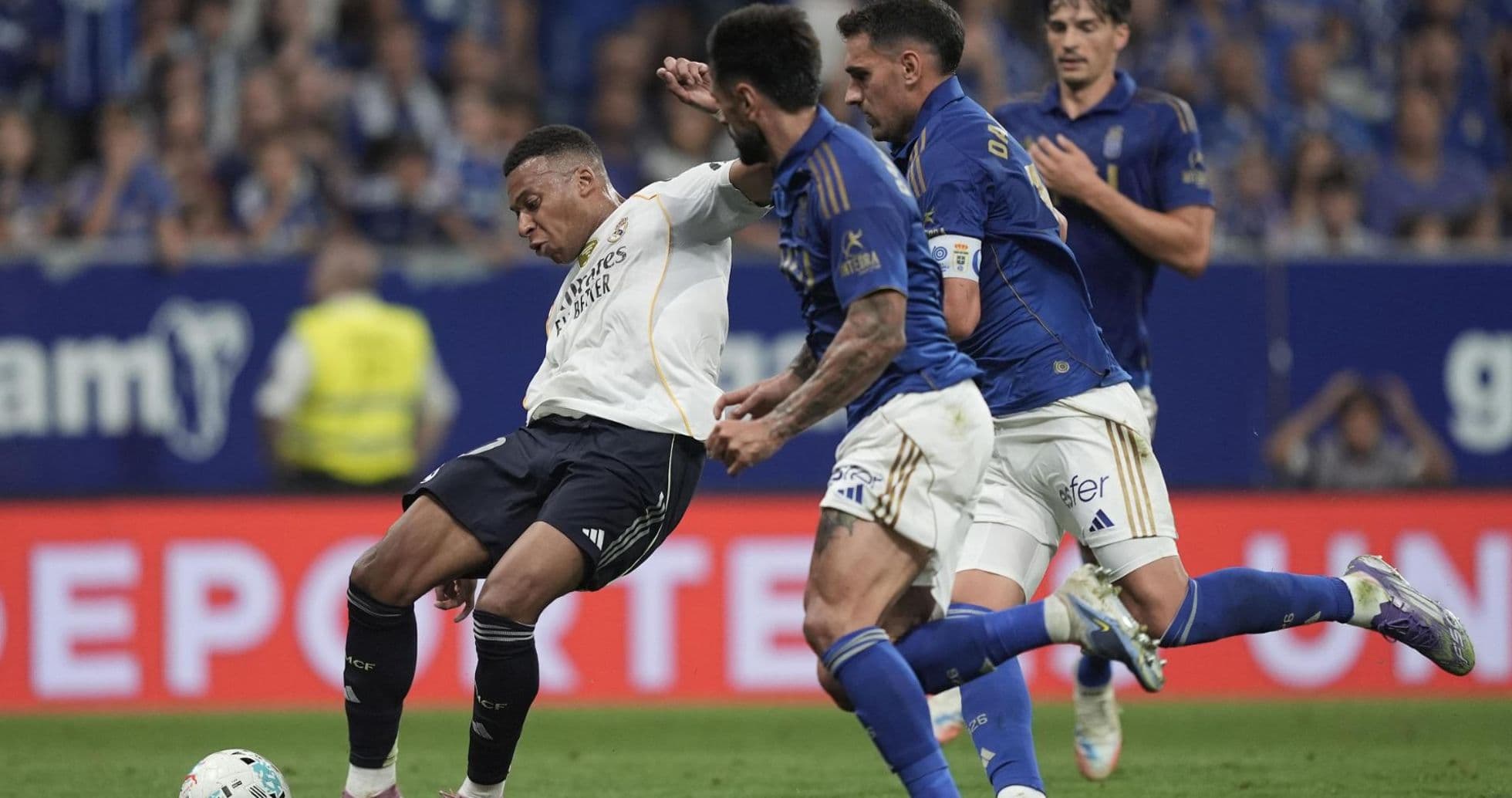
On the tactical board, the “Hunter vs Shield” duel was defined by Kylian Mbappé’s shadow. Even though he began on the bench, his La Liga body of work – 24 goals and 5 assists in 29 appearances, with 102 shots and 61 on target – shaped Oviedo’s entire defensive plan. E. Bailly and D. Costas were forced to hold a deeper line than they might have preferred, wary of Mbappé’s potential introduction and the vertical runs of Vinícius. That hesitation gave Madrid’s midfield more room to dictate.
Oviedo’s “shield” has been porous all season. Overall they have conceded 56 goals in 36 matches, an average of 1.6 per game; away from home that balloons to 2.2. F. Viñas, their leading scorer with 9 league goals and 1 assist, is also their most combative forward: 484 duels contested and 49 tackles, but also 45 fouls committed and 2 straight reds. His presence in the XI at the Bernabéu encapsulated Oviedo’s dilemma: they rely on his physicality to escape pressure, but that same edge risks undermining their defensive discipline.
The “Engine Room” battle revolved around Madrid’s double pivot. Camavinga and Tchouameni, supported by the drifting movements of Mastantuono and Brahim Díaz, controlled the tempo. Camavinga’s ability to receive under pressure allowed Madrid to play through Oviedo’s first line, while Tchouameni’s positioning screened transitions whenever Oviedo tried to spring Chaira or Fernández into space. On Oviedo’s side, Colombatto and Fonseca were forced into a reactive role, shuttling laterally rather than stepping forward to press, which only deepened the territorial imbalance.
In the wide areas, Vinícius Júnior was a constant release valve. His league output – 15 goals and 5 assists in 35 appearances, with 190 dribble attempts and 86 successful – underpinned Madrid’s strategy of isolating him against Vidal. Every time Madrid rotated possession from right to left through Alaba and Camavinga, Vinícius pinned Oviedo’s back four deeper, opening lanes for Garcia and late runs from midfield.
From a statistical prognosis standpoint, the outcome aligned almost perfectly with the season’s trends. Madrid’s overall scoring rate of 2.0 goals per game, combined with Oviedo’s concession rate of 1.6 overall and 2.2 away, pointed towards a multi‑goal home performance. Defensively, Madrid concede just 0.9 per game overall and 0.8 at home, while Oviedo’s attack has been anaemic: 0.7 goals per match in total and only 0.5 at home, 0.9 away. A clean sheet for Courtois sat well within expectation.
xG data is not provided, but the underlying profiles allow a reasonable inference. Madrid’s volume of chances at the Bernabéu, given their 41 home goals, typically supports an xG comfortably above 1.5 per game. Oviedo’s away record suggests they rarely generate more than a handful of low‑quality opportunities. The 2‑0 scoreline, with Madrid in control and Oviedo largely contained, is consistent with a home xG edge and a defensive performance in line with Madrid’s season‑long solidity.
Following this result, the narrative is reinforced rather than rewritten. Madrid’s depth has absorbed a long list of absentees, their 4‑4‑2 structure proving adaptable, while Oviedo’s fragility – tactical, technical and disciplinary – remains the defining theme of a season spent fighting, and usually losing, uphill battles.