Real Madrid Dominates Oviedo with 2-0 Victory
Real Madrid’s 2-0 win over Oviedo at Estadio Santiago Bernabéu was a controlled, system-driven performance built on territorial dominance and a clear structural superiority in and out of possession. Across 90 minutes, Alvaro Arbeloa’s 4-4-2 consistently pinned back Guillermo Almada Alves Jorge’s 4-3-3, translating 65% possession and a 19–9 shot advantage into a comfortable victory that broadly matched the underlying numbers (xG 1.46 vs 1.03).
The game’s tactical story hinged on Real Madrid’s ability to convert a nominal 4-4-2 into a fluid, ball-dominant structure, while Oviedo struggled to transform their 4-3-3 into meaningful pressure or counter-attacking threat. Real Madrid’s 616 passes, with 570 accurate (93%), underline how stable their progression was compared to Oviedo’s 325 passes, 275 accurate (85%).
First Phase
In the first phase, Thibaut Courtois acted as a low-usage but secure base; with only 1 save required and 0.16 goals prevented, his main function was to connect calmly with the back four. The defensive line of T. Alexander-Arnold, R. Asencio, D. Alaba and A. Carreras split and staggered to create a three-plus-one shape in buildup: Alexander-Arnold often pushed a little higher and narrower, allowing Carreras to provide width on the opposite side, while Alaba and Asencio gave a strong left-right balance in circulation.
Ahead of them, the central pairing of E. Camavinga and A. Tchouameni provided the platform that defined the match. Tchouameni anchored, frequently dropping between or just in front of the centre-backs, while Camavinga shuttled diagonally to support both flanks. With Real Madrid winning the midfield pass and tempo battle, Oviedo’s central trio of N. Fonseca, S. Colombatto and A. Reina spent long stretches in a reactive, horizontally compact block, unable to step out aggressively without leaving space between the lines.
The wide midfielders, F. Mastantuono on the right and B. Diaz on the left, were crucial to stretching Oviedo’s 4-3-3. Diaz in particular became the key link: starting wide, then drifting into the left half-space to overload Oviedo’s right side, where N. Vidal and Colombatto were repeatedly forced into 2v3 scenarios. That pattern produced the breakthrough at 44', when G. Garcia finished for 1-0 after being supplied by B. Diaz. The timing of the goal, just before half-time, validated Real Madrid’s territorial control and ensured the 1-0 half-time scoreline reflected the flow of play.
Forward Pairing
Up front, the pairing of G. Garcia and Vinicius Junior offered complementary movements. Garcia often occupied the central defenders, E. Bailly and D. Costas, with pinning runs, while Vinicius worked from the left channel, targeting the space outside Costas and behind Vidal. Real Madrid’s 11 shots inside the box (from 19 total) show how frequently the forwards and late runners managed to attack central spaces after wide combinations.
Oviedo’s 4-3-3 was designed to offer transitions through wide forwards I. Chaira and T. Fernandez flanking F. Vinas, but the execution never fully materialized. With only 1 shot on goal from 9 attempts and 7 of those from inside the box, Oviedo did reach dangerous zones sporadically, yet lacked either the final touch or the composure to convert. Their xG of 1.03 suggests a handful of decent chances, but Real Madrid’s defensive structure and Courtois’ positioning kept the clean sheet intact.
Second Half Substitutions
The second half substitutions shifted the tactical dynamics only in Real Madrid’s favor. At 54', Oviedo introduced S. Cazorla (IN) for I. Chaira (OUT), seeking more control and line-breaking passing from midfield, but this adjustment coincided with Real Madrid’s own changes that increased their control of the tempo.
At 64', D. Carvajal (IN) came on for T. Alexander-Arnold (OUT), and J. Bellingham (IN) replaced A. Tchouameni (OUT). Carvajal’s introduction stabilized the right flank defensively, allowing Real Madrid to protect against any late Oviedo surges, while Bellingham’s arrival reconfigured the midfield from a double pivot into a more vertical, box-arriving presence. With Camavinga holding more, Bellingham was free to attack the half-spaces and second balls around the area.
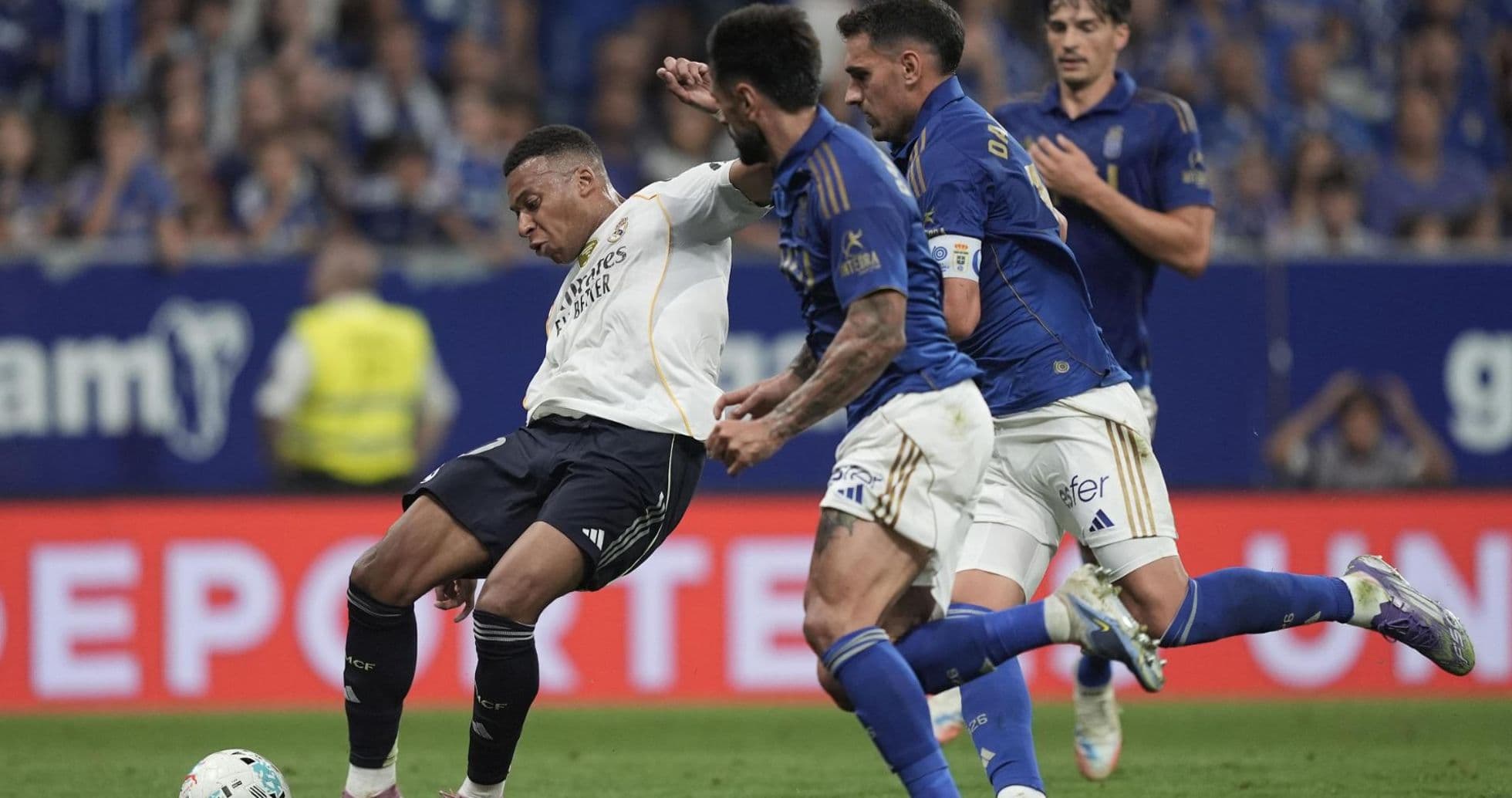
On 69', K. Mbappe (IN) replaced G. Garcia (OUT), and H. Hassan (IN) came on for T. Fernandez (OUT) for Oviedo. Mbappe’s presence instantly changed Real Madrid’s threat profile: deeper starting positions, explosive runs in behind, and a willingness to drift wide to combine with Vinicius or Diaz’s replacement. For Oviedo, Hassan was meant to sharpen the counter, but Real Madrid’s possession dominance limited his involvement.
The final Real Madrid wave of substitutions at 77' further refreshed the attacking structure: C. Palacios (IN) for B. Diaz (OUT) and D. Yanez (IN) for F. Mastantuono (OUT) maintained intensity on both flanks, preserving width and pressing energy. Oviedo responded at 79' with L. Ahijado (IN) for N. Vidal (OUT) and P. Agudin (IN) for N. Fonseca (OUT), effectively trying to add legs and some dynamism down the right and in midfield, but by then Real Madrid had full control of rhythm and territory.
Tactical Payoff
The tactical payoff of these changes arrived at 80', when J. Bellingham scored for 2-0, assisted by K. Mbappe. The sequence encapsulated Real Madrid’s second-half plan: Mbappe dropping and combining to draw defenders, then releasing a late-arriving midfielder from the second line. Bellingham’s advanced positioning, made possible by Camavinga’s deeper role, provided exactly that extra runner Oviedo could not track consistently.
Statistically, Real Madrid’s 7 shots on goal to Oviedo’s 1, and a 5–1 edge in goalkeeper saves (A. Escandell with 5 saves and 0.16 goals prevented for Oviedo), underline both Real Madrid’s attacking volume and Oviedo’s reliance on their goalkeeper to stay in the game. Oviedo’s 14 fouls to Real Madrid’s 7 reflect the away side’s increasing need to disrupt play as they chased the ball and tried to slow Real Madrid’s rhythm.
From a broader lens, Real Madrid’s overall form metrics in this match—high possession, high passing accuracy, and a comfortable xG edge—align with a side in control of its game model late in the season. Defensively, their index is strong: limiting Oviedo to a single shot on target despite conceding some box entries suggests a compact, well-coordinated block, especially once Carvajal and Bellingham entered to balance the structure.
Oviedo’s numbers show a team that could reach the final third but lacked either the pressing cohesion or the counter-attacking clarity to unsettle a superior opponent. Their 35% possession and lower passing volume forced them into long spells without the ball, and while their xG of 1.03 hints at missed opportunities, the tactical reality was of a match largely dictated by Real Madrid’s structure, control, and well-timed personnel changes.