Patrick Vieira Begins Four-Year Journey as Senegal Coach
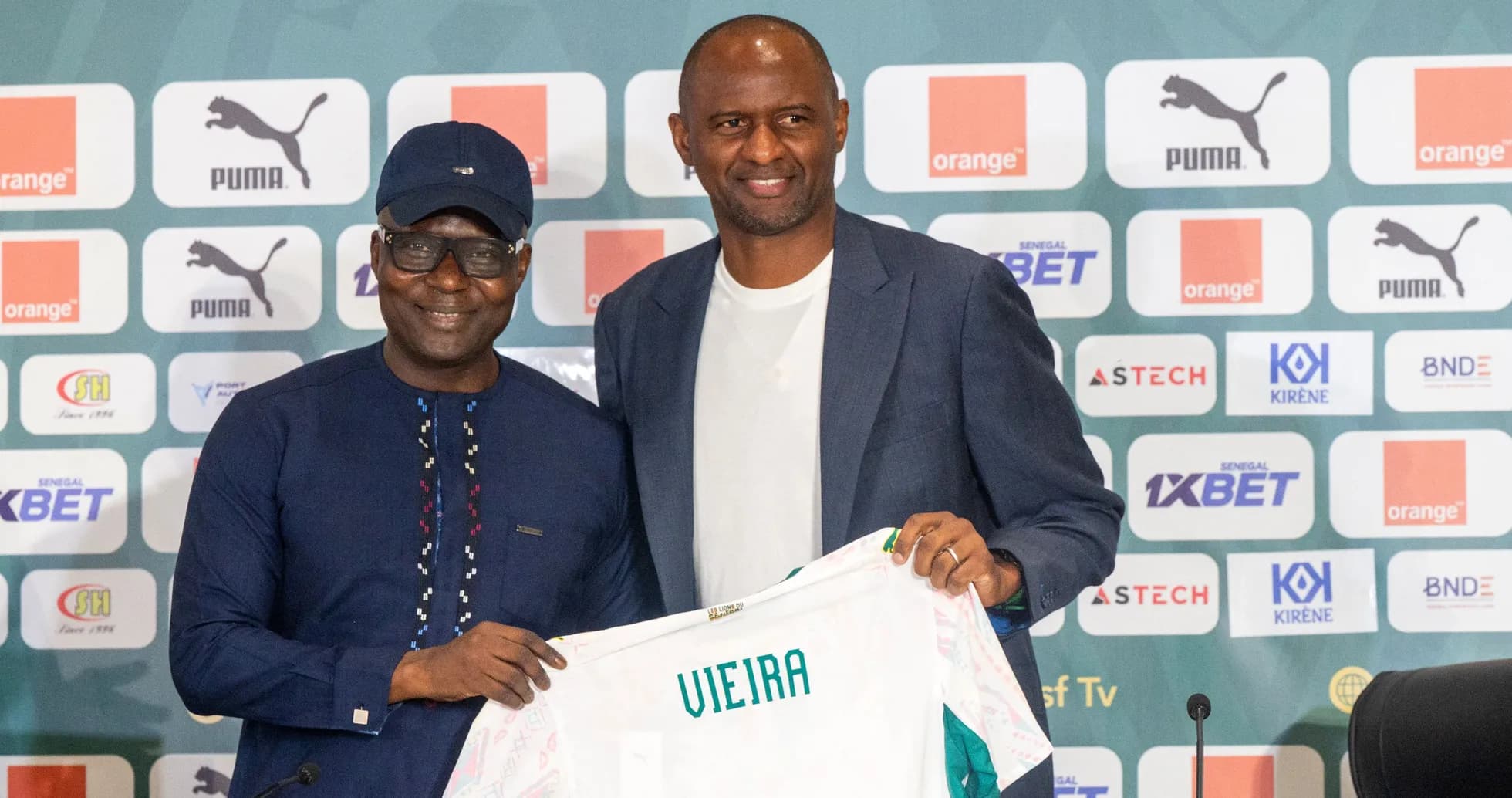
Patrick Vieira walked back into Dakar not as a visiting legend, but as the man now responsible for the country’s footballing future. Presented officially as Senegal’s new head coach, the 50-year-old has been handed a four-year mandate: keep the Lions of Teranga among the elite and build a side ready to peak by 2030.
For the Senegalese Football Federation, this was not a luxury hire. It was, in the words of president Abdoulaye Fall, an “absolute necessity” for the national team.
A job that feels like destiny
Vieira did not try to hide what this meant to him. Born in Dakar and raised in France from the age of eight, he framed the role less as a career step and more as a return to his roots.
“As I told you, I was born here in Dakar. My parents were born in Dakar. My whole family, my history is here in Dakar,” he said. “And from there, taking this national team is not a new step in my career, it is a homecoming.”
He underlined that he accepted Senegal’s offer with his heart, not his wallet. Emotion first, money nowhere near the decision. The pledge that followed was simple: total commitment to match a nation’s towering expectations.
But his first major act in charge immediately stirred debate.
Mané left out – but not frozen out
Vieira’s opening 29-man squad landed with one glaring omission: Sadio Mané. No talisman, no icon, no No 10 to build around for this first camp.
The explanation was direct. Mané, now at Al-Nassr, is carrying a minor physical issue and will sit out this window after a phone conversation with the new coach.
“Regarding Sadio's absence, whom I spoke to on the phone, he has a physical issue and that is why he will not be with us for this camp, but he surely will be for the next one,” Vieira said.
So this is not a rupture. It is a pause. But it does mean Vieira’s first steps, his first tactical imprints, will be made without the player who has defined Senegal’s modern era.
Evolution, not demolition
Look closely at the list and a clear message emerges: this is not a revolution. It is a recalibration.
“The important thing is not to start from scratch,” Vieira insisted. “I'm not going to tear everything down or throw everything out the window, but to preserve what has been achieved and begin a four-year cycle.”
He has kept a strong core yet opened the door to new blood. Seven debutants are included, spread across the pitch and hinting at a gradual refresh rather than a brutal reset.
In goal, the retirement of Edouard Mendy from international duty forced an immediate change. Vieira responded by calling up four goalkeepers, including first-time selections for Monza’s Ngagne Demba Thiam and AS Saint-Etienne’s Mamour Ndiaye. The message is clear: the battle for the No 1 shirt is wide open.
At the back, Monaco centre-back Sadibou Sane and Auxerre full-back Lamine Sy headline the new faces, while in attack FC Metz forward Pape Moussa Fall joins the group, another fresh option for a frontline temporarily missing its biggest star.
The squad, on paper, is a blend: experience to steady the ship, youth to push it into new waters.
A brutal first test window
There will be no gentle easing-in period. Senegal’s 29-man group will gather immediately for a demanding international window that offers Vieira little margin for hesitation.
The new era starts with competitive fire: the opening fixture of their 2027 AFCON qualification campaign away to Mozambique in Maputo on September 25. Four days later, they head to face Ethiopia on September 29. Then comes a change of scenery but not intensity, with a friendly against Comoros in Marseille on October 4.
Three games. Three different environments. One camp to lay down principles and convince a dressing room.
And all of it without Sadio Mané.
For Vieira, the homecoming glow ends the moment the whistle blows in Maputo. From then on, every selection, every tweak, every risk will be judged against the standard Senegal have set in recent years.
He asked not to start from scratch. The question now is whether this four-year cycle can turn continuity into something even bigger by 2030.