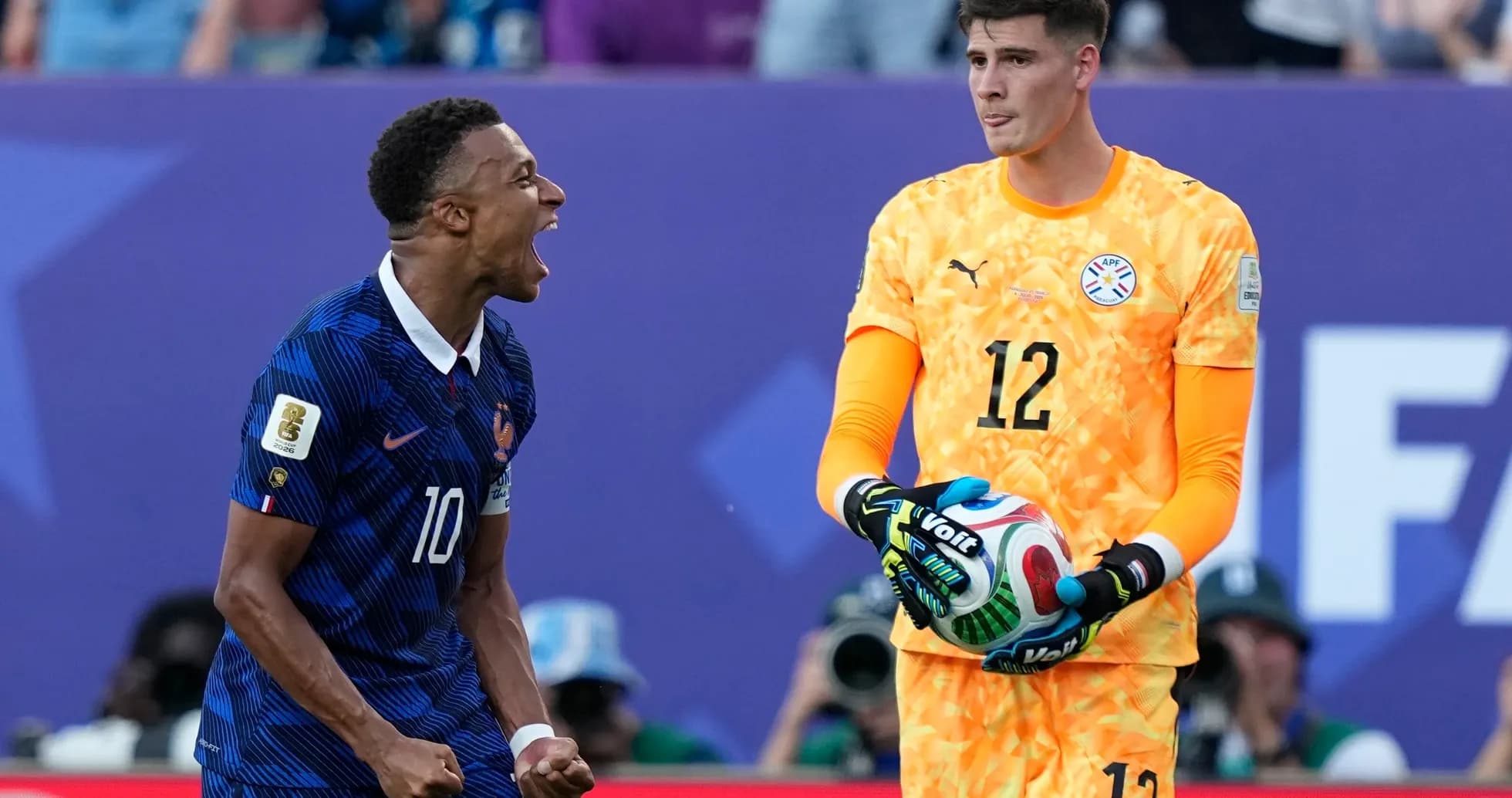
Paraguay vs France: Tactical Duel in World Cup Round of 16
Lincoln Financial Field staged a clash of footballing identities in this World Cup Round of 16: Paraguay, battle-hardened and abrasive, against a France side that has swept through the tournament with ruthless efficiency. The 1–0 final scoreline in favour of France only hints at the deeper tactical duel that unfolded and what it says about both squads.
I. The Big Picture – Styles Colliding on the Knockout Stage
Heading into this game, the numbers painted a stark contrast. Overall this campaign, Paraguay had played 5 matches, winning 2, drawing 1 and losing 2. Their attacking output was modest: 4 goals in total, with 0 goals at home and 4 on their travels, an overall average of 0.8 goals per match (0.0 at home, 1.3 away). Defensively, they had conceded 6 in total (1 at home, 5 away), an overall average of 1.2 goals against (0.5 at home, 1.7 away). The overall goal difference stood at -2, a reflection of a side that survives more than it dominates.
France arrived as the form juggernaut. Overall, they had played 5, won all 5, with 14 goals scored and only 2 conceded. That yields an overall scoring average of 2.8 goals per game (3.0 at home, 2.5 away) and just 0.4 goals conceded on average (0.3 at home, 0.5 away). Their overall goal difference of +12 underlined a team not merely winning, but suffocating opponents. Group-stage standings reinforced the picture: Paraguay finished 3rd in Group D with 4 points and a goal difference of -2 (2 scored, 4 conceded in 3 matches), while France topped Group I with a perfect 9 points and a group-stage goal difference of +8 (10 scored, 2 conceded in 3).
Against that backdrop, the lineups told the story of intent. Gustavo Alfaro’s Paraguay went to a 5-4-1, a low-slung defensive shell with O. Gill in goal, a back five of J. Caceres, G. Velazquez, G. Gomez, O. Alderete and J. Alonso, and a hardworking midfield quartet of M. Almiron, D. Gomez, A. Cubas and M. Galarza behind lone forward J. Enciso. Didier Deschamps doubled down on France’s proactive identity with a 4-2-3-1: M. Maignan behind a back four of J. Kounde, D. Upamecano, W. Saliba and L. Digne; a double pivot of M. Kone and A. Rabiot; and a devastating three of O. Dembele, M. Olise and B. Barcola in support of K. Mbappe.
II. Tactical Voids – Discipline, Risk and the Edges of Control
Paraguay’s season data warned that discipline would be a live issue. Overall, they had collected yellow cards heavily in the final quarter of matches: 33.33% of their yellows arrived between 76–90 minutes, with additional spikes early (22.22% between 0–15) and a further spread across 46–60 and 61–75. They had also already seen one red card this campaign, and it had come between 46–60 minutes. That profile suggested a side that tackles on the edge, particularly as fatigue bites.
That edge is personified by M. Almiron. Across the tournament he has combined industry with volatility: 9 tackles, 3 interceptions and 1 blocked action, but also 1 yellow and 1 red card. His presence in the starting XI here was both a weapon and a risk. Alongside him, D. Gomez and M. Galarza brought bite: D. Gomez had 11 tackles, 2 blocked shots and 9 interceptions, while Galarza had 17 tackles and 7 interceptions, each already on 2 yellows this campaign. Paraguay’s midfield, then, was built to foul, disrupt and survive.
France’s disciplinary profile was calmer. Overall, their yellows were more evenly distributed: 25.00% each between 16–30, 61–75, 76–90 and 91–105 minutes, and no red cards. Even their main creative outlet, M. Olise, carried just 1 yellow across 5 appearances. Deschamps could therefore commit numbers forward knowing his side rarely self-destructs.
III. Key Matchups – Hunter vs Shield, Engine Room vs Enforcer
The defining duel was always going to be K. Mbappe against Paraguay’s back five. Mbappe entered this tie as one of the tournament’s standout performers: 7 goals and 2 assists in 5 appearances, from 24 shots (17 on target), with an 8.38 average rating. His 21 dribble attempts with 9 successes and 12 key passes made him not just a finisher, but the spearhead of France’s entire attacking structure.
Paraguay’s shield was anchored by G. Gomez in the centre of the back line, flanked by G. Velazquez and O. Alderete, with J. Caceres and J. Alonso as narrow full-backs. The plan was clear: compress the central lane, deny Mbappe space between the lines, and trust the midfield trio of D. Gomez, A. Cubas and M. Galarza to close passing corridors into him and into M. Olise.
But France’s threat was multi-directional. O. Dembele had already scored 4 goals and provided 2 assists this campaign, with 8 shots (5 on target) and 9 successful dribbles from 9 attempts. On the opposite side, B. Barcola offered verticality, while M. Olise, the competition’s leading assister with 5, orchestrated from the half-spaces. His 270 passes at 88% accuracy and 10 key passes illustrate how he knits phases together, and his 48 duels (25 won) show a willingness to fight through contact.
For Paraguay, the counterpunch was always going to come through J. Enciso and M. Almiron. Enciso has quietly been one of their most important outlets: 1 goal, 2 assists, 28 dribble attempts with 13 successes and 6 key passes. His duel volume – 64 contests, 27 won – underlines his role as the carrier who can turn a clearance into a transition. Almiron, despite modest attacking numbers, offers the vertical running to support him when Paraguay escape their block.
In midfield, the engine-room contest pitted Paraguay’s enforcers against France’s control pair. M. Kone and A. Rabiot were tasked with both protecting the centre-backs and progressing play into Olise and Dembele. Against them, D. Gomez and Galarza brought aggression and anticipation. Gomez’s 11 tackles and 9 interceptions this campaign made him Paraguay’s primary ball-winner; Galarza’s 17 tackles and 7 interceptions added a second wave of pressure. The question was whether that pressure could be applied without tipping into the costly bookings that have so often defined Paraguay’s matches late on.
IV. Statistical Prognosis – Margins, xG Logic and the Road Ahead
Even before a ball was kicked, the statistical logic of this tie leaned heavily towards France. A team scoring 2.8 goals per game overall and conceding just 0.4, with 5 wins from 5, facing a Paraguay side with an overall goal difference of -2, failing to score in 2 of their home fixtures and averaging 0.8 goals per match, was always likely to dominate the expected goals battle.
Paraguay’s path to an upset depended on three pillars: the compactness of their 5-4-1, the transitional threat of Enciso and Almiron, and the ability of D. Gomez and Galarza to disrupt France’s rhythm without triggering the disciplinary time-bombs suggested by their yellow-card distribution and Almiron’s prior red. France, by contrast, could trust the weight of their numbers: Mbappe’s finishing, Olise’s creativity, Dembele’s unpredictability, and a defence that had conceded just 2 goals in 5 matches overall.
The 1–0 outcome ultimately reflects that underlying balance: France’s superiority expressed in control and territory, Paraguay’s resilience ensuring the scoreline stayed narrow. From a squad-analysis lens, the match confirmed France as a complete, multi-layered contender whose attacking stars are supported by structure and discipline, and Paraguay as a courageous, tactically committed underdog whose margins for error at this level are simply too thin.