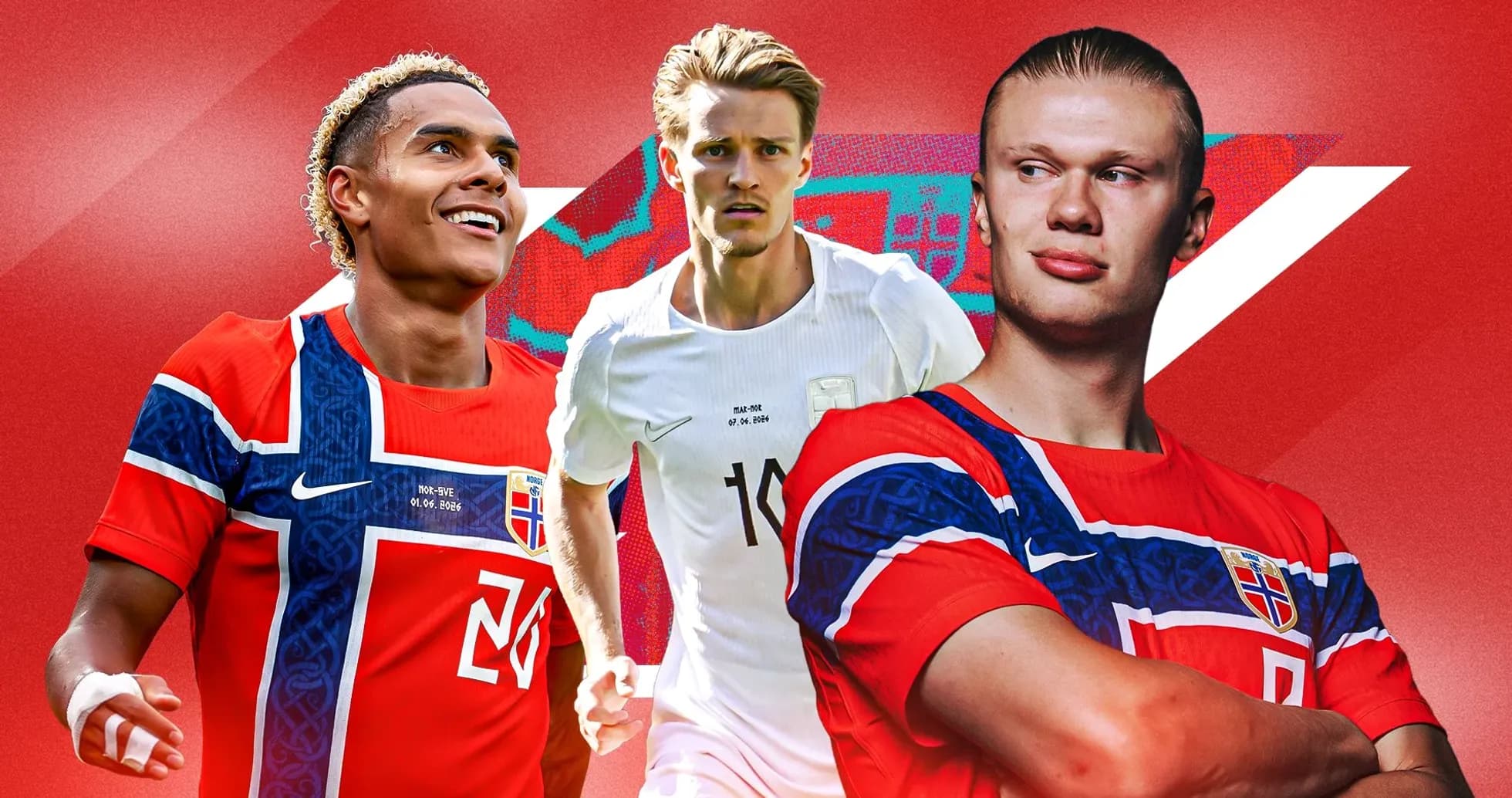
Norway's Dynamic Attack: More Than Just Haaland
Erling Haaland will dominate the billboards in North America, but Norway are not turning up to this World Cup as a one-man show. Stale Solbakken has built something more layered, more awkward to handle, and far more dangerous than a simple “give it to the big No.9” plan.
The spine is obvious. The threats from the wings are anything but.
Wide men built to feed a monster
Norway’s entire attacking structure bends toward one idea: get the ball to Haaland early, often and in brutal areas. The players asked to do that from the flanks are young, quick and ruthless.
On the left, Antonio Nusa looks set to own the position. The RB Leipzig winger is only 21, but he already carries himself like a senior man. He glides past defenders, doesn’t mind a tackle, and rarely wastes a good crossing angle. His qualifying numbers tell the story: six goal contributions in six games, including a goal and an assist in a 3-0 hammering of Italy and more damage in a 4-1 win in the return fixture. When Norway broke big teams open, Nusa was usually on the scene.
Waiting behind him is Andreas Schjelderup, another left-sided livewire with a growing reputation. The 22-year-old arrives from a strong second half of the season under Jose Mourinho at Benfica, stacking up 10 goals and assists in 14 league matches. He also announced himself on the biggest club stage with a brace against Real Madrid in the Champions League in January. He may not be nailed on as a starter yet, but inside the Norway camp and across Europe, few doubt where his trajectory is heading.
The right flank tells a very different story.
Alexander Sorloth, all 6'5" of him, is officially a striker for Atletico Madrid. For Norway, he often starts wide. On paper, that sounds illogical. On the pitch, it’s a problem for defenders. When Norway have the ball, Sorloth drifts inside to stand alongside Haaland, turning the box into a forest of limbs and aerial targets. He matched Nusa’s efficiency in qualifying with eight goal contributions in eight games and arrives off a 20-goal season in Spain, despite not always starting for Atletico. Call him a “wide forward” if you like. In reality, he’s a second centre-forward hiding on the team sheet.
Oscar Bobb offers a different profile on that side. The Fulham man has not exploded in the Premier League yet, but he brings neat feet, intelligence between the lines and another option if Solbakken wants more guile than brute force. Jens Petter Hauge, back in the squad after missing qualifying, has forced his way in with sharp performances for Bodo/Glimt, including starring roles in stunning Champions League wins over Man City and Inter. Norway’s right flank can change shape quickly – from power to craft in a single substitution.
Odegaard, the conductor
Behind all of that movement sits the player who makes it make sense.
Martin Odegaard is the face of this Norwegian midfield and the mind of their attack. At Arsenal, debate often rages about his consistency. For his country, the argument is quieter. He delivers.
Despite missing three of eight qualifiers in an injury-hit season, the 27-year-old still produced seven assists – the most of any player in Europe, including a hat-trick of assists in a single game against Israel. When Norway flow, he is usually on the ball, knitting the game together, dragging wide players into space and threading passes into Haaland’s stride or Sorloth’s forehead.
He will not carry this tournament alone. Sander Berge, now at Fulham, gives the midfield its ballast, screening the defence and breaking up play before launching counters. Alongside him, Benfica’s Fredrik Aursnes offers tireless running and subtle quality as a No.8. His story is remarkable: he walked away from international football two years ago to “have more time and freedom to prioritise other things in my life besides football,” only to reverse that decision in February. He missed qualifying entirely, yet now looks set to start at the World Cup.
Behind that first-choice trio, Solbakken can turn to Bodo/Glimt captain Patrick Berg, a smooth passer with leadership presence, and Italian-based pair Kristian Thorstvedt and Morten Thorsby. It is not a midfield built on star power alone. It is built on options.
Still, the blueprint is clear. Odegaard is the creator-in-chief, the man expected to link those dangerous wings with the striker who terrifies defences before he even touches the ball. If Norway are to survive the “Group of Death” – France, Senegal and Iraq – they will need their captain in full command.
Life after Haaland? Norway have a plan
Solbakken will not want to test it, but Norway are better equipped than most to cope if Haaland ever needs a breather or, worse, breaks down.
Sorloth is the obvious next man up through the middle. His record for the national team is solid, and his form for Atletico this season has been outstanding. Solbakken spelled out his value in an interview with FIFA, praising his physicality, versatility and relentless work rate. The coach highlighted that Sorloth can play with Haaland, to the right of him, or instead of him – always offering both goals and assists while doing the heavy running for the team.
Then there is Jorgen Strand Larsen. The Crystal Palace forward has impressed since arriving in the Premier League in 2024, and he sharpened his finishing touch with a brace against Sweden in a pre-tournament friendly. He also scored against Italy in qualifying. Even if Haaland plays every minute, Strand Larsen is well placed to see action, particularly with Sorloth often stationed wide. He is not a like-for-like replacement for Haaland, but he is a genuine centre-forward with a growing reputation and a knack for rising to the occasion.
For a country once accused of lacking depth, Norway suddenly have a queue of strikers who can step into the spotlight.
The secret weapon at right-back
All of this talk about wide players and strikers, and yet Norway’s most devastating threat from the flanks might actually wear the No.2 shirt.
Julian Ryerson has turned the right-back role into an attacking launchpad. The Borussia Dortmund defender is given license to surge forward whenever Sorloth moves inside, effectively turning Norway’s right side into a rotating carousel of runners and targets. Ryerson’s delivery is lethal: he racked up an extraordinary 18 Bundesliga assists in the 2025-26 season, a number that would make many wingers jealous.
The pattern is simple and brutal. Sorloth drifts into the box, Haaland occupies the centre-backs, and Ryerson arrives on the overlap to whip balls into a penalty area packed with size and aggression. From open play, he is a constant outlet. From dead balls, he is even more dangerous. A significant chunk of those 18 assists came from corners and free-kicks, where his technique and calm under pressure turn every set-piece into an event.
Opponents will spend hours plotting how to stop Haaland. They will pore over Odegaard’s passing maps. If they ignore Ryerson, they will pay for it.
A nation finally back on the big stage
Norway return to the World Cup for the first time in 28 years, and the emotion around the squad is real. Solbakken has spoken of what qualification means to a country that has watched every tournament since 1998 from the sofa. When they finally made it, 50,000 fans turned out on a freezing Monday night in minus four degrees to greet the team. That kind of hunger does not vanish once the plane lands in North America.
Solbakken is not selling a fairy tale. He does not pretend Norway are contenders to win it all. He calls them dark horses only in the sense that, on their day, they can bloody the nose of any heavyweight. In a group with France, Senegal and Iraq, there will be no easy minutes. The margins will be thin. Organisation and match-winners – his words – will decide whether this adventure ends in the group stage or stretches into something more memorable.
What he does promise is a different Norway: more attacking, more expressive, more willing to lean on their individual quality while still working ferociously for each other. Haaland’s goals will set the tone, but they will not define the entire story.
The question now is simple: in a World Cup built on fine details and fleeting moments, can this team of clever wide men, a masterful conductor, a rampaging right-back and the most feared striker on the planet turn potential into something historic?