Marcelo Bielsa: The Coach Who Refuses to Play the Media Game
Marcelo Bielsa has never cared much for the performance around football. Only the game itself. The rest – the noise, the theatre, the optics – tends to irritate him.
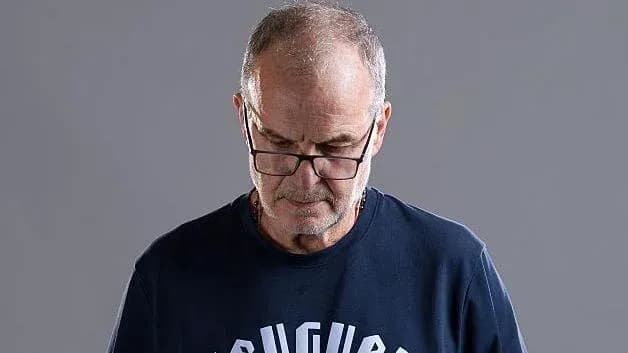
So when Fifa’s official World Cup portraits dropped and Uruguay’s 70-year-old coach appeared staring downwards, stone-faced, refusing to meet the camera’s gaze, it felt entirely on brand. While players and coaches from around the tournament leaned into the moment – smiles, poses, a little bit of personality for the global feed – Bielsa looked as if someone had dragged him away from a tactics session and pointed him at a lens he had no interest in.
No smile. No pose. Just Bielsa, eyes lowered, body language saying he would rather be at the training ground.
The reaction, inevitably, came quickly. Social media spun up theories. Was this Bielsa making a statement? A protest? A coded message about Fifa, about image culture, about something, anything?
He was having none of it.
After Uruguay’s opening 1-1 draw with Saudi Arabia in Miami on Monday, questions about his picture surfaced in the press conference. Bielsa listened, unimpressed. Then he cut the whole debate off at the knees.
"I don't have to give any explanation, the picture was taken the way it was taken," he said. "I'm not a model."
That was Bielsa in a single line: uninterested in playing the game off the pitch, uninterested in smoothing edges for the cameras. The image exists. That is enough. No narrative required.
Fifa’s tournament photoshoots have become part of the modern World Cup circus. Carefully lit backdrops. Viral clips. Players and coaches turning their few seconds in front of the camera into content that will run for weeks. For most, it is harmless fun, a small price for the exposure and the spectacle.
Bielsa has never been “most”.
The Argentine, one of the most respected coaches of his generation, is now leading a third national team at a World Cup after previous spells in charge of Argentina and Chile. His reputation was built on obsessive detail, relentless work, and a monastic devotion to preparation. The same man who sat on an ice box at Leeds, who built video vaults and demanded litter-picking sessions to teach players about their community, was never going to suddenly turn into a media-friendly frontman at 70.
So when another question came his way later in the press conference, Bielsa circled back to the subject on his own terms, using it to draw a line between what he owes the public and what he does not.
"There is a limit in terms of what we need to explain," he said. "If I'm wearing glasses, why am I wearing glasses? You look somebody in the eye, why do you do that?
"There is nothing wrong about wearing glasses or looking into somebody's eyes or looking down."
In other words: not everything is a symbol, not every gesture is a message. Sometimes a man is just looking down.
His stance also underlined something deeper. Bielsa believes his responsibility lies in how his team plays, how they compete, how they represent Uruguay on the pitch. The rest – the pose, the portrait, the viral moment – is decoration. Optional. Dispensable.
Uruguay’s 1-1 draw with Saudi Arabia leaves work to do in the group, and Bielsa will already be deep into that, rewinding and replaying, hunting for details others miss. The next test comes against surprise package Cape Verde on Sunday at 23:00 BST, a fixture that suddenly carries weight after the opening stalemate.
While others debate his photograph, Bielsa will be locked in the one image that truly matters to him: 11 players in sky blue, moving exactly as he has drawn it up.