Nigeria’s Super Falcons Aim for 11th WAFCON Title in Morocco
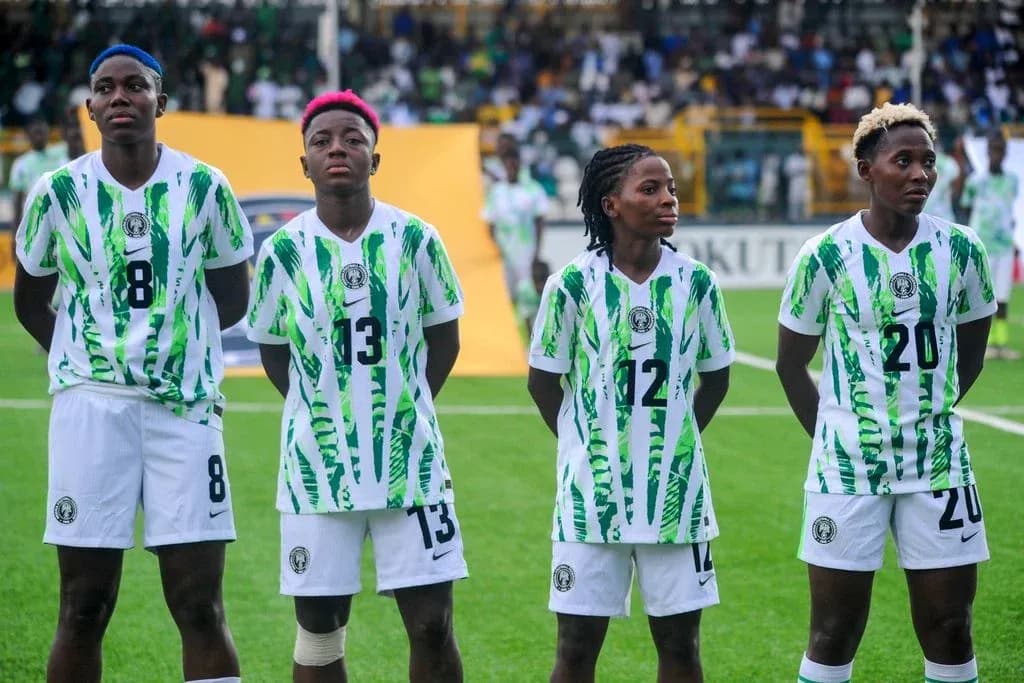
Nigeria’s Super Falcons have named their 25-woman squad for the 2026 Women’s Africa Cup of Nations in Morocco, a group built to chase history and defend a crown they have worn more than any other nation on the continent.
They are going for title number 11. Everyone else is chasing them.
Madugu shows his hand
Head coach Justine Madugu, announcing the list through the Nigeria Football Federation, has gone with a familiar spine wrapped in fresh legs. The tournament runs from July 26 to August 16, but the tone is being set now.
Rasheedat Ajibade wears the armband and carries the responsibility of leading a dressing room that blends World Cup experience with emerging talent. Alongside her stands the enduring star power of Asisat Oshoala, six-time African Women’s Player of the Year and still the reference point for any defence facing Nigeria.
In goal, there is no ambiguity. Chiamaka Nnadozie, outstanding for Brighton & Hove Albion and a standout performer for country, remains the clear No. 1. She is backed up by Portsmouth Ladies’ Comfort Erhabor and Abia Angels’ Fatima Oloko, a trio that offers security and competition in equal measure.
One notable absence jumps off the page. Ashleigh Plumptre, a key figure in recent years, misses out as she continues her recovery from surgery. Her composure and range of passing from the back will be hard to replace, and Madugu knows it.
Depth across the pitch
Nigeria travel to Morocco as the undisputed giants of African women’s football. Ten WAFCON titles. The last one secured in the most hostile of settings: a 3-2 win over hosts Morocco in the previous edition’s final. That history shapes expectation. Anything short of another deep run will feel like underachievement.
Madugu’s list is structured with purpose: three goalkeepers, eight defenders, five midfielders and nine forwards. It is a squad built to dominate games, not merely survive them.
At the back, experience meets youthful energy. Osinachi Ohale brings years of tournament know-how. Michelle Alozie, Oluwatosin Demehin, Rofiat Imuran, Shukurat Oladipo, Glory Ogbonna, Sikiratu Isah and Christy Ucheibe complete a defensive unit that can play high, defend deep, and adapt to different types of opponents.
Ajibade’s influence stretches beyond the captain’s armband. Listed among the midfielders, she is now one of Nigeria’s most decisive players, capable of driving from deep or arriving late in the box. Around her, Halimatu Ayinde offers steel, Deborah Abiodun brings energy, Toni Payne adds balance and versatility, while Jennifer Echegini supplies craft and goals from midfield areas.
Up front, the options are almost unfair. Oshoala headlines a forward line loaded with pace, movement and variety. Folashade Ijamilusi, Esther Okoronkwo, Chinwendu Ihezuo, Francisca Ordega, Gift Monday, Uchenna Kanu, Omorinsola Babajide and Joy Omewa give Madugu the luxury of tailoring his attack to any opponent. Target striker, wide runners, inside forwards – he has them all.
Many of these players come from Europe’s top leagues; others arrive from North America, Asia and the Nigerian Women’s Football League. The blend of global experience and homegrown sharpness gives this squad a layered, competitive edge.
Group C: familiar foes and fresh faces
Nigeria have been drawn in Group C with Zambia, Egypt and Malawi. On paper, the Super Falcons are favourites. On the pitch, they will have to prove it all over again.
They open their campaign against Malawi, debutants at this level, on Tuesday, July 28, at Al Madina Stadium in Rabat. It will be the first senior competitive meeting between the two nations. For Nigeria, it is a chance to start fast. For Malawi, it is a shot at a seismic upset.
Next comes a game laced with recent scars. On Saturday, August 1, at the same venue, Nigeria face Zambia. The Super Falcons have won two of the three previous meetings, but the Copper Queens landed the heaviest blow: a 1-0 win in the third-place playoff at WAFCON 2022. That result still lingers. This fixture now carries the weight of a score to settle.
Nigeria close out the group against Egypt on Wednesday, August 5, at the Rabat Region Stadium. The history between them at WAFCON is brutally one-sided – a 6-0 Nigeria win in 1998 at the inaugural African Women’s Championship. The context has shifted since then. Egypt’s women’s programme has grown, their standards have risen, and they arrive in Morocco as a far more organised and ambitious side.
More than a title on the line
This WAFCON is not just about continental supremacy. It doubles as Africa’s qualification route to the 2027 FIFA Women’s World Cup in Brazil. Reach the semi-finals, and a World Cup ticket is secured.
For a team as decorated as Nigeria, that bar sounds like a minimum requirement. Yet the margins are shrinking across African women’s football. Zambia, Morocco, South Africa and others have closed gaps that once felt unbridgeable.
Madugu’s 25 have been chosen to keep Nigeria in front of that chase. The names are known. The pedigree is proven. The question now is simple: can the Super Falcons turn this loaded squad list into another chapter of dominance in Morocco?