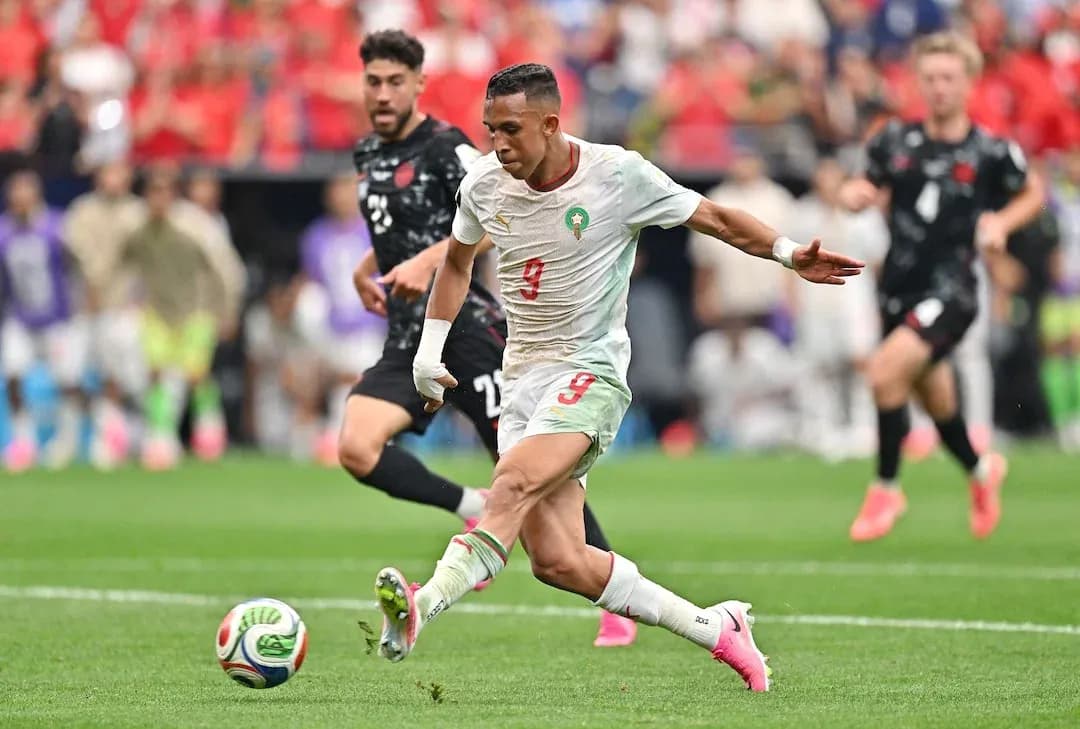
Morocco Dominates Canada in Round of 16 Clash
Under the closed roof of NRG Stadium, this Round of 16 tie felt like a clash between a rising project and an established tournament machine. Canada arrived as Group B’s second-place side, forged by a wild group phase in which they scored 8 and conceded 3 in total, while Morocco came in from Group C with 7 points and a total goal difference of 3 built on control and efficiency. Over 90 minutes, Morocco’s 3–0 win did not just settle a knockout tie; it underlined the structural differences between these squads.
Canada lined up in their now-familiar 4-4-2, the only formation they had used in total across the tournament. Jesse Marsch again trusted a back four of A. Johnston, M. Bombito, L. De Fougerolles and R. Laryea in front of M. Crepeau, with a midfield band of four and a front two of J. David and T. Oluwaseyi. The numbers coming into this game painted a side that lives on volatility: at home they had averaged 2.3 goals for and 1.3 against, 1.8 goals scored and 1.2 conceded in total, with a biggest home win of 6–0 and a heaviest home defeat of 0–3. This is a team built to play at high tempo, but also one that leaves space.
Morocco, by contrast, arrived with a total record that looked far more controlled. Across all venues they had 4 wins and 1 draw from 5, scoring 11 and conceding 4 in total. On their travels they had averaged 1.8 goals for and just 0.5 against, with two away clean sheets. The 4-2-3-1 they used in Houston was the same shape they had deployed in total this campaign, with Bono in goal, a back four of A. Hakimi, I. Diop, R. Halhal and N. Mazraoui, a double pivot of A. Bouaddi and N. El Aynaoui, and a creative band of B. Diaz, A. Ounahi and B. El Khannouss behind the lone forward I. Saibari.
The tactical voids were clearest in midfield. Canada were without I. Koné, ruled out with a fracture of the lower leg. In a knockout match against a side that thrives on positional play, that absence mattered. It placed extra responsibility on S. Eustaquio and N. Sigur to both screen and build. With Canada’s card profile skewed towards aggression in the middle phases – 27.27% of their total yellows arriving between 31–45 minutes and another 27.27% between 46–60 – there was always a risk that chasing the game would turn their midfield into a liability rather than an asset.
Discipline, in fact, was a quiet but telling subplot. L. De Fougerolles came into the tie as one of the tournament’s leading card collectors, with 2 yellows and also featuring among the top red-carded profiles in the competition data, while C. Larin – a key impact forward off the bench – also had 2 yellows to his name. For a Canada side that had only 2 clean sheets in total, every marginal decision at the back carried weight.
Morocco’s disciplinary profile was more controlled but no less physical. I. Diop had 2 yellows and had already blocked 4 shots in total, embodying a back line that is aggressive in the box but rarely reckless. Their yellow-card distribution was concentrated between 16–60 minutes, with 33.33% of their total yellows in each of the 16–30, 31–45 and 46–60 ranges, suggesting a team that raises intensity through the heart of each half but then manages games calmly in the closing stages.
The “Hunter vs Shield” duel was headlined by J. David against Morocco’s defence. David arrived with 3 goals in total, 12 shots and 8 on target, and a willingness to work without the ball – 4 tackles, 1 blocked shot and 3 interceptions in total. His threat is not just in the box but in the half-spaces, pulling centre-backs into uncomfortable zones. Yet Morocco’s shield was formidable: I. Diop’s 288 total passes at 88% accuracy, plus those 4 blocked shots and 5 interceptions, spoke of a defender who reads danger early and steps out with conviction. With A. Hakimi and N. Mazraoui narrowing in defensive phases, David and T. Oluwaseyi were often confronted by a compact, horizontally tight back four.
In the opposite direction, the Hunter was I. Saibari. With 3 goals from 6 total shots and 3 on target, plus 7 dribble attempts and 4 successes, Saibari offered Morocco a direct, vertical threat. His movement against a Canadian back line that had conceded 6 in total (4 at home, 2 away) always looked like a potential breaking point. De Fougerolles’ 55 total duels, with 30 won, showed his willingness to engage high, but that same front-foot defending can be exploited by a forward who times his runs off the blind side.
The “Engine Room” duel tilted heavily towards Morocco. B. Diaz came in as one of the tournament’s leading creators with 4 assists, 8 key passes and 136 total passes at 90% accuracy. His ability to drift between lines and combine with A. Ounahi and B. El Khannouss gave Morocco multiple angles of entry into the final third. On Canada’s side, the closest analogue was N. Saliba, whose tournament to date – 1 goal, 2 assists, 4 key passes, 102 total passes at 83% accuracy – had hinted at a new creative hub. But starting on the bench in Houston, his influence was always going to be reactive rather than foundational.
Out wide, A. Hakimi’s role was decisive. With 1 goal, 2 assists, 15 key passes and 343 total passes at 90% accuracy, plus 11 tackles, 1 blocked shot and 5 interceptions, he functioned as both playmaker and enforcer on the right flank. His duels total of 72, with 35 won, underscored just how central he is to Morocco’s territorial dominance. Against a Canadian side whose total defensive record is respectable but not elite, Hakimi’s overlaps and underlaps repeatedly forced the wide midfielders – particularly T. Buchanan and A. Ahmed – into long recovery runs that blunted Canada’s own counter-attacking threat.
From a statistical prognosis standpoint, the balance of evidence already leaned Morocco’s way before a ball was kicked. Canada’s total averages of 1.8 goals for and 1.2 against, combined with only 2 clean sheets, suggested they would need to win a shoot-out. Morocco’s total average of 2.2 goals scored and just 0.8 conceded, plus 2 clean sheets and no defeats in 5, pointed to a side comfortable controlling both territory and tempo. Even Morocco’s apparent weakness – penalties, with 5 taken in total, 3 scored and 2 missed (40.00% missed) – never came into play in a tie they dominated in open play.
Following this result, the narrative crystallises: Canada’s 4-4-2, with its vertical energy and individual talent in J. David and C. Larin, remains a dangerous but incomplete project at this level, especially when shorn of I. Koné and reliant on a back line that walks a disciplinary tightrope. Morocco, meanwhile, look every inch a knockout operator. With Bono’s calm, a back four led by Hakimi and Diop, an engine room anchored by Bouaddi and El Aynaoui, and a creative trident built around B. Diaz and Saibari, they marry structure with incision. On the evidence of Houston, their total defensive solidity and layered attacking options make them a side nobody will want to face in the 1/4 final.