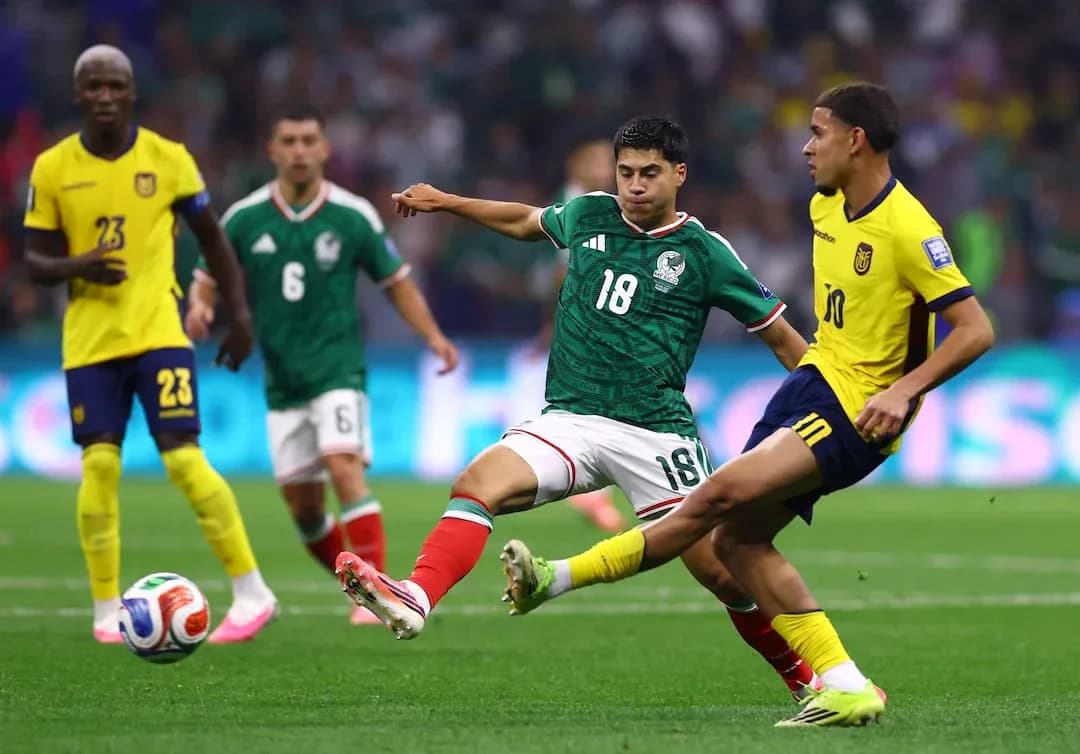
Mexico’s Tactical Efficiency in 2-0 Victory Over Ecuador
Mexico’s 2-0 win over Ecuador at Estadio Banorte in this World Cup Round of 32 tie was a classic example of using structure and efficiency to beat a more ball-dominant opponent. Javier Aguirre’s 4-3-3 was compact and vertically sharp, while Sebastian Beccacece’s 4-4-2 controlled possession but rarely destabilized Mexico’s block.
Mexico’s plan without the ball was the foundation. The front three of Roberto Alvarado, Raúl Jiménez and Julián Quiñones screened Ecuador’s double pivot rather than pressing high continuously. They allowed Ecuador to have the ball (43% vs 57% possession) but dictated where it could go, forcing circulation into wide areas and then compressing aggressively. The midfield trio of Gilberto Mora, Erik Lira and Luis Romo stayed narrow and staggered, with Lira anchoring in front of the centre-backs and Mora stepping out to press the ball-carrier when Ecuador tried to play through Moisés Caicedo or Pedro Vite.
This compactness explains the shot profile: Ecuador had just 7 total shots and only 1 on goal despite their territorial advantage. When Ecuador did progress, Mexico’s back four held their line well. Jorge Sánchez and Jesús Gallardo rarely overlapped simultaneously, prioritizing defensive stability over attacking width. César Montes and Johan Vásquez controlled the box, limiting Ecuador to 5 shots inside the area, most of them under pressure. That allowed Raúl Rangel (Mexico) to have a relatively quiet but focused night, needing just 1 save; the negative goals prevented figure (-0.57) underlines that Ecuador’s single effort on target was of moderate quality and that Mexico’s defensive structure did most of the work before the shot.
With the ball, Mexico were direct but not chaotic. Their 15 total shots, 10 inside the box, came from well-timed vertical attacks rather than long sterile phases. The first goal encapsulated the plan: Quiñones drifted off the left, attacking the half-space between full-back and centre-back, while Jiménez occupied the last line. Alvarado’s assist for Quiñones at 22' came from exploiting Ecuador’s wide midfielder not tracking the full-back tightly enough, creating a lane to play into the channel. Once ahead, Mexico continued to look for early forward passes rather than slow construction, reflected in their lower pass volume (319 passes) and efficiency (249 accurate, 78%).
The second goal at 31' showed the complementary roles in the front line. Quiñones again operated as a hybrid winger-forward, this time turning provider for Jiménez. Mexico’s midfield had drawn Ecuador’s central block upfield, then broke lines quickly. Jiménez’s movement between the centre-backs created a simple but high-value chance, consistent with Mexico’s xG of 1.02 from just 3 shots on goal. The finishing was clinical relative to chance volume, but the patterns were repeatable: win the ball, find the front three early, attack the box with numbers.
Beccacece’s 4-4-2 struggled to create central overloads. Moisés Caicedo and Vite were often outnumbered three-versus-two against Lira, Mora and Romo, forcing Ecuador to build via the full-backs and wide midfielders John Yeboah and Nilson Angulo. Crosses and wide combinations did generate 8 corners, but Mexico defended set plays solidly, with Rangel (Mexico) commanding his area and the centre-backs dominant in first contacts.
At the other end, Hernán Galíndez (Ecuador) also registered just 1 save, a reflection of Mexico’s shot quality rather than volume; many of their 15 attempts missed the target or were blocked (3 blocked shots). Ecuador’s negative goals prevented (-0.57) mirrors Mexico’s, suggesting that both goalkeepers faced fewer truly dangerous shots than the scoreline might imply, with Mexico’s edge coming from exploiting defensive imbalances rather than sustained bombardment.
The substitution pattern underlined the divergent game states. Beccacece reacted at half-time, withdrawing Alan Franco and Joel Ordóñez for Yaimar Medina and Ángelo Preciado at 46', effectively pushing for more dynamism on the right and fresh legs in the back line to handle Mexico’s transitions. Later changes — Kevin Rodriguez for Enner Valencia at 59', Jordy Caicedo for Yeboah and Kendry Páez for Angulo at 79' — tilted the structure towards a more attacking, asymmetrical 4-2-4. However, the underlying issue remained: Ecuador could circulate (407 passes, 340 accurate, 84%) but struggled to disorganize Mexico’s mid-block or create multiple high-quality entries into the box.
Aguirre’s changes were more about energy management and preserving control. Brian Gutiérrez (IN) came on for Mora (OUT) at 58', maintaining the three-man midfield shape while refreshing the press. Obed Vargas (IN) for Romo (OUT) at 73' kept the central compactness intact. In attack, Santiago Giménez replaced Jiménez at 74', offering fresh running against a higher Ecuadorian line, while Orbelín Pineda (IN) for Quiñones (OUT) and Israel Reyes (IN) for Alvarado (OUT) at 80' signalled a shift towards a more conservative, hybrid 4-4-2/4-5-1 to see out the game.
Discipline also told a tactical story. Mexico committed 10 fouls but avoided any cards, suggesting controlled aggression and good defensive timing. Ecuador, by contrast, accrued 14 fouls, 3 yellow cards and 1 red card. The late bookings for Kendry Páez and Moisés Caicedo, plus Piero Hincapié’s red for Unsportsmanlike conduct deep into added time, reflected frustration as Mexico’s structure continued to deny clear routes back into the match.
Statistically, Ecuador’s 0.73 xG from 7 shots underscores how effectively Mexico kept them at arm’s length. Mexico’s 1.02 xG, converted into 2 goals, aligns with a side that created fewer but cleaner chances. The passing and possession numbers might suggest Ecuador control, but the tactical reality was Mexico dictating the zones of play, compressing centrally, and striking decisively in transition and early phases of build-up. In knockout football, that blend of defensive order and vertical punch proved decisive.