Martin O’Neill Returns as Celtic Manager
Martin O’Neill is set to complete one of the most remarkable managerial returns in modern British football, with Celtic expected to confirm the 74-year-old as their permanent manager on a one-year deal.
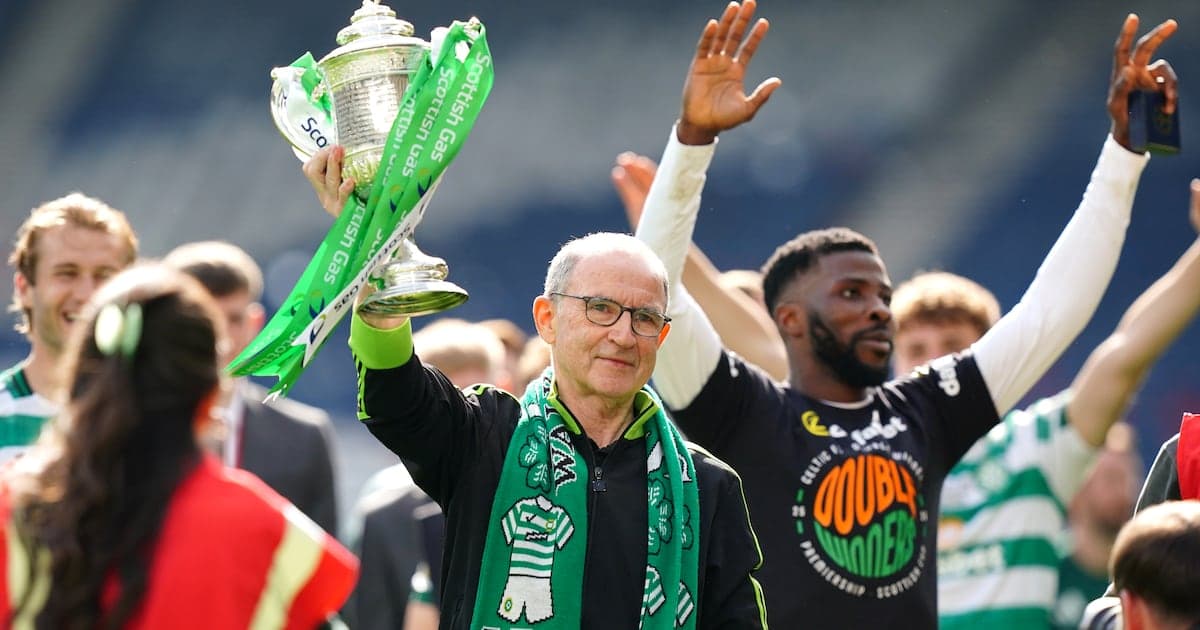
The agreement, which includes an option for a second season, comes at the end of a campaign in which O’Neill twice stepped in as interim and still managed to deliver a domestic double. He closed the season by retaining the Premiership title and lifting the Scottish Cup against Dunfermline, then asked for time to reflect. In truth, the pull of Celtic Park rarely lets go.
A familiar saviour
O’Neill’s comeback is steeped in history. It is 26 years since Dermot Desmond first persuaded him to swap Leicester for Glasgow, a decision that reshaped Celtic’s modern era. Under the former midfielder, Celtic tore into Rangers’ dominance, collecting three Scottish titles, three Scottish Cups and two Scottish League Cups, and marching all the way to the 2003 Uefa Cup final, where they fell to José Mourinho’s Porto in Seville.
That legacy has never really left the club. Nor has O’Neill. When Brendan Rodgers resigned last October, it was the veteran who answered the emergency call, steadying a listing season before stepping aside for Wilfried Nancy. The Frenchman’s reign imploded almost as soon as it began, lasting only eight games. Celtic turned back to O’Neill, and he did what he has so often done in Glasgow: he won.
The Premiership was secured again. The Scottish Cup followed. The noise around the boardroom grew quieter as the silverware stacked up.
Keane talk, Keane backlash
Behind the scenes, though, Celtic’s hierarchy explored a different path. Robbie Keane emerged as a serious contender and held talks this week with Desmond, the club’s principal shareholder. On paper, it had a certain symmetry: a former Celtic striker, young, ambitious, with recent experience in Israel at Maccabi Tel Aviv and in Hungary with Ferencvaros, where he resigned at the end of May.
The reaction from parts of the support was immediate and fierce. A vocal section of the fanbase objected strongly to Keane’s spell in Israel, and the prospect of his appointment sparked a backlash that the board could not ignore. Momentum drained from the Keane idea almost as quickly as it had built.
Against that backdrop, O’Neill’s candidacy felt safer, but it was more than nostalgia. He had just delivered trophies under pressure, reasserted control of a fractured dressing room and reconnected a restless crowd with the team on the pitch.
Back for good
After the Scottish Cup final, O’Neill asked for breathing space, a pause to weigh up whether he wanted the grind of full-time management again at 74. The expectation around the club, though, never really shifted. Those close to the situation believed he would accept if the terms were right and the backing clear.
Now, with the one-year deal agreed and an option for another season on the table, Celtic are ready to hand the keys back to the man who first transformed them a generation ago.
He returns to a very different landscape: new rivals, new financial realities, a fanbase that demands not just domestic dominance but a credible European presence. Yet the equation is familiar. Celtic need stability, authority and a manager who understands the scale of the shirt.
They have turned, again, to Martin O’Neill. The last time Desmond coaxed him north, Celtic were reborn. The question now is not what he has done for the club, but how much more he can squeeze from one of the great second acts in Scottish football.