
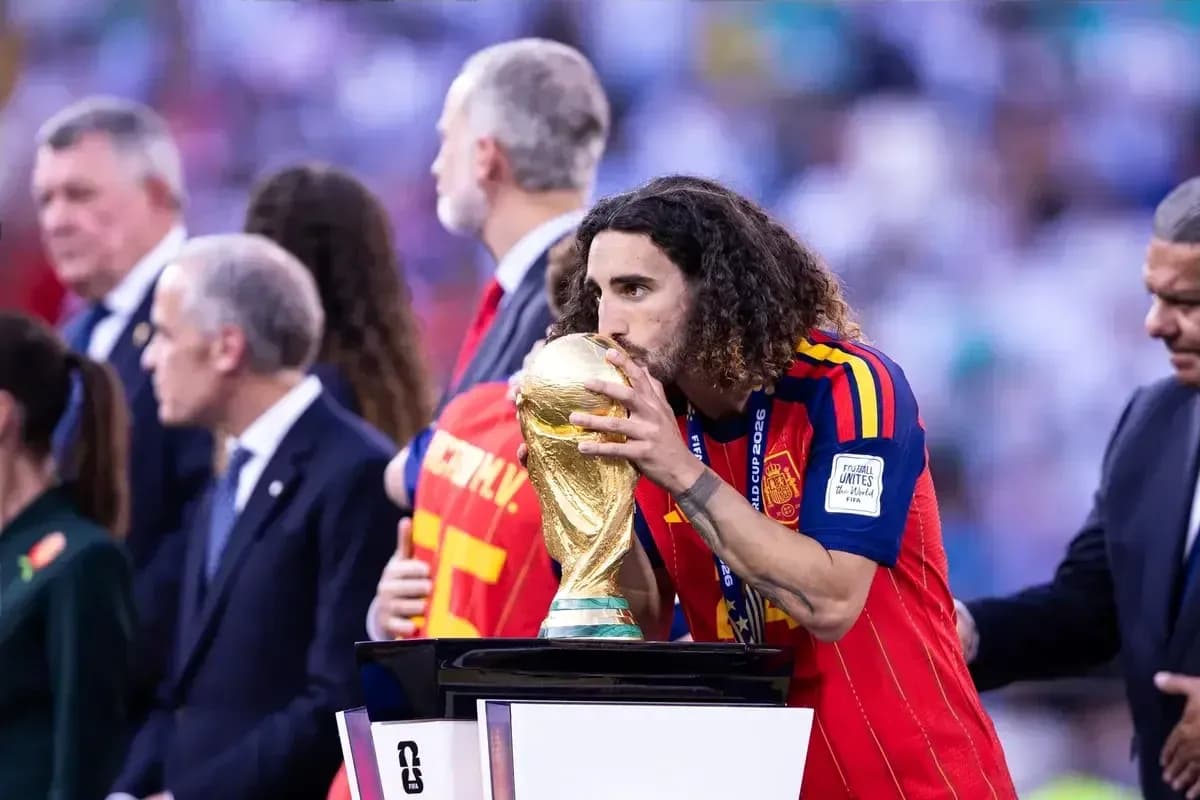
Marc Cucurella: Real Madrid's Game-Changing Transfer
Real Madrid signed Marc Cucurella this summer to strengthen the left flank. On paper, it looked like a smart, functional move. In practice, it has already turned into one of the most profitable pieces of business of the window – both on and off the pitch.
Spain’s World Cup triumph in 2026 has Real Madrid fingerprints on it for one simple reason: Cucurella. Before he arrived, Luis de la Fuente’s squad list did not contain a single Real Madrid player. Not one. With the fullback on board, the club suddenly had a direct presence in a Spain side that went on to lift the biggest trophy in international football.
The ripple effect was immediate. World Cup glory carries weight in the modern game, and Cucurella rode that wave. Fans voted him into the FIFA World Cup Best XI, one of three Real Madrid players to make that team. His reputation soared, and so did his market value. Transfermarkt now places him at €60 million – a sharp jump for a player Madrid had only just brought through the door days earlier. An instant appreciation of an asset, generated by a tournament played in another shirt but celebrated in the boardroom at Valdebebas.
Yet this is not just about prestige or balance sheets. His signing quietly solves a structural problem that could have caused Madrid real headaches in Europe.
A World-Class Left Back Who Also Ticks a Crucial Box
On the pitch, Cucurella offers what every elite side craves from a fullback: energy, aggression, and quality down the left side. But his profile delivers something more subtle, something that matters just as much when UEFA paperwork lands on the club’s desk.
UEFA rules are clear. From a 25-man squad, at least eight players must be locally trained to be eligible for the Champions League and other European competitions. For Real Madrid, “locally trained” covers footballers developed either in their own academy or at any other academy in Spain between the ages of 15 and 21.
Cucurella fits that rule perfectly. He grew up in Barcelona’s youth system, continued his development at Eibar and Getafe, and only then made the leap abroad to Chelsea. His footballing education is firmly rooted in Spain, and that makes him invaluable beyond his defensive work and overlapping runs.
His arrival means Madrid now hit the locally trained quota without having to make uncomfortable compromises on squad selection. No forced promotions before players are ready. No last-minute reshuffles to squeeze in a homegrown option at the expense of quality. Cucurella gives them both: a Champions League-level left back and a clean tick in a vital regulatory box.
For a club that lives under constant scrutiny – sporting, financial, and institutional – that combination matters. A signing that brings World Cup glory by association, a surge in market value, and regulatory relief in Europe is rare. Real Madrid moved for Cucurella to strengthen a position. They may have ended up solving three problems with one transfer.




