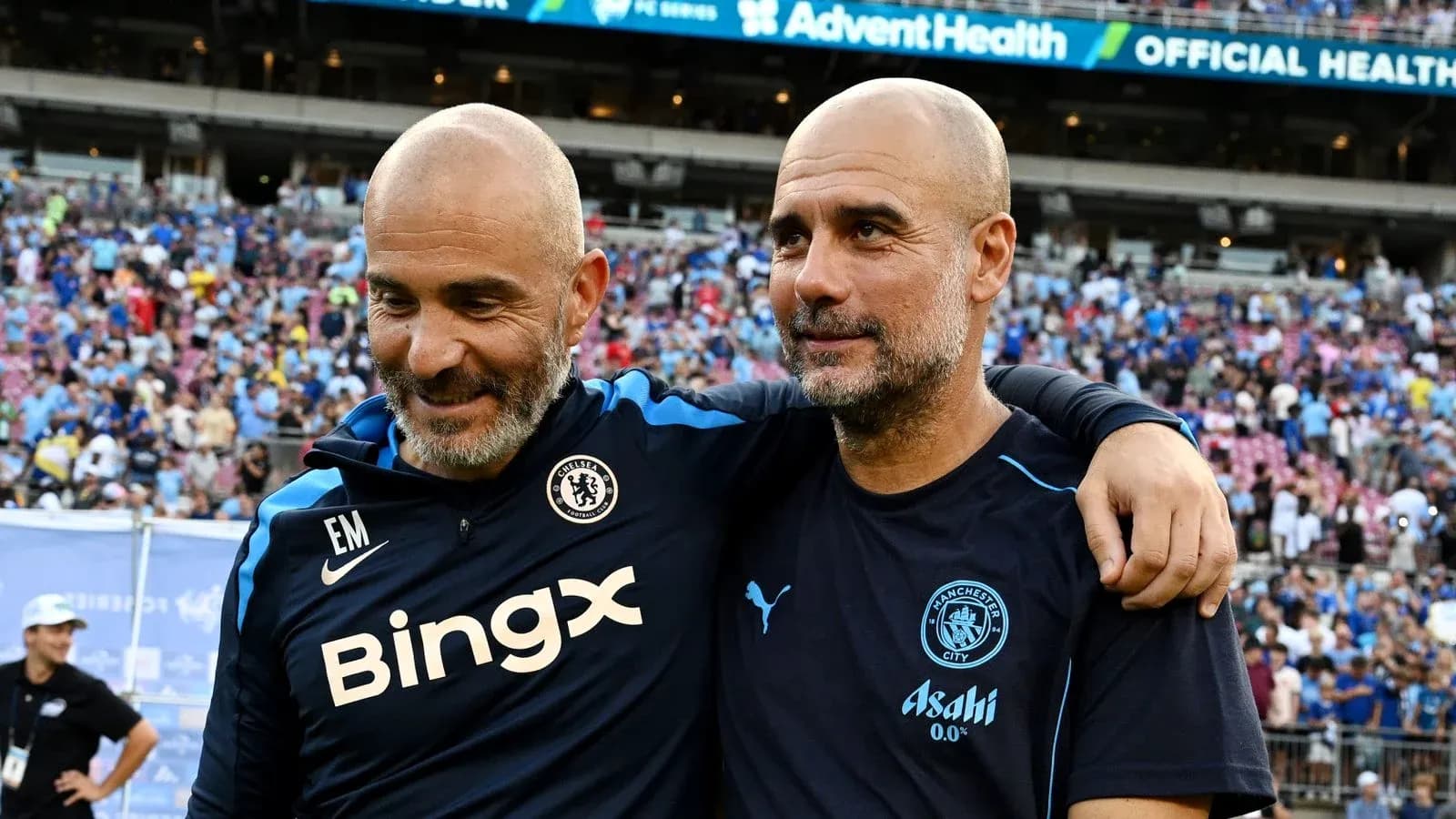
Manchester City and Enzo Maresca: A New Era After Pep
The banners for Pep Guardiola’s decade-long project are barely down and already Manchester City have rolled the dice again. No soft reboot, no grand reset. Just another demand: keep winning.
Into that unforgiving brief walks Enzo Maresca, the coach who knows the building, knows the standards and knows exactly whose shadow he is stepping into.
This is his third spell at City. First as an academy coach in 2020-21, then as Guardiola’s assistant in the historic 2022-23 treble season, and now as the man asked to prove he can deliver trophies on the same stage, but this time with his name on the honours list.
A kind fixture list – but no hiding place
If the fixture computer has any sense of romance, it’s also got a ruthless streak. Maresca’s first three Premier League games – Bournemouth, Crystal Palace, Coventry City – look sympathetic on paper, a gentle incline rather than a cliff face.
It’s a run that should let him install his ideas without the season feeling like it’s on fire by September. It also hands City’s World Cup core a rare luxury: time.
Rodri, the metronome of Spain’s triumphant campaign and the player City can least afford to burn out, is the obvious beneficiary. He played almost every minute of the tournament. Normally, that would mean a brutal turnaround into the Premier League grind. This time, those early fixtures are forgiving enough that City can phase him back, rather than fling him straight into the furnace.
But there’s a flip side. When the schedule offers you nine points, you’re expected to take nine points. Maresca cannot afford a sluggish start, not with Manchester United and Liverpool looming in two of the next three games in September. Those are not just fixtures; they’re early verdicts on whether City’s post-Pep project looks like evolution or erosion.
Maresca called it a “dream situation” when he walked through the door – a well-balanced, talent-rich squad built by Guardiola, with depth at almost every turn. “It provides the consistency I need to do my job effectively,” he said.
Consistency, yes. Comfort, no.
The demands are identical to those placed on Guardiola, without the decade of political capital and the unique job security the Spaniard quietly accumulated. Guardiola always managed on his own terms. Maresca has a strong relationship with chairman Khaldoon Al Mubarak, but that doesn’t guarantee the same latitude if results wobble.
Same principles, different picture
Tactically, this will not be a revolution. City will still want the ball. They will still look to control games, press high and squeeze opponents into submission.
But the details matter, and this is where Maresca’s City will look different.
Under Guardiola, the structure often dissolved by design. Full-backs stepped into midfield, centre-backs drifted into wide areas, wingers tucked in to overload central zones. It was a shape-shifting system with Rodri at its heart, orchestrating a team that could look like a 2-3-5 one minute and a 3-2-4-1 the next.
Maresca is cut from the same possession-first cloth, but his approach is more defined, more rigid in its starting positions. He favours a 4-2-3-1, with clear lines and clearer roles. Wingers are asked to stay high and wide, stretching the pitch rather than collapsing it. Width comes from the touchline, not from inverted runs into traffic.
That puts new emphasis on the No 10. At Chelsea, Cole Palmer became the conduit between midfield and attack in Maresca’s system, the player who knitted possession into penetration.
At City, he has options. Phil Foden, who has already shown he can dictate games from central pockets, and Rayan Cherki, a natural technician between the lines, both fit the profile. Whoever owns that role will be central to how quickly City adjust to the new blueprint.
The big question is adaptation. City’s attacking players have been drilled for years to drift inside, rotate, and create chaos in central areas. Now they may be asked to hold their width and stretch defences instead. It’s not a question of whether they can do it; it’s how long it takes before it looks instinctive again.
Younger legs, fewer lieutenants
Behind the touchline, another long-term project has been quietly ticking away. Under sporting director Hugo Viana, City have spent the last two or three windows lowering the squad’s average age. It has dropped from 29 to just over 25.
That shift has a cost.
The departures of Bernardo Silva and John Stones this summer – following Kevin De Bruyne’s exit before them – have created a clear leadership void. These were not just elite technicians; they were voices, references, players who carried Guardiola’s message onto the pitch.
The dressing room is not empty of authority. Rodri and Ruben Dias remain pillars. Erling Haaland took on more responsibility last season, no longer just the finisher but a visible leader. Marc Guehi and Josko Gvardiol add experience and stability at the back, while Mateo Kovacic offers know-how in midfield. The spine is still imposing.
Recruitment has been aggressive but targeted. Elliot Anderson has arrived from Nottingham Forest for serious money, a move designed to toughen and future-proof the midfield. Jeremy Monga has been poached from Leicester as another piece for the years ahead.
City still want more. A right-back and a winger sit on the wish list, and the club continue to track Lille teenager Ayyoub Bouaddi, who shone for Morocco at the World Cup and has also drawn Arsenal’s eye.
Outgoings will shape the final picture. If valuations are met, the likes of Savinho, Omar Marmoush, Nico Gonzalez, Jack Grealish, Tijjani Reijnders and Rico Lewis could all be on the move. With the World Cup now done, the market is expected to accelerate, and so will the pressure to give Maresca the exact tools he wants.
The first big test: identity without Pep
For the first time since the Abu Dhabi takeover, City step into a season without a clear, long-term masterplan built around one man. For a decade, everything – recruitment, infrastructure, even youth development – was aligned to lure Guardiola, then to maximise his tenure.
That era has closed. The question is simple and uncomfortable: what now?
City have hardwired a culture that only really recognises success in the form of silverware. Anything less might be tolerated briefly, but not for long. Supporters arrive at the Etihad expecting a show, but they demand wins above all else. Maresca’s Chelsea never quite struck that balance, and it cost him.
He does, at least, enter a league where he is not the only new face in a big dugout. Andoni Iraola at Liverpool, Xabi Alonso at Chelsea and Michael Carrick at Manchester United all carry their own unknowns.
This is not a settled Premier League landscape; it’s a reshuffle. In that chaos lies opportunity. Get it right quickly, and City can impose themselves while others search for their footing. Get it wrong, and the league will not wait.
The storm beyond the touchline: 115 charges
Hovering over all of this is a cloud that no coach can control.
The 115 Premier League charges against Manchester City have not gone away. They frame every conversation about the club’s success and will follow Maresca into every press conference until a verdict arrives.
Guardiola handled that glare with a combative assurance honed at Barcelona and Bayern Munich. He knew the City press pack, understood when to confront, when to deflect, and when to shut a line of questioning down entirely.
Maresca’s experience of scrutiny has been different. At Chelsea, criticism focused on football – selections, tactics, results – not legal and ethical battles playing out in the background. Now, he will have to navigate a narrative he did not create but cannot escape.
How he manages those exchanges, how he protects his players from the noise and keeps the focus on the pitch, will shape the tone of his first 12 months – especially if the case reaches a conclusion within that period.
Sink, swim… or redefine the standard?
Enzo Maresca inherits a squad built to win now, a club conditioned to judge seasons by trophies, and a fanbase that has lived a decade at the sport’s summit.
He also inherits the most daunting comparison in modern club football.
The fixtures give him a runway. The squad gives him weapons. The league, with so many new managers at the top, gives him an opening.
What he does with it will decide whether this is remembered as the season City proved they can live without Guardiola – or the moment everyone realised just how hard that is to do.