
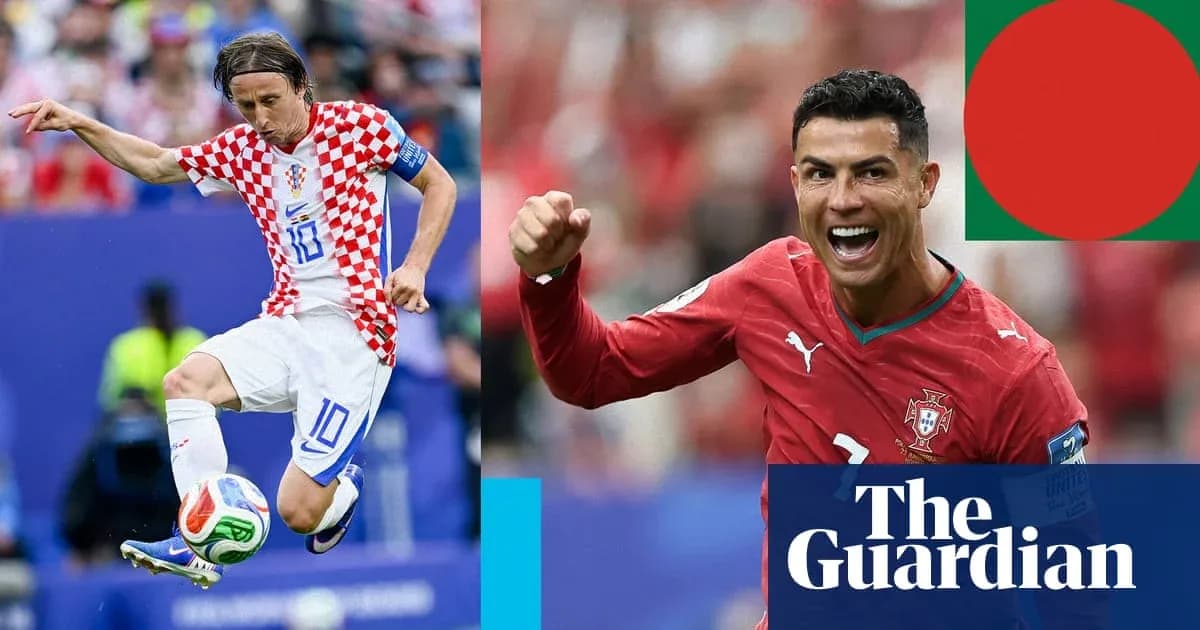
Luka Modric and Cristiano Ronaldo: A Legendary Football Journey
Can you remember what you were doing on 1 March 2006?
Some were at Anfield, watching England edge Uruguay 2-1. Others saw Switzerland put three past Scotland at Hampden Park. On another channel, in a different corner of Europe, a slight 20‑year‑old midfielder pulled on the Croatia shirt for the first time. Luka Modric stepped into international football against Argentina, in a game that also delivered Lionel Messi’s first goal for his country.
That same evening, Cristiano Ronaldo scored twice in a 3-0 win for Portugal over Saudi Arabia, striking in a country he would one day call home. Three prodigies, three storylines, one date on the calendar.
Messi and Ronaldo went on to devour the spotlight, the numbers, the awards. Modric took a different path. Less noise, more rhythm. He passed when others shot, dictated when others chased, and stayed, quietly, in the same rarefied air. While the arguments raged over who was the greatest, he just kept turning up, season after season, tournament after tournament.
Now, all these years on, two of that trio stand on the brink of another milestone. Ronaldo, 41, and Modric, 40, are set for their 232nd and 202nd caps respectively when Portugal meet Croatia in the last 32 of the World Cup. An ordinary line in a fixture list, an extraordinary line in football history.
They belong to an almost mythical club: players with at least 200 international appearances. Only four men have ever got there. Ronaldo and Modric are two of them. The numbers feel almost absurd. When Modric made his Croatia debut back in 2006, Ronaldo already had 29 caps. More than two decades later, with both still answering every call, that gap has grown by just one. Parallel careers, separated by a sliver.
They never treated international duty as an obligation. It was a summons. Ronaldo chased every qualifying campaign, every friendly, every Nations League date as if it were a final. Modric did the same, carrying Croatia from promising outsiders to World Cup finalists and perennial dark horses. The calendar changed, teammates came and went, managers rotated. They stayed.
Their paths began to knot together in England. In the 2008-09 season, Modric’s first in the Premier League, the pair met in the Carling Cup final. Modric for Tottenham, Ronaldo for Manchester United. Both played the full game, both rated a 7, both watched United lift the trophy after a penalty shootout. It felt like a clash between rising forces. In reality, it was just the prologue.
By 2010-11, Ronaldo had gone to Spain and the stakes had risen. Real Madrid met Spurs in the Champions League quarter-finals, and again Modric found himself on the wrong side of Ronaldo’s relentless march. Madrid went through, as they so often would in that era, and Modric’s performances nudged him toward the Bernabéu.
When he arrived there, their relationship changed. Opponents became allies. For six seasons, they shared the same white shirt and the same ruthless standards. Real Madrid dominated Europe, winning four Champions League titles in that span and reaching the semi-finals in the other two campaigns. Ronaldo finished the moves. Modric often started them.
If there was a single image that captured their shared peak, it came in Cardiff in the 2017 Champions League final. Juventus were reeling, Madrid were circling. Modric darted into space on the right, looked up, and cut the ball back with typical precision. Ronaldo met it, as he so often did, and swept Madrid 3-1 up. The goal felt inevitable. The pass made it so.
That was one of 222 matches in which they shared a pitch. No central midfielder has played more often alongside Ronaldo than Modric. The connection was not built on showreels but on repetition, trust, and an understanding that didn’t need words.
Now they meet again, this time split by national colours and by time. Portugal against Croatia in a World Cup knockout tie. Ronaldo on one side, still hunting goals and records. Modric on the other, still threading passes through impossible gaps. It might be the last time they share a field, the final chapter in a story that started on a cold night in 2006.
If this is the end of their shared stage, it comes with a question that lingers over both: how much longer can they keep bending the limits of international football before the game finally moves on without them?




