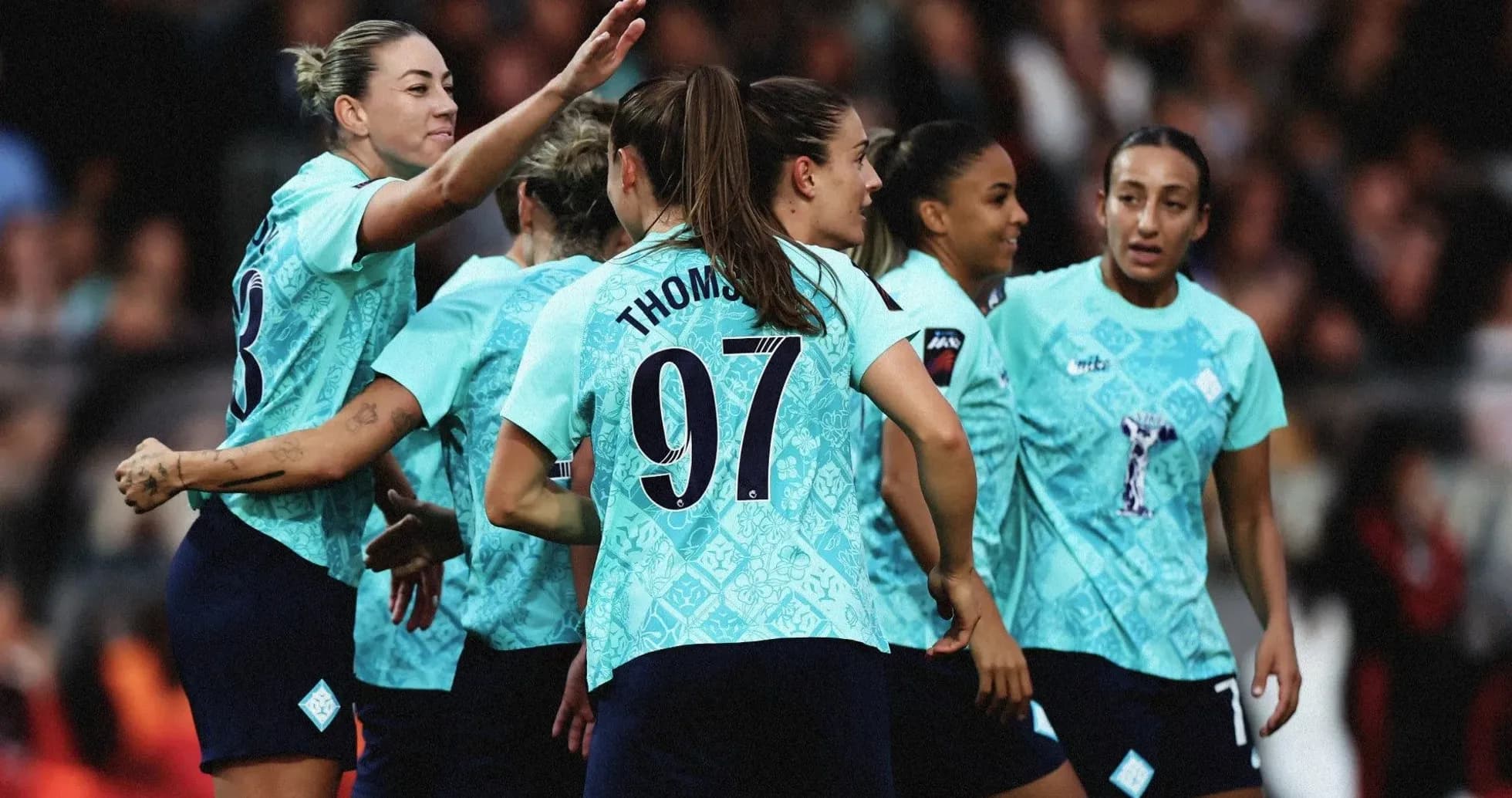
London City Shine as WSL Contenders Against Disjointed Man Utd
The word is out. If anyone wondered whether the buzz around London City was just pre-season noise, the answer came in the form of a record-breaking sell-out in the capital on Friday night – and a performance to match the occasion.
Many came for the stars. To see Alexia Putellas in competitive club colours for the first time. To glimpse Mary Earps, a Lionesses icon, even if only from the sidelines. Instead, they watched something far more ominous for the rest of the league: a team already playing like a team, weeks before they should really be this slick.
Putellas was steady, controlled, efficient. No fireworks, no chaos, just a calm debut that hinted at how much more is to come. Earps watched on as Elene Lete almost stole the goalkeeper headlines, denied a first clean sheet of the WSL season only in the 100th minute, when Simi Awujo finally broke through. By then, the contest was long gone.
Because this was about everyone else.
Grace Geyoro looked like a player on a mission. After a muted first campaign following her world-record move, she buzzed around midfield, snapping into tackles, driving play, demanding the ball. This didn’t look like a star still settling. It looked like a reset.
Alongside her, Alanna Kennedy justified every bit of faith shown in her. Stationed in midfield with Geyoro and Putellas, she brought balance and bite, and it was her pressure that forced Julia Zigiotti Olme into an early own goal. That moment set the tone: London City were sharper, quicker, more aggressive in every duel.
Out wide, Rosa Kafaji tormented her marker all evening, a player clearly intent on rewriting the narrative after a failed spell at Arsenal. On the opposite flank, Delphine Cascarino tore into United repeatedly, earning Sky Sports’ Player of the Match with a devastating display down the right. Lucia Corrales matched that intensity on the left, stretching the pitch and shredding United’s shape.
And that still doesn’t cover it.
Isa Kardinaal shone at centre-back, reading danger early and stepping in with authority, while her partner, Leila Ouahabi Leon, stood out with her distribution, turning defence into attack with a single pass. Ahead of them, Danielle van de Donk knitted everything together in a false nine role. Her movement dragged defenders into places they didn’t want to go, her touch was clean, and her clever flick to double the lead summed up the fluidity of London City’s front line.
This was not a group still learning a new playbook. This was a side that looked like it had been running Eder Maestre’s patterns for months.
Maestre, appointed at the winter break last season, has had a proper pre-season to drill his ideas. The difference showed. Kennedy had admitted to GOAL in pre-season that the mid-campaign change had been “a little bit disruptive” last year, but spoke of a squad now in “a good spot” after real time together to “hopefully do something special”.
On Friday, that “something special” felt very real.
London City hunted in packs, pressing Manchester United high, forcing errors and panic. When they had the ball, they stitched passes together with confidence, rotating positions, making angles, constantly offering options. Off the ball, their movement dragged United’s defensive line apart, opening channels that the visitors never quite managed to close.
The buy-in was obvious. So was the work done over the summer.
For United, the contrast was brutal.
Cristina Olid has only been in the job a month, and it showed. This was a team still trying to understand what it is supposed to be. The starting XI contained just one new signing, Andrea Medina, yet the lack of cohesion was glaring.
Some of that is the tactical shift. Olid has asked her full-backs to play in a way she herself admitted this week has been a “challenge” for them. “It’s a little different [to] how they were playing,” she said. “These first weeks have been a challenge for that because it’s different in our style of play.”
On the pitch, the uncertainty was obvious. At times it was hard to tell if United were in a back three or a back four. Medina and Anna Sandberg on the left looked like strangers still learning each other’s runs and instincts. On the right, Jayde Riviere, usually a marauding outlet, stayed unusually deep and cautious.
The tactical confusion was only part of the problem. United were sloppy. Touches bounced away, passes went astray, decisions came a beat too late. London City pounced on every mistake. Phallon Tullis-Joyce had to repeatedly rescue her side, producing a string of interventions that kept the scoreline respectable.
“Players were nervous, without confidence,” Olid told Sky Sports afterwards. “That is not us.” It didn’t sound like an excuse, more an admission of how far they still have to travel.
Look at this game in isolation and it is hard to avoid one conclusion: in the short term, it is London City Lionesses who look better equipped to harry Manchester City, Chelsea and Arsenal for those Champions League spots. They have star power, yes, but more importantly, they already have a functioning structure to house it.
Van de Donk’s verdict on Sky Sports after the match was as chilling for rivals as it was honest. “We don’t even know our best level yet,” she said. “We’ve not really played together that much. Hopefully there’s still more to come. We have loads to improve.”
If this is the starting point, the ceiling is high.
United, by contrast, look set for a season of growing pains. The club is betting that short-term discomfort under a new coach and a new style will pay off later. On nights like this, though, with a sold-out crowd roaring for the opposition and a slick, ruthless London City side running the show, that long-term vision can feel a very long way away.