Juventus Secure Narrow Win Over Frosinone in Serie A Opener
Under the late‑August heat at Stadio Benito Stirpe, Serie A’s new campaign opened with a narrow but telling 1–0 win for Juventus over Frosinone. Following this result, the table already sketches out contrasting trajectories: Frosinone sit 14th with 0 points and a goal difference of −1 (0 goals for, 1 against), while Juventus are 8th on 3 points with a goal difference of +1 (1 goal for, 0 against). It is only Round 1 of the Regular Season, but the identities of both sides were sharply outlined in ninety minutes.
Both coaches mirrored each other structurally in a 4‑2‑3‑1, but with very different intentions. Massimiliano Alvini’s Frosinone were compact and reactive, trying to protect the central lane and spring forward through a young, mobile attacking band. Luciano Spalletti’s Juventus, by contrast, imposed themselves as a methodical, possession‑first side, using their double pivot to suffocate transitions and keep the game tilted toward the Frosinone half.
Frosinone's Structure
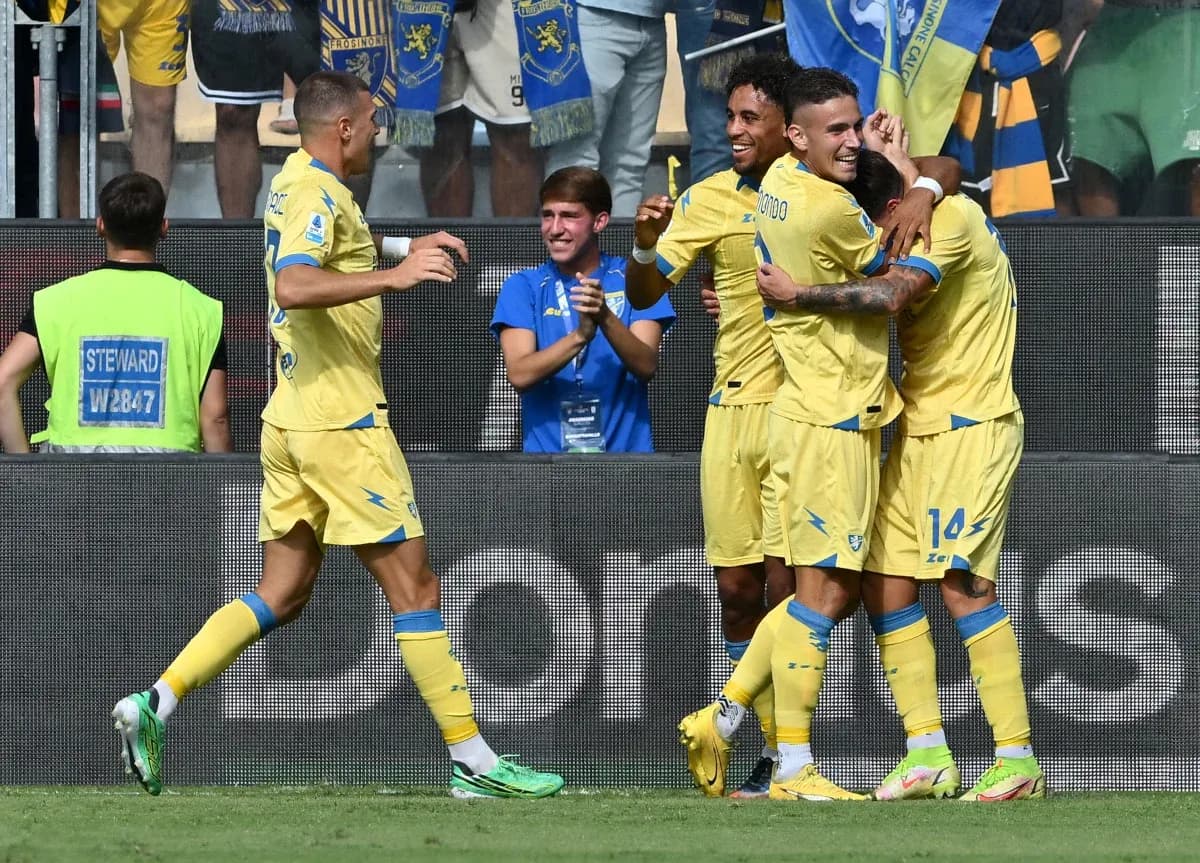
For Frosinone, the spine was youthful and exposed. L. Palmisani in goal had a baptism of fire behind a back four of I. Monterisi, G. Calvani, G. Cittadini and G. Bracaglia. The double pivot of G. Calo and M. Cichella was tasked with doing a lot of dirty work: screening the space in front of the centre‑backs, receiving under pressure, and finding the three advanced midfielders S. Fini, R. Schmid and G. Kvernadze. A. Raimondo led the line as a lone forward, often isolated and forced to chase lost causes.
The numbers underline how fragile Frosinone’s attacking platform currently is. Overall this season, they have played 1 match, lost 1, and failed to score, with 0 goals for in total and an overall scoring average of 0.0 goals per game. At home, they have also scored 0 with a home average of 0.0. That lack of punch meant every defensive error carried a heavy price. Defensively, they conceded 1 goal in total, all at home, giving them an overall and home average of 1.0 goal conceded per game.
Juventus' Approach
Juventus arrived in Frosinone with a different aura: a heavyweight side under a coach who prizes structure and control. G. Vicario started in goal, shielded by a back four of P. Kalulu, Bremer, L. Kelly and Z. Celik. In front, M. Locatelli and Douglas Luiz formed a technically secure and tactically disciplined double pivot. Ahead of them, the line of three — F. Conceicao, W. McKennie and K. Yildiz — rotated constantly behind R. Kolo Muani, who offered depth, pressing and penalty‑box presence.
The decisive figure, fittingly, was a defender. Bremer, already among the league’s top scorers lists thanks to his goal here, delivered a complete centre‑back performance. In total this campaign he has 1 goal from 1 appearance, with 2 shots and 1 on target, and he added 36 completed passes at 88% accuracy. Defensively he made 2 tackles, blocked 1 shot and produced 1 interception, dominating 5 of his 8 duels. His goal did more than separate the sides; it embodied Juventus’s superiority on set pieces and their ability to punish even small positional lapses in Frosinone’s back line.
Creative Contributions
On the creative side, Francisco Conceição already stands out as one of Serie A’s leading assist providers. In this match he logged 1 assist in 69 minutes, with 3 shots (1 on target), 26 passes at 88% accuracy and 2 key passes. His 9 attempted dribbles, 4 of them successful, show how Juventus look to him as the primary one‑v‑one destabiliser in the final third. His chemistry with R. Kolo Muani and the late‑arriving McKennie promises to be a recurring theme this season.
Discipline and Tactical Story
Discipline and card timing added another layer to the tactical story. Frosinone’s season‑long yellow‑card distribution so far is split evenly: 50.00% of their yellows have come between 31–45 minutes, and 50.00% between 91–105 minutes. That profile — fouls late in each half — suggests fatigue and late reactions, particularly under sustained pressure. R. Schmid exemplified that edge: in his 59 minutes he committed 4 fouls, drew 2, and collected a yellow card, underlining how much defensive work he was forced into between the lines.
Juventus, by contrast, have taken a more controlled but still aggressive approach. Their yellow cards are concentrated in the middle and late phases: 50.00% between 46–60 minutes and 50.00% between 76–90 minutes. Z. Celik’s caution fits that pattern, the by‑product of proactive defending high up the pitch. A. Cambiaso, who appears both among the leading yellow‑card recipients and red‑card statistics despite only 21 minutes of action, embodies the risk‑reward profile of Spalletti’s full‑backs: aggressive stepping out, front‑foot duels, and the occasional overstep.
Absences and Tactical Landscape
Absences also shaped the tactical landscape. Juventus travelled without M. Di Gregorio, J. Ekhator and F. Gatti, all listed as missing this fixture. That forced Spalletti to lean fully into Bremer’s leadership at the back and to trust the Kelly–Bremer axis from the opening whistle. The fact that Juventus still produced a clean sheet — they have conceded 0 goals in total so far, with an overall and away average of 0.0 goals conceded per game — underlines the depth and coherence of their defensive structure even when rotation is enforced.
In midfield, the “engine room” battle tilted decisively toward Juventus. M. Locatelli and Douglas Luiz offered a blend of circulation and counter‑pressing that Frosinone’s Calo–Cichella pair struggled to match. Every Frosinone attempt to build through the centre was quickly funneled into wide areas, where Juventus’s full‑backs and wingers could trap and recover. That territorial dominance explains why Juventus, on their travels, already have 1 goal scored and 0 conceded, translating into an away scoring average of 1.0 and an away defensive average of 0.0.
Looking Ahead
Looking ahead, the “hunter vs shield” dynamic for future Juventus fixtures is already clear. Bremer, a centre‑back who has started the season as a scorer and defensive anchor, will be the hunter on attacking set pieces while remaining the shield in open play. Behind him, G. Vicario has begun his campaign with a perfect record: 1 clean sheet from 1 away match. For opponents, breaking this axis will require either pinning Locatelli and Douglas Luiz deep to prevent clean restarts, or isolating the full‑backs to avoid Bremer dominating aerially.
For Frosinone, the tactical void is in the final third. With 1 match played in total, 1 defeat, 0 goals scored and 1 match where they failed to score, Alvini must find a way to connect Raimondo with the creative trio behind him. Kvernadze’s movement between the lines and Schmid’s ability to receive under pressure are promising tools, but without more aggressive support from the full‑backs and a higher starting block, they risk spending long stretches pinned back, accumulating late‑half yellow cards and inviting pressure.
Statistically and structurally, this opener paints a clear prognosis. Juventus, with 1 win from 1 overall and a clean sheet away, look built on defensive solidity and controlled risk, with Conceição and Kolo Muani providing the cutting edge and Bremer the set‑piece threat. Frosinone, still searching for their first goal and first point, have shown resilience but too little incision. If trends hold — Juventus conceding nothing, Frosinone yet to score — future meetings between sides of this profile will likely be decided by whether the underdog can disrupt the double pivot and deny Juventus their preferred, patient rhythm.