
Ibrahim Mbaye: The Youngest African to Score at a World Cup
There is a version of 16 June 2026 that never makes the highlight reel.
France 3-0 Senegal, 85 minutes gone at MetLife Stadium, game apparently dead, soundtrack already fading to the usual endgame rituals of a World Cup group match. Then a teenager steps off the bench and refuses to play his assigned role.
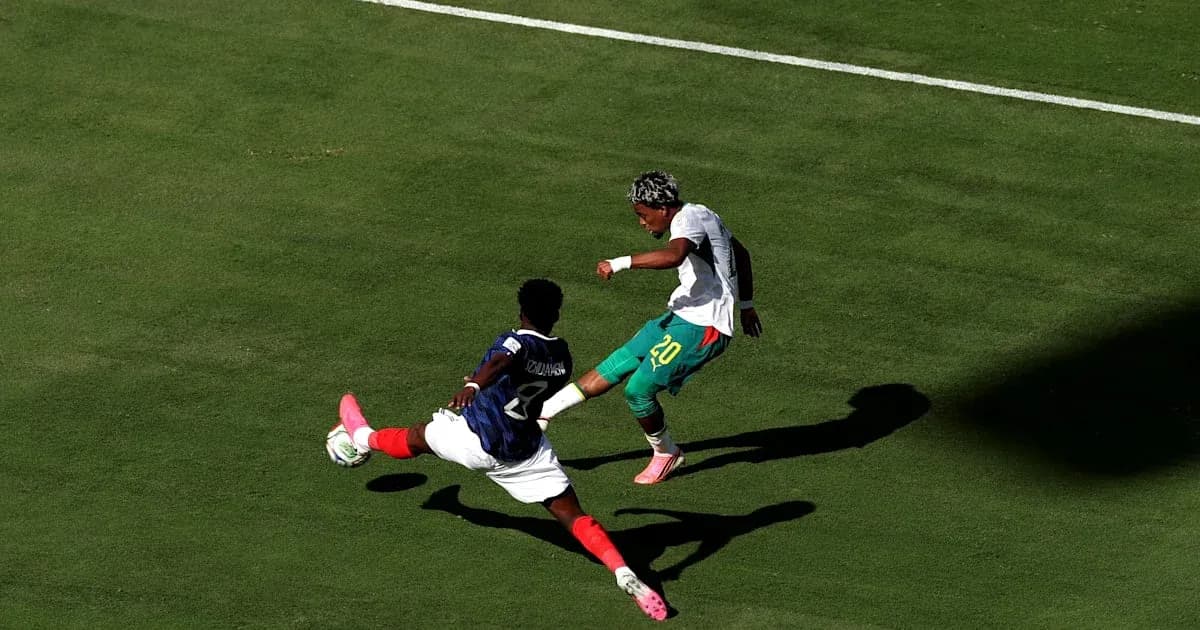
Ibrahim Mbaye takes the ball on the right touchline, a sliver of space and not much else. Théo Hernandez squares up. One feint, a roll of the foot, and the full-back is gone. Mbaye drives inside, head still, body balanced, and lashes a shot past Mike Maignan.
Stoppage time. Minute 95. France 3, Senegal 1.
The scoreboard calls it consolation. The record books call it history.
At 18 years and 143 days, Mbaye becomes the youngest African ever to score at a FIFA World Cup, knocking his compatriot Moussa Wagué off the top line of that particular ledger. Look wider and the names around him change from interesting to iconic: Pelé, Manuel Rosas, Gavi, Lamine Yamal. Only that quartet found the net younger on this stage.
C’est du sérieux. And the truth is, Mbaye has been taking things seriously for a long time.
Books, balls and a different kind of pressure
Wind back ten months. Paris Saint-Germain are flying to Marseille for a Ligue 1 game. The squad boards together. Their latest prodigy does not.
Mbaye, then 17, is sitting his baccalauréat, the exam that turns French teenagers into officially educated adults. While his teammates run through set pieces and patterns of play, he is working through equations. PSG arrange a separate trip; he joins up later, just in time for an 8pm kick-off.
For most players, that story would live forever as the defining anecdote. For Mbaye, it is just part of the week.
This is how PSG’s academy operates now. The same system that produced Warren Zaïre-Emery and Senny Mayulu drills its prospects in the classroom as relentlessly as on the training pitch. Academy director Yohan Cabaye talks about a 95 per cent baccalauréat pass rate and insists that academic discipline cannot be separated from football development.
In Mbaye, that philosophy has found its clearest case study. The nutmeg and finish against France is not a wild flash of improvisation; it is a problem solved under pressure, an exam question answered in real time. The same calm that carries him through an afternoon in an exam hall carries him through a 95th-minute chance at a World Cup.
He treats both as situations to be read, not moments to be feared.
Trappes, three flags and one decision
Mbaye’s story starts in Trappes, the Paris suburb that long ago etched its name into football folklore by sending Nicolas Anelka into the world. His father is Senegalese, his mother Moroccan, his football education unmistakably French. He comes through the national youth ranks, the kind of talent that makes federation officials sleep easily. Players like this, they assume, do not slip away.
In November 2025, he proves them wrong.
Mbaye chooses Senegal. No tug-of-war, no public row, no ultimatum. Just a teenager who knows what he wants.
“I will never regret choosing to play for Senegal because it was a decision from the heart,” he tells Senegalese broadcaster RTS after lifting the Africa Cup of Nations trophy in January, still a teenager among men with twice his experience. Months later, he returns to the subject and strips it down further: “If only you knew… it’s the best decision I’ve ever made in my life. The Senegalese have such huge hearts; it’s incredible.”
That is what gives his goal against France its extra weight. A boy raised in the Paris banlieues, polished in the most famous academy in French football, scoring his first World Cup goal against the nation that shaped him – while wearing the green of Senegal.
Quelle histoire. The script would have been thrown out in a writers’ room for being too neat.
The numbers of a fast-forward career
Strip away the romance and Mbaye’s rise still looks outrageous on paper.
He makes his Ligue 1 debut at 16 years, six months and 23 days, becoming PSG’s youngest-ever league starter, nudging Warren Zaïre-Emery out of the record. He signs his first professional contract in February 2025, scores his first senior goal within weeks, and by August is the youngest Frenchman to appear in a UEFA Super Cup, overtaking a benchmark that had belonged to Ryan Giggs since 1987.
In May 2026, with PSG chasing yet another title, he steps off the bench away at Lens and scores in stoppage time. The goal seals the club’s 14th Ligue 1 crown. Another exam, another correct answer.
The Senegal chapter is just as compressed. A debut against Brazil in November 2025. A goal three days later on his second cap. The youngest player ever to appear at the Africa Cup of Nations in December. The youngest Senegalese scorer at AFCON a month later, as the team lifts the trophy on the pitch before CAF later rules to award the victory to Morocco after the match.
The paperwork may have changed. The impression he left did not. Four goals in 12 caps before his 19th birthday do not need any help from hyperbole, and the comparisons with Kylian Mbappé do not feel lazy.
Coaches talk most about his choices. When to run. When to pass. When to slow everything down. It is the economy of it all that sticks in the mind. Mbaye does not need 20 touches to make his point.
He often needs one.
“Mbaye is world class, and he is ours, he did not choose France – he chose Gaindeyi,” Senegalese journalist Wahany Johnson Sambou tells Olympics.com in January, invoking the Wolof nickname for the national team. “He’ll do great things, just watch.”
Dakar, LA and the Olympic horizon
Senegal’s Olympic football story is still in its opening chapters. The men’s team has appeared only once, at London 2012, a tournament that helped propel Sadio Mané, Idrissa Gueye and Cheikhou Kouyaté into the wider spotlight. They have not been back since.
That might be about to change.
This October, the Youth Olympic Games arrive in Dakar, the first Olympic event ever staged on African soil. The country’s sporting identity will sit under a global microscope, football included. It is hard to imagine a more fitting backdrop for a new generation to announce itself.
Mbaye, born in January 2008, will be 20 when the Olympic flame reaches Los Angeles in 2028. That is prime age for an Under-23 tournament that has previously acted as a springboard for Lionel Messi, Neymar and Mohamed Salah. Olympics.com already lists him among Africa’s brightest prospects for LA 2028. Watch him for a few minutes and you understand why.
The medals and milestones make him interesting. The temperament makes him dangerous.
This is the same teenager who sat a baccalauréat exam on a matchday, then flew to join PSG and played as if nothing unusual had happened. The same teenager who walked into a World Cup debut against the reigning world champions and, with the clock almost out, treated the moment like another question to solve.
For now, he keeps moving as he always has: quietly, calmly, ahead of schedule.
The rest of the world is only just catching up to Ibrahim Mbaye. Senegal, and PSG, know they are already living with a player built for the biggest stages – and for the moments when everyone else thinks the story is over.




