
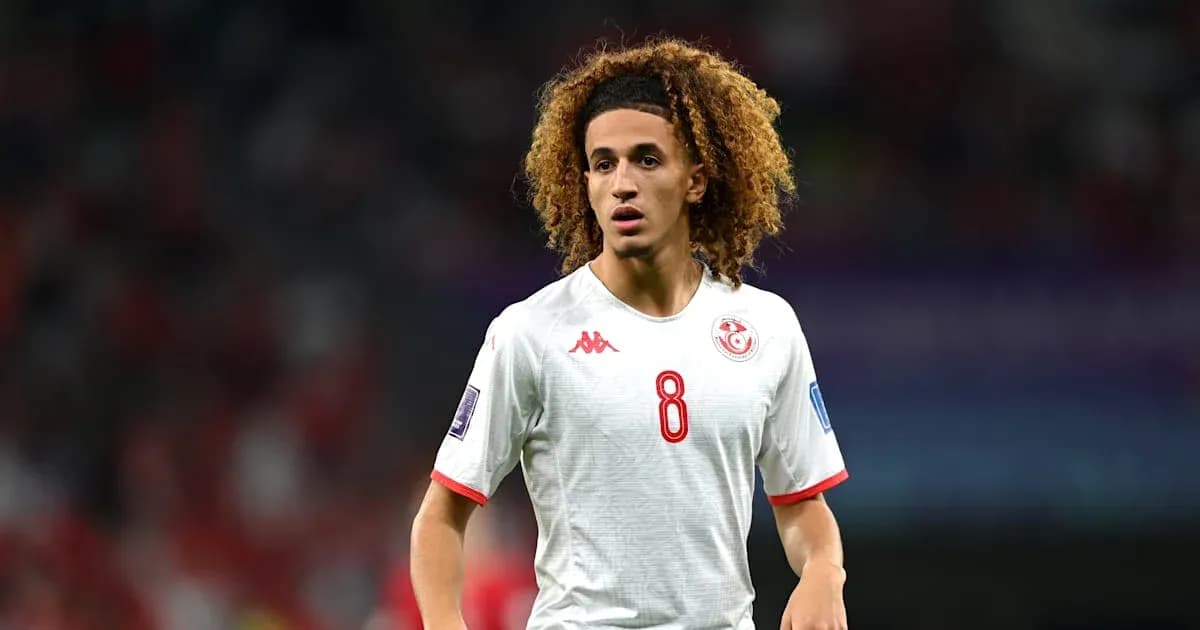
Hannibal Mejbri: Tunisia's Rising Star at the World Cup
The Eagles of Carthage have carried one of football’s great nicknames for decades. At this World Cup cycle, they finally have a Hannibal worthy of the legend.
Not the general who took elephants over the Alps and stared down Rome. This one wears the number of a playmaker, not a commander’s cloak. Yet 23-year-old Hannibal Mejbri now marches at the head of Tunisia’s charge towards a frontier the country has never crossed: the knockout rounds of a FIFA World Cup.
A Hannibal from La Banane
His story doesn’t begin in Tunis or Sfax, but in the 20th arrondissement of Paris, a dense, working-class slice of the capital where football stitches together a patchwork of identities.
Many Tunisians. Many Algerians. Many Moroccans. Senegalese, Malians. A concrete world where the ball never stops moving.
In the middle of it stands a curved block of flats known as La Banane – the Banana – and a boy who stayed downstairs until darkness swallowed the pitch.
“Instead of going straight up to my house, I used to stay out and play football until night fell,” Mejbri recalls in the series World at Their Feet, which tracks emerging talent on the road to the FIFA World Cup 2026. No master plan, no personal brand. Just a kid with friends, chasing the game.
Yet nobody around him thought he was just another kid.
Childhood friend Hubert Mbuyi remembers the sight instantly. The hair arrived before the reputation: big, blonde, impossible to miss. “He had a unique style, with big hair, big blonde hair. So everyone knew him and had a lot of expectations for him,” Mbuyi says. On any scrap of asphalt, any cage, any patch of grass, the rule was simple: where there was a ball, there was Hannibal.
Paris, Monaco, Manchester: a fast climb
The talent was organised early. At six, Mejbri joined the academy of Paris FC and stayed for almost seven formative years. A short spell at Boulogne-Billancourt followed, the sort of stepping stone that rarely makes headlines but often shapes careers.
Then Monaco called.
In 2018, the Ligue 1 club paid €1 million to bring the 15-year-old into their youth system. For a boy from La Banane, the contrast hit immediately.
“I could feel the richness of Monaco,” he says. The surroundings changed; the game remained. It felt like a dream, but a demanding one. He learned. He struggled at times. The experience, by his own admission, was not always ideal.
Yet the raw material was too obvious to ignore. Bayern Munich watched. Paris Saint-Germain looked. Barcelona tracked his progress. He could have chosen almost any badge in Europe.
He chose Manchester United.
In August 2019, at just 16, Mejbri signed for the three-time Champions League winners. The move to Old Trafford could have swallowed him. Instead, he cut through the layers quickly. By 2021, he had his Premier League debut. By September 2023, he had his first top-flight goal for United, a fierce strike in a 3–1 home defeat to Brighton.
The moment still jolts him. “I still get chills,” he says. The team were 3–0 down, the game gone, but his celebration told a different story – rage, release, defiance. “I don't know why I started to celebrate when we were losing 3–0, and you can see in my celebration that I had a certain rage in me and that I let go of everything when I scored.”
Even in a losing cause, it felt like a line in the sand.
Choosing Tunisia with his heart
At youth level, the French system had already embraced him. He played for France at under-16 and under-17, another Paris-raised talent on the conveyor belt.
Then came the decision that would define his international career.
In 2021, Tunisia called. Mejbri listened. He thought of his parents. He thought of his roots. He thought of La Banane.
“I joined Tunisia because I chose with my heart,” he explains. The choice was not a rejection of the country that raised him. “Even though I lived in France, it doesn't take away the love I have for France. But I find that the love I have for Tunisia is greater.”
The numbers show how quickly he has become central to the Eagles of Carthage. He is already 44 caps into his international career. Twice he has been named African Revelation of the Year at the Africa d'Or awards. For Tunisia, he is no longer a prospect; he is a pillar.
Yet every time he pulls on the red shirt, his mind travels back to that curved building in Paris.
“When I represent my country, I also represent my neighbourhood,” he says. “Because I know that I will represent them, and so all of that, it's a bit related to pride.”
The pride flows both ways. “All Tunisians are proud of him,” Mbuyi says. “Because in the end, he's a kid from the neighbourhood.” On matchdays, the screens in La Banane light up. People track the ball, but their eyes are hunting for something else. “We're all watching Hannibal's hair on the pitch. We try to spot him every time.”
Giving back to the block that made him
Success has not cut the cord with home. Every summer, Mejbri returns to La Banane and turns the courtyard into a small festival of football. He organises a tournament, hands out shirts, spends time.
Last year alone, he gave away around 100 shirts. They have become part of the local landscape. “You can just walk around here and find two or three people wearing his shirt,” Mbuyi notes.
For the kids staring up at the tower blocks, it is more than merchandise. It is proof.
“Hannibal is a great example of what the people look for in this area,” Mbuyi says. A boy from the same corridors, the same stairwells, now standing on a World Cup stage with the Eagles of Carthage.
Two thousand years ago, another Hannibal tried to conquer Rome and saw his ambition stall at the gates. This one is chasing a different kind of history: not empire, but a place in the last 16 and beyond.
If he makes it over that mountain, every shout that rises from La Banane will sound like an echo from Carthage itself.




