France Defeats Paraguay 1-0: Tactical Analysis of World Cup Knockout Match
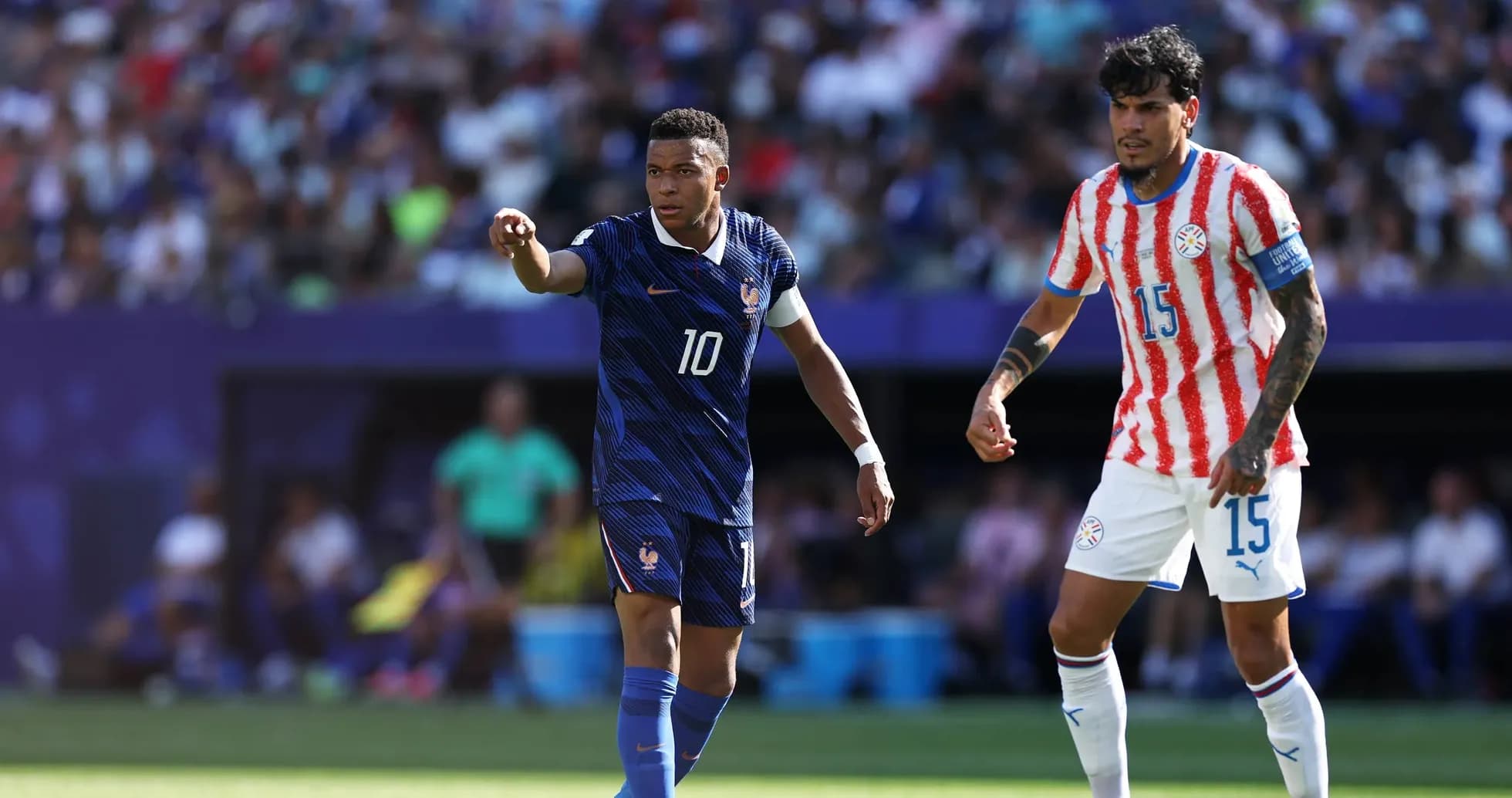
France’s 1-0 win over Paraguay at Lincoln Financial Field was a tactical arm-wrestle defined by structure versus control. Paraguay, in a 5-4-1 under Gustavo Alfaro, committed fully to deep-block survival and counter-punching, while Didier Deschamps’ France, in a 4-2-3-1, used the ball as their main defensive tool, suffocating space and tempo until the decisive penalty from Kylian Mbappé on 70 minutes, confirmed by a VAR check on Dési ré Doué’s earlier involvement.
Paraguay’s shape was unambiguous: a back five of Juan Cáceres, Gustavo Velázquez, Gustavo Gómez, Omar Alderete and Junior Alonso sat extremely deep, with Andrés Cubas screening as the central pivot in front of them. Miguel Almirón and Matías Galarza tucked in from the sides to form a narrow midfield four with Diego Gómez, leaving Julio Enciso isolated as the lone outlet. The numbers tell the story of that approach: only 24% possession and 183 total passes, of which 99 were accurate (54%). Paraguay were content to concede territory and volume of shots (5 total, just 1 on goal) in exchange for maintaining density in their own box and protecting central lanes.
France, by contrast, imposed a patient, territorial game. The back four of Jules Koundé, Dayot Upamecano, William Saliba and Lucas Digne played high and wide, compressing the pitch. With Manu Koné and Adrien Rabiot as the double pivot, France built with security and short connections, reflected in 568 total passes and 510 accurate (90%). The wide trio of Ousmane Dembélé, Michael Olise and Bradley Barcola operated between Paraguay’s full-backs and wide centre-backs, trying to pull apart the rigid 5-4 line, while Mbappé stayed high to pin the central three.
Despite their dominance – 76% possession, 15 total shots, 5 on goal – France initially struggled to convert circulation into clear chances, in part because Paraguay’s back five plus Cubas rarely vacated the central corridor. Paraguay allowed shots from distance (10 of France’s 15 attempts came from outside the box) but were quick to close down entries into the area, evidenced by France registering only 5 shots inside the box and Paraguay blocking 4 attempts. The low expected goals for Paraguay (0.15) underlines how rarely they transitioned into meaningful attacking positions; their 1 shot on goal and a single effort inside the box were isolated moments rather than a sustained plan.
The decisive phase arrived after Deschamps began to adjust his attacking personnel. At 61', Bradley Barcola (OUT) was replaced by Dési ré Doué (IN), injecting fresh legs and more direct dribbling against a tiring right side of Paraguay’s block. Just before that, Paraguay had already begun to reconfigure: Omar Alderete (OUT) for José Canale (IN) at 58' and Julio Enciso (OUT) for Gustavo Caballero (IN) at 61' signalled a need to refresh both the defensive line and the lone forward. However, these changes did not alter the fundamental passivity of their block.
The key turning point came at 68', when VAR confirmed a penalty for France after Dési ré Doué’s involvement in the box. This was the natural product of France’s territorial squeeze: repeated wide overloads and second balls eventually forced Paraguay into a desperate intervention in their own area. Mbappé converted from the spot at 70', a strike consistent with France’s xG of 1.36, which reflects a game where volume and territory finally translated into a high-quality opportunity.
Paraguay’s reaction was constrained by their initial game plan and limited attacking structure. Immediately after the goal, Alfaro made a double change at 71': Miguel Almirón (OUT) for Gabriel Ávalos (IN) and Gustavo Gómez (OUT) for Mauricio (IN). Moving Ávalos on gave Paraguay a more classic reference point up front, but with such a low passing base and France still circulating the ball efficiently, Paraguay never generated sustained pressure. Their 2 corner kicks to France’s 12 underline how little time they spent in advanced zones.
Defensively, Paraguay executed their low block with discipline and physical commitment. They committed 13 fouls, slightly more than France’s 11, but crucially avoided any cards. Their xG against, at 1.36, is relatively modest considering France’s shot volume and territorial dominance, which suggests that the back five, plus Cubas, successfully limited the quality of most French chances to low-probability efforts from distance or wide angles.
On the French side, the three yellow cards – Bradley Barcola at 19' (Foul), Manu Koné at 81' (Foul), and Michael Olise at 90+7' (Unsporting behaviour) – reflect the intensity of their counter-press and game management in the closing stages. Barcola’s early card came as France tried to immediately smother Paraguay’s rare breaks. Koné’s booking late on underlined the willingness of the double pivot to break up transitions before they developed, while Olise’s caution deep into added time was tied to the emotional and tactical edge of closing out a narrow knockout win.
Between the posts, Orlando Gill (Paraguay) was a key figure in keeping the scoreline tight. He made 4 saves, matching the volume of on-target efforts that breached Paraguay’s compact block, and his 0.37 goals prevented aligns with the impression of a goalkeeper who dealt well with the best of France’s chances beyond the penalty. At the other end, Mike Maignan (France) had a relatively quiet evening, needing just 1 save as Paraguay mustered only 1 shot on goal. France’s own goals prevented figure of 0.37 points to Maignan (France) and his defence dealing cleanly with the few moments of danger.
In statistical terms, this match was the archetype of a big favourite controlling every structural metric and finally breaking a stubborn underdog. France’s overwhelming passing superiority (568 vs 183), accuracy (90% vs 54%), possession (76% vs 24%), and set-piece volume (12 corners vs 2) all point to a side that imposed its game relentlessly. The shot profile – 15 vs 5 total shots, 5 vs 1 on target – aligns with the xG split (1.36 vs 0.15), underlining that the 1-0 scoreline slightly flatters Paraguay in terms of competitiveness.
From a tactical lens, Paraguay’s 5-4-1 was coherent and almost enough to drag the tie deep, but it offered too little offensive threat to ever tilt the balance. France’s 4-2-3-1, with its high line, double pivot control and rotating attacking midfielders, systematically eroded that block until a VAR-confirmed penalty provided the breakthrough their dominance merited. In a knockout context at the World Cup Round of 16, this was a controlled, professional display by France against a Paraguay side that maximised its defensive resources but could not escape the structural pressure applied for 90 minutes.