
England's World Cup Build-Up: A Circus Before Kick-Off
England’s World Cup build‑up has descended into the sort of circus that usually arrives after a bad tournament, not before a ball has been kicked.
The football hasn’t started. The noise very much has.
Tuchel, Maguire and a FaceTime fallout
Harry Maguire’s World Cup ended before it began, with Thomas Tuchel delivering the news in the most modern – and apparently most controversial – way possible: FaceTime.
The detail came from The Sun’s Tom Coley, who reported that Tuchel told Maguire via video call that he would not be going to the tournament. No squad place. No seat on the plane. No way back in time.
The method has sparked as much mock outrage as the decision itself. As if the real issue here is not the England manager discarding one of his most experienced defenders, but the platform on which he did it. Phone call? Acceptable. House visit? Old‑school class. Quick DM? Cold, but at least on brand for 2024. FaceTime? Apparently a step too far.
Maguire’s own account of the conversation only deepened the sense of awkwardness. He explained that Tuchel told him he had stuck with “the four lads that he got through the qualifying in the autumn camps where he felt like they did well during those six games,” then added that the manager “can’t really give me an excuse.”
Except he had just given him one. The logic and the denial sat side by side, a neat summary of where Maguire’s England career currently lives: trapped between justification and rejection.
The pressure game: semi‑finals or failure
If the handling of Maguire felt clumsy, the expectations being loaded onto Tuchel are anything but subtle.
On the eve of England’s opener against Croatia, The Sun’s website pushed a blunt headline on Martin Lipton’s column: Tuchel “can have no excuses” and must “make the semi-finals at least or he has failed.”
No caveats about form, injuries or the chaos of tournament football. No acknowledgment that Spain, one of the pre‑tournament favourites and reigning European champions, have already shown how unforgiving this stage can be. The message is simple: reach the last four or wear the label of failure.
The tone jars with the reality of England’s build‑up. Preparation has been patchy, key players are short of fitness, and the manager is still wrestling with big calls on personnel and shape. Yet the bar has been nailed into the sky.
Saka’s gamble and Arsenal’s supposed ‘alarm’
Bukayo Saka sits at the heart of that tension between ambition and reality.
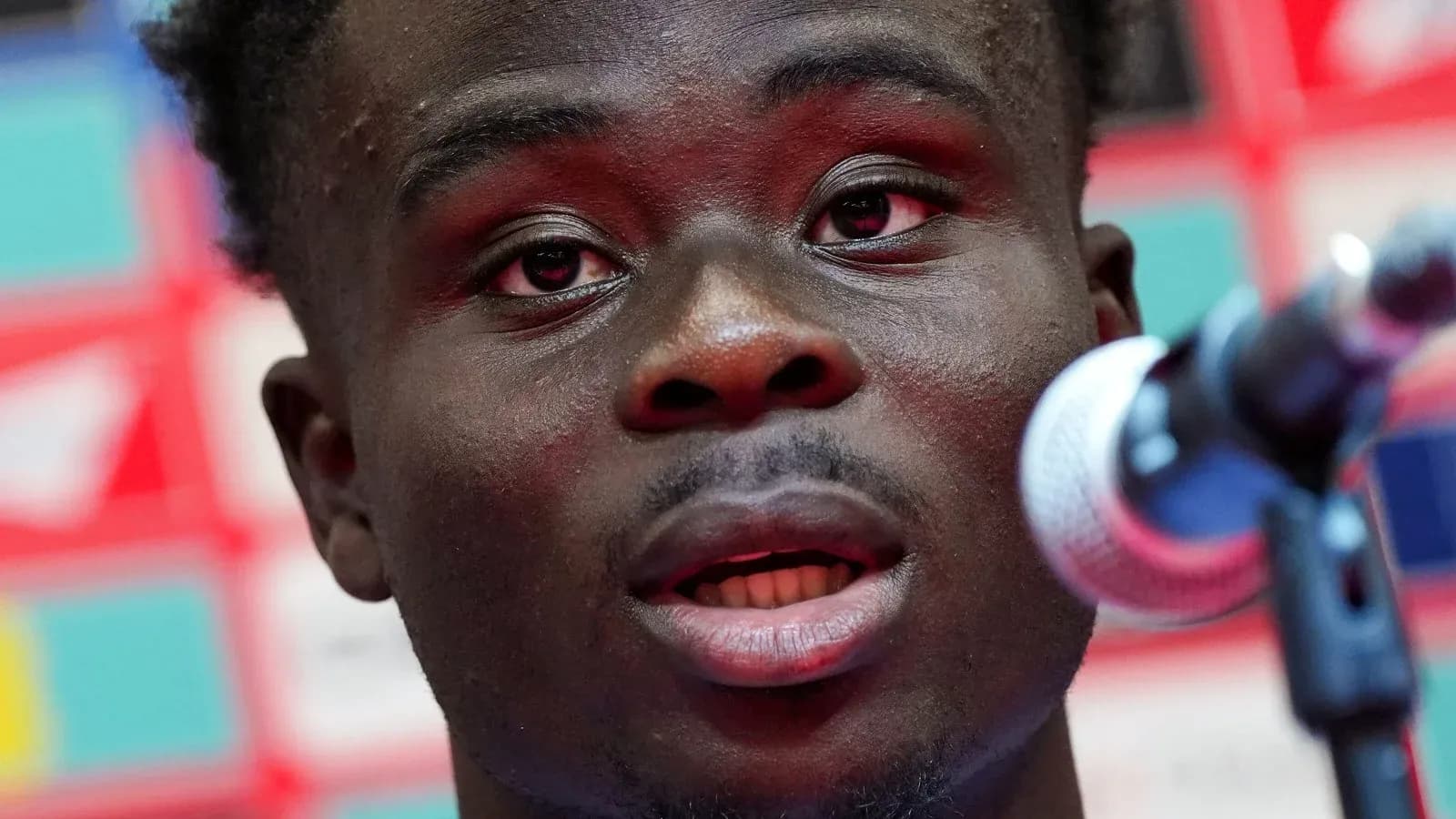
The forward spoke openly on Monday about his fitness, with Tuchel having already admitted that “it is very unlikely he starts and finishes all the matches” at this World Cup. Given Saka has started and finished just one game for club or country since mid‑March, that was hardly a revelation.
Saka, though, was clear. He said he feels “ready to go” and is “happy to take the gamble” on his body for England.
That should have been a straight‑forward story: a gifted player, not fully fit but desperate to play, prepared to push himself on the biggest stage. Instead, the Daily Express website twisted it into this: “Bukayo Saka sparks Arsenal concerns with alarming England comments at World Cup.”
The original piece by John Cross in the Daily Mirror carried a far more measured headline about Saka’s “gamble” being a boost to England. By the time it reached the sister site, it had been repackaged into a mini‑crisis.
The reality is far more mundane and far more honest. Saka has been managing an Achilles issue for months. He started only two of Arsenal’s last seven Premier League games in the title run‑in. He was limited to under an hour in their Champions League semi‑final second leg. He played less than 30 minutes across England’s warm‑up games after missing the March internationals entirely.
Saka himself praised Mikel Arteta and “the Arsenal medical team” for how they have worked with England to manage his workload “amazingly since March.” Tuchel echoed that, saying Arsenal had been “very aware” of the problem and had “took very good care of him.”
Everyone involved knows he is not at 100%. Everyone has known it for some time. Yet his willingness to play through that reality is framed as “alarming comments” and a trigger for “Arsenal concerns.”
The only truly alarming thing is how quickly a reasonable, nuanced situation becomes a headline designed to rattle.
Manufactured peril around England’s camp
The sense of drama has not stopped at injuries and selection.
The Sun’s foreign editor Nick Parker has been busy painting England’s World Cup base as a magnet for peril. First came the story of a tornado that “shook” the squad, even though it forced them to change nothing about their quiet evening indoors.
Now, a new headline: “SWAT team rushes to armed standoff just mile from England World Cup stadium as suspect arrested.”
The opening line set the scene: a SWAT team and armed police responding to an incident a mile from where England will play their first match. The implication was clear – danger close to home.
Buried in the seventh paragraph came the key line: “There is no indication the incident was connected to the World Cup or posed any threat to the tournament or its venues.”
So no link to England. No link to the competition. No actual impact on anything. Just another brushstroke in a picture of looming jeopardy that doesn’t really exist.
At this rate, a firework display five miles away will be cast as a psychological test for the squad.
Spain stumble, England supposedly tremble
The attempt to spin every development into a message for England stretched even further with Spain’s early slip.
“Why England and all other World Cup rivals should be worried after Spain are humbled by Cape Verde,” ran one Sun headline.
The conclusion? Spain “still cannot be ruled out of contention for the trophy” despite drawing their opening game and with two group fixtures left. In other words, a heavyweight has had a shaky start but remains dangerous – the kind of story that has accompanied every tournament since the World Cup was invented.
Yet even this becomes part of the England narrative. Tornadoes, SWAT teams, crimes nowhere near them, Spain drawing, Saka wanting to play. All thrown into the same pot, all stirred into a sense that England are somehow under siege before they have even kicked off.
Transfer subplots and tangled logic
The noise is not confined to the national team.
Jeremy Cross in the Daily Mirror turned his attention to Liverpool, noting that Florian Wirtz and Alexander Isak have both impressed at this World Cup – Wirtz against Curacao, Isak against Tunisia. For Liverpool, who have long admired both, that is encouraging.
Then came a strange twist. Cross wrote that Andoni Iraola “will want this to continue” but “would never admit it,” suggesting the Spaniard will secretly hope Isak uses “the biggest stage of all” to rediscover his best form and bring that confidence back to Anfield.
Why would Iraola not admit to wanting his most expensive forward to find form on the world stage? What manager doesn’t want his main striker sharp and confident? The logic frays the longer you look at it.
It’s another example of how even straightforward football truths – good players playing well is good news for their clubs – can be turned into something convoluted in the rush to find a fresh angle.
A storm of noise before Croatia
Strip away the drama and the picture is simpler.
England face Croatia in their World Cup opener with a manager under explicit orders, at least in the court of public opinion, to reach the semi‑finals or be branded a failure. One of his most trusted defenders has been cut loose by video call. His most dangerous wide forward is willing to gamble on a troublesome Achilles. The media around the camp is already oscillating between crisis and triumph, threat and opportunity, with barely a pause for breath.
The football will bring its own clarity. It always does.
The question is whether England can cut through the storm long enough to play like a team capable of meeting those sky‑high demands – or whether this World Cup will be remembered more for the noise that surrounded it than anything they actually did on the pitch.




