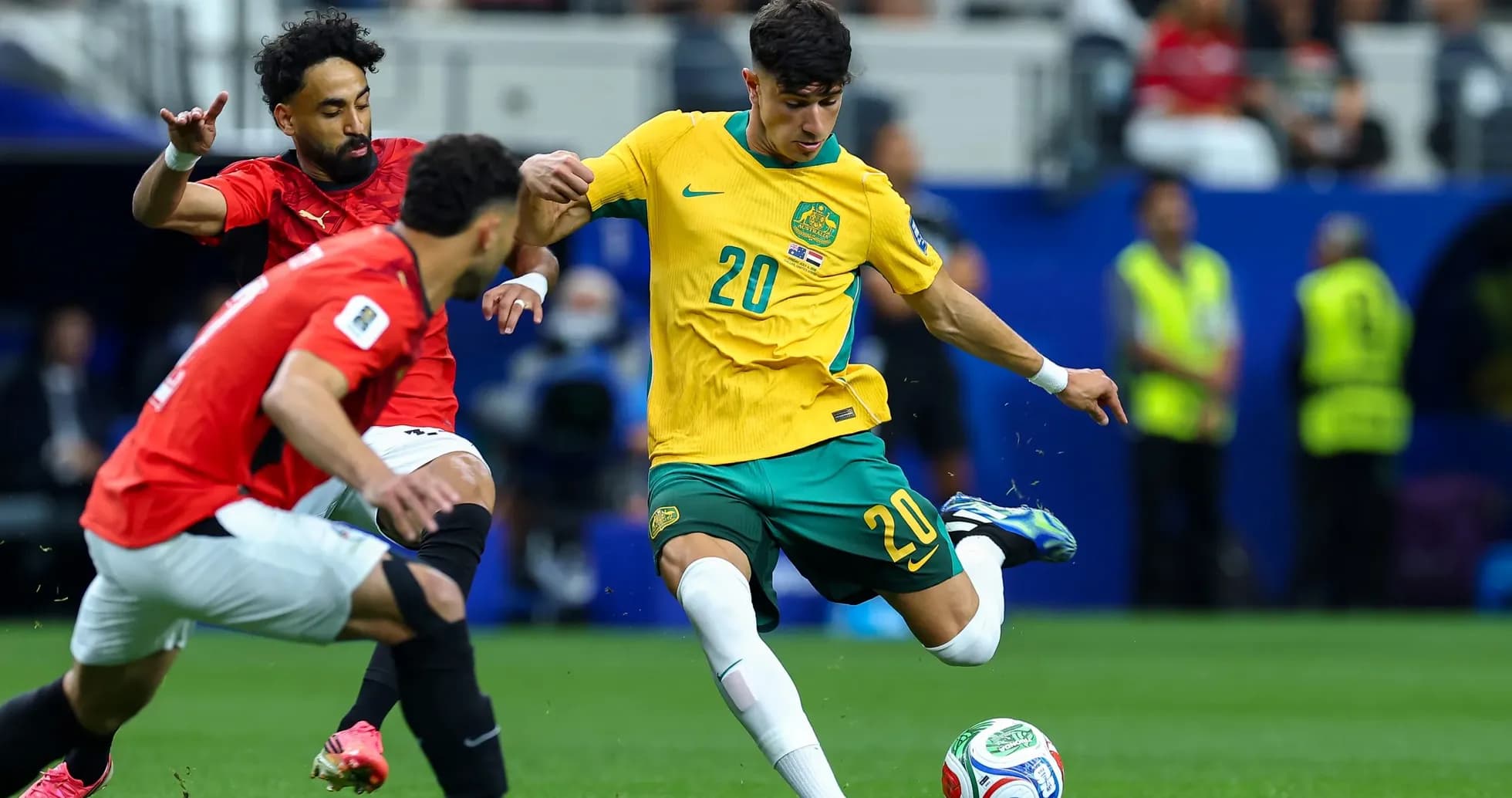
Egypt Edges Australia in Penalty Shootout After Dramatic Tie
Under the closed roof of AT&T Stadium in Dallas, Australia and Egypt dragged each other through 120 minutes and into the unforgiving geometry of a penalty shootout. The World Cup Round of 32 tie finished 1–1 after extra time, Egypt having led 1–0 at half-time before Australia clawed back to parity. From the spot it was Egypt who held their nerve, converting four penalties to Australia’s two to edge through.
This was a meeting of two sides whose group-stage identities had been clearly sketched. Australia arrived as Group D runners-up, with 4 points from 3 matches and a goal difference of 0, built on balance rather than fireworks: 2 goals scored and 2 conceded overall in the group. Egypt, second in Group G, had been more expansive and harder to beat, collecting 5 points from 3 games with a positive goal difference of 2, scoring 5 and conceding 3 overall. The numbers hinted at the story that unfolded: Australia’s structure and resilience against an Egyptian side more comfortable in open play and marginally sharper in both boxes.
Tony Popovic doubled down on that Australian identity with his starting shape. The Socceroos lined up in a 3‑4‑2‑1, P. Beach installed in goal behind a back three of A. Circati, H. Souttar and L. Herrington. The wing-backs, J. Bos on the right and A. Behich on the left, flanked a central pairing of J. Irvine and A. O’Neill. Ahead of them, C. Volpato and C. Metcalfe operated as dual tens behind the spearhead, the explosive N. Irankunda.
It was a system that reflected their tournament arc. Heading into this game, Australia had played 4 matches overall at this World Cup, winning 1, drawing 2 and losing 1. At home-designated venues they had played 2 times, winning 1 and drawing 1, and on their travels they had 2 matches with 0 wins, 1 draw and 1 defeat. Their attacking profile was modest but controlled: overall they had scored 3 goals in 4 games, with all 3 coming in home-designated fixtures. That translated to an average of 1.5 goals at home and 0.0 away, for an overall rate of 0.8. Defensively, they had conceded 3 goals overall, 1 at home and 2 away, an average of 0.5 at home, 1.0 away and 0.8 overall. The goal difference across the campaign stood exactly at 0, 3 scored and 3 conceded.
Popovic’s choice of three centre-backs and two industrious wing-backs was therefore no surprise: Australia had been built on compactness, with a willingness to trade attacking volume for stability. The card data underlined their edge-of-the-knife approach. Across the tournament they had picked up yellow cards in concentrated bursts, with 20.00% of their bookings coming in each of the 16–30, 31–45 and 46–60 minute windows, and a late-game surge of 40.00% between 76–90 minutes. They had yet to see a red card, but the pattern suggested a side that tackles aggressively as matches stretch and fatigue bites.
Egypt, by contrast, came to Dallas with a more assertive attacking record. Over 4 matches overall they had scored 6 goals, 1 at home-designated venues and 5 on their travels, averaging 1.0 at home, 1.7 away and 1.5 overall. They had conceded 4 goals overall, split evenly between home and away (1 and 3 respectively), for an average of 1.0 in both dimensions and 1.0 overall. The net effect was a positive goal difference of 2, 6 scored and 4 conceded. They had not lost a match heading into this tie: 1 win and 3 draws overall, with all 3 away fixtures unbeaten.
Hossam Hassan’s decision to roll out a 4‑4‑2 at AT&T Stadium was a subtle but telling twist on Egypt’s usual blueprint. They had mostly leaned on a 4‑2‑3‑1 in this tournament, using it 3 times, with 4‑4‑2 only once. Here, O. Shobeir started in goal behind a back four of M. Hany, Y. Ibrahim, R. Rabia and K. Hafez. The midfield band of four featured E. Ashour wide, H. Fathy and M. Attia centrally, and O. Marmoush drifting inside from the left. Up front, the responsibility fell to the star quality of M. Salah alongside M. Ziko.
The absences Egypt carried into the tie shaped this structure. Hossam Abdelmaguid was suspended through a sports court decision, removing a defensive option. In midfield, Mohanad Lasheen, one of the tournament’s standout enforcers with 2 yellow cards and 13 tackles overall, was missing through a yellow-card suspension. Without his ball-winning, Hassan relied on H. Fathy and M. Attia to patrol central spaces. Further back, the injuries to Ahmed Abou El Fotouh and Mohamed Abdelmonem stripped depth from the defensive line, making the selection of the experienced Rabia and the disciplined Ibrahim all but mandatory.
On the ball, Egypt’s attacking heartbeat was always likely to be Salah. Across the tournament he had delivered 1 goal and 2 assists in 4 appearances, with 113 passes and 16 key passes, supported by 6 shots on target from 6 attempts. His 13 dribble attempts, 6 successful, and 9 fouls drawn framed him as both creator and magnet for contact. In Dallas, his positioning as a forward in the 4‑4‑2 allowed him to pull into half-spaces between Australia’s wide centre-backs and wing-backs, asking constant questions of Circati and Herrington in particular.
Behind him, the “shield” was Yasser Ibrahim. One of the tournament’s leading collectors of yellow cards with 2 bookings overall, he had also been quietly effective: 7 tackles, 3 blocked shots and 2 interceptions across his 4 appearances. His duel numbers – 52 contested, 22 won – painted him as a defender willing to engage repeatedly, even at the cost of cards. Against Australia’s lone striker Irankunda and the underlapping runs of Metcalfe, Ibrahim’s aggression was both asset and risk.
The disciplinary patterns hinted at a volatile undercurrent. Egypt’s yellow cards had been front-loaded: 12.50% in the opening 0–15 minutes, 25.00% between 16–30, another 25.00% from 31–45, before a lull and then a late spike with 25.00% in the 91–105 window and 12.50% from 106–120. This distribution suggested a team that starts intensely, then rediscover their edge in extra time. In the context of a knockout tie, that mattered. Australia’s own tendency to collect 40.00% of their yellows between 76–90 minutes intersected dangerously with Egypt’s late surges: a recipe for a chaotic closing act and, ultimately, for the contest spilling into extra time and penalties.
Tactically, the “hunter versus shield” duel centred on Salah against an Australian defence that, heading into this match, had conceded only 1 goal at home-designated venues and 3 overall in 4 games. With a back three and double pivot, Popovic sought to crowd the central lane, forcing Egypt wide and trusting Souttar’s aerial dominance and Beach’s command of the box. Egypt, with 0 clean sheets overall in the tournament, accepted that they might need to outscore rather than shut down Australia; their 1‑3 away win in the group phase remained their attacking reference point.
In midfield, the “engine room” clash pitted J. Irvine and A. O’Neill against the reshaped Egyptian core of Fathy and Attia. Australia’s pair were tasked with screening Salah’s drops and Marmoush’s inward drifts while still providing enough support to Volpato and Metcalfe to connect attacks. Egypt’s duo, shorn of Lasheen’s presence, had to balance ball circulation with emergency defending in transition whenever Irankunda or Bos sprang forward.
In the end, the statistical logic of the campaign held. Egypt, unbeaten and slightly more potent in attack with 1.5 goals per game overall, found a way to survive Australia’s compact, low-scoring structure and drag the tie to the one phase of the game where numbers give way to nerve. Following this result, the narrative of Dallas will remember a balanced Australian side that pushed a more incisive Egyptian outfit all the way to penalties, only to watch the shootout tilt towards the team that had spent the entire tournament living on the right side of fine margins.