Diomande: Real Madrid's Vertical Threat Unleashed
Diomande, the Vertical Bullet Madrid Want to Unleash
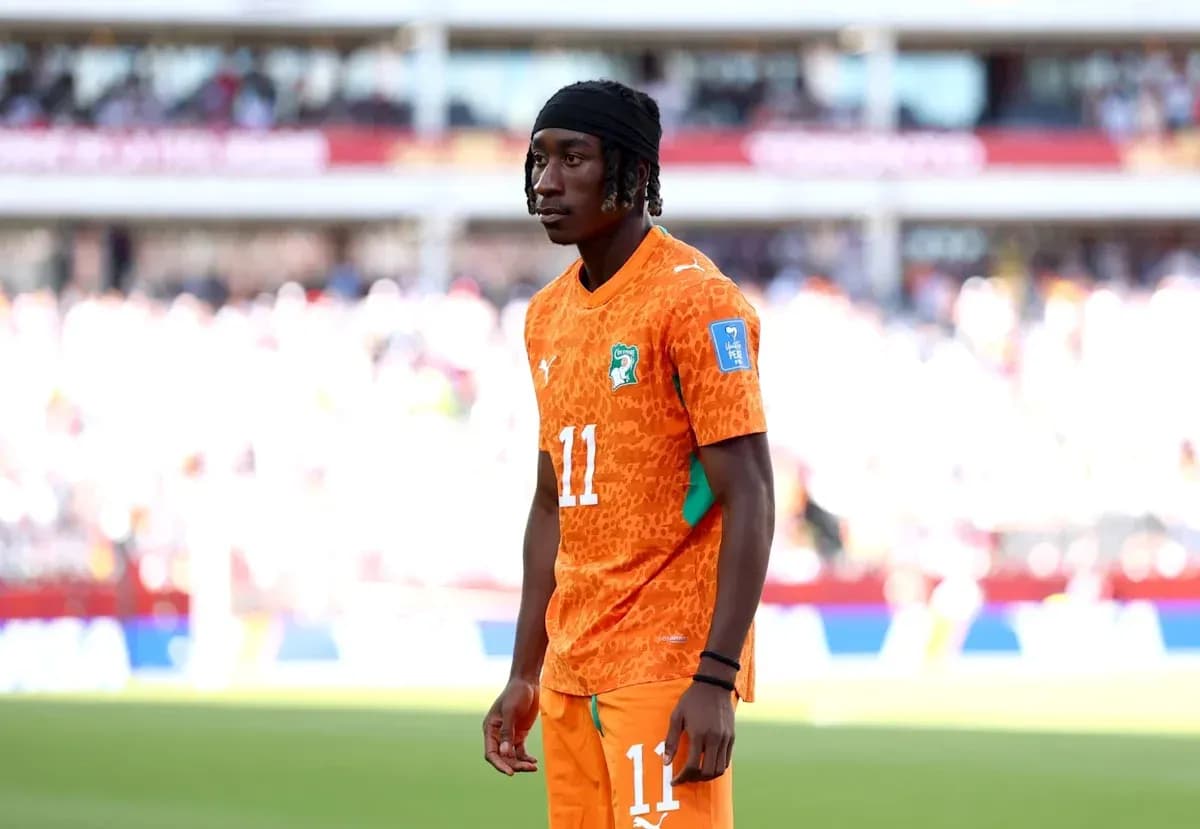
Real Madrid have chased plenty of wingers who dance between the lines, glide inside, and knit attacks together. Diomande is not that player. He doesn’t caress games into life; he rips them open.
Marca’s analysis of the Ivorian makes one thing clear: his game is built on vertical shock. He is sharp, direct, and brutally fast. At the last World Cup he was clocked at 34.7 km/h, blistering by any standard, even if it still sits just behind Kylian Mbappé’s 37.6 km/h. Give him grass to run into and he does not hesitate. He detonates.
Speed is only the headline act. The undercard is just as punishing. With RB Leipzig last season, Diomande completed 118 successful dribbles from 213 attempts in the Bundesliga. That’s almost double the tally of the league’s next-best dribbler, Michael Olise, who finished with 65 from 149. Defenders know what’s coming. They still struggle to stop it.
Two Wings, Two Faces
What separates Diomande from a more classical winger like Vinicius is not just his rawness. It’s his versatility. Naturally a right-sided player, he handled both flanks for Leipzig, though the distribution of minutes tells its own story: 1,591 on the right, just 478 on the left.
On the right, his game stretches the pitch. He receives the ball wide, almost glued to the touchline, and often with his boots on the chalk. There, he tends to be more methodical. First touch. Draw the marker. Scan. If the picture isn’t clear, he resets and goes again.
Working on his natural side, he looks to create space down the wing, hit the byline and pull the ball back. He doesn’t rely on elaborate feints. Standing start or full sprint, he overwhelms full-backs with strength, power and sudden changes of pace rather than a catalogue of tricks.
The diagonal run inside is less refined. He doesn’t yet have the natural, left-footed precision of someone like Olise when he drives infield from the right. His left foot is still more tool than weapon, despite chipping in with several goals last season when he shifted the ball onto it late on the edge of the area. He tends to use that weaker side during long, looping runs to unbalance opponents rather than to finish moves consistently.
Yet this is exactly where his threat grows. Even without perfecting that inside cut, he has found a way to hurt packed defences that close off the outside lane. He drags defenders across with him, then whips balls into the front zone or the far side. It’s his built-in escape route: if you block the door, he’ll smash open a window.
The numbers back the eye test. On the right wing, Diomande creates more chances per 90 minutes. He attempts more dribbles (4.41 per 90 against 3.23 on the left), completes more crosses (0.91 against 0.67) and plays more passes into the box (2.21 against 1.48). His shot volume is higher too (1.7 per 90 against 1.48), as are his expected goals (0.21 against 0.16). The price for that ambition is risk: he also loses the ball more often on that side (2.21 turnovers per 90 against 1.48).
Shift him to the left, though, and something in his game loosens.
Chaos From the “Wrong” Side
On the left flank, Diomande looks bolder, more instinctive, and surprisingly liberated despite leaning on his weaker foot. He still receives out wide, but less frequently, and he spends more time where it hurts: inside the area. His touches in the opposition box jump to 7.8 per 90, compared with 6.51 on the right.
From this side, he stops obsessing over the outside lane. He no longer leans on raw power to barrel down the flank. Instead, his right foot becomes the knife. He cuts inside to shoot or to deliver, and that simple change of angle feeds his confidence to attack defenders directly. His dribbling feels more assertive, more purposeful.
Two numbers leap out. On the left, his expected goals rise to 1.17 from 0.84, and his expected assists climb to 0.43 from 0.21. Same player, different wing, completely different flavour of threat.
Put simply, the right flank turns Diomande into a chance machine through volume: repeated take-ons, crosses, surges down the line. The left transforms him into a chaos agent, a player who doesn’t just create situations but distorts defensive structures around him.
Even with fewer minutes on that side, one pattern keeps repeating. He thrives in empty spaces away from the ball. When he receives with his back to goal in tight pockets or is surrounded and clipped, he finds a way out: a sharp lay-off, a quick one-two, then an explosive sprint in behind. With his acceleration and open grass in front of him, he becomes almost unmanageable.
Relentless Without the Ball
The most intriguing part for a coach like Carlo Ancelotti? His work when Madrid don’t have the ball barely changes, no matter the wing.
Energy defines him. So does his aggression the instant possession is lost. Among Bundesliga forwards with at least 1,000 minutes last season, Diomande topped the league for ball recoveries with 148. He ranked second for interceptions (16) and fourth for successful tackles (19). Those are not the numbers of a luxury winger. They belong to a forward who defends like a midfielder.
At set pieces he keeps things simple, holding his position and reacting to second balls. Once his team wins it back, he switches in an instant from guard dog to predator.
On the counter, he often occupies central lanes, where his dribbling and straight-line speed become lethal. Give him a channel behind the defence and a team willing to play forward early, and he rips through it.
For Madrid, the echoes are obvious. Under José Mourinho, the Bernabéu lived off those devastating transitions, with Cristiano Ronaldo and Ángel Di María tearing into open space. Diomande is not a copy of either, but he carries tools that fit that same landscape of fast breaks and vertical punishment.
The only real question now is not whether he can hurt teams at this level. The data, and the footage, have already answered that.
It’s where Madrid choose to unleash him: hugging the right touchline as a relentless creator, or cutting in from the left as the chaos-bringer defences can’t quite pin down.