Cristiano Ronaldo Honors Diogo Jota in Portugal's World Cup Victory
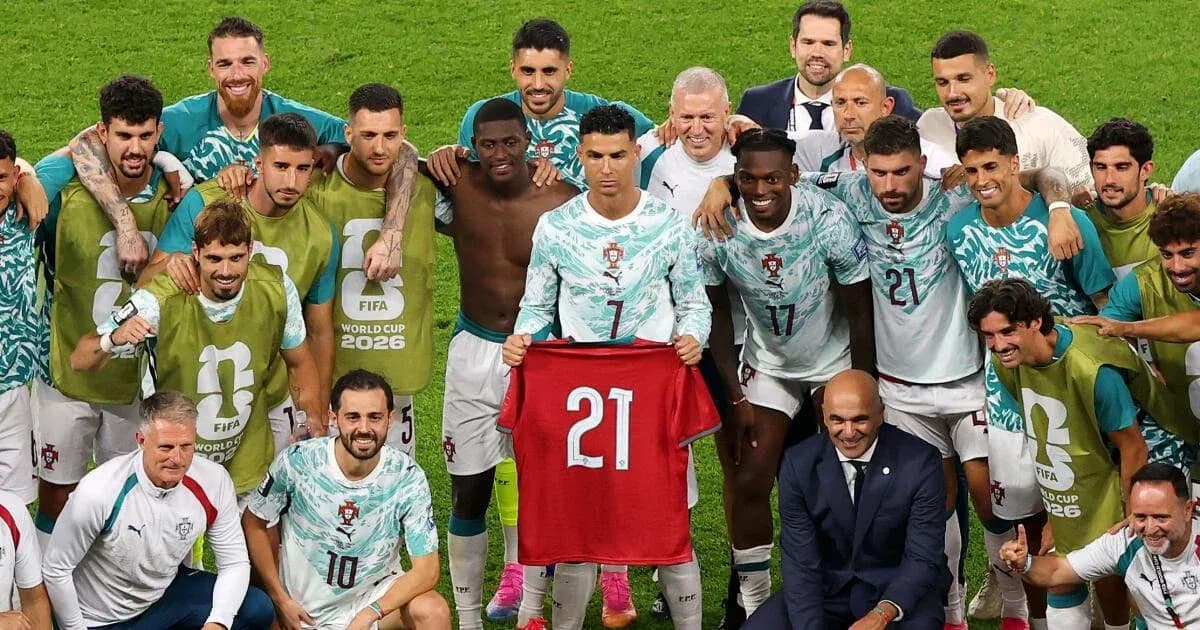
Cristiano Ronaldo stood alone in the glare of the floodlights, a red No. 21 shirt held tight to his chest.
Around him, teammates laughed, shouted, posed. Portugal had just survived Croatia, 2-1, in a World Cup knockout game at Toronto Stadium, a comeback that veered from desperation to delirium in the space of 90 frantic minutes plus stoppage time.
Ronaldo didn’t smile.
He planted himself front and center for the postgame photo, the captain’s armband on one arm, Diogo Jota’s Portugal jersey in his hands. The faces behind him told the story of the night. His told a different one.
Then he pulled the shirt over his own, turned toward the stands and began a slow walk across the pitch, acknowledging the noise as it swelled around him. The 41-year-old, who has spent a career living inside football’s loudest moments, suddenly looked overwhelmed.
“It’s a special day, for our Jota, who is up there illuminating us,” he told Portugal’s Sport TV later. “We know he’s present with us and it only made sense to win today to honor him in the best way.”
On the eve of the one-year anniversary of Jota’s death, Portugal played with a weight that was impossible to miss. They also played with a purpose.
A game dragged back from the brink
For a long stretch, it looked like the story would turn cruel.
Croatia led, Portugal labored, and the clock inched toward a result that would have cut deep on a night already heavy with emotion. Then, as he has done for two decades, Ronaldo changed the mood.
In the 68th minute, he stepped up to the penalty spot. One clean strike. 1-1. Another entry in a catalogue of vital goals, but this one carried an extra layer. He didn’t celebrate wildly. He just roared, fists clenched, as teammates swarmed him.
The stadium’s energy flipped. Portugal surged. Croatia wobbled.
The pressure finally told in stoppage time. A cross, a leap, and Goncalo Ramos rose to meet it, steering a header into the net for 2-1. Bedlam on the pitch, chaos in the stands. Portugal’s bench emptied, the substitutes tearing down the touchline to join the pile-on.
The drama still wasn’t done. Deep into added time, Croatia thought they had found their own late twist, the ball bundled into the net and celebrations starting. The flag went up. Offside. The goal was ruled out, and with it went Croatia’s last breath of resistance.
Only when the final whistle sounded did the adrenaline drain away and the emotion rush back in.
“We think about him every day,” Ramos told Fox Sports, speaking about Jota after the match. “It’s even more special to win this game in this day. And he gives us strength every day and for every game.”
A night built around No. 21
From the moment the teams walked out, the match belonged to more than the 22 players on the field.
As Portugal’s national anthem played, Jota’s image appeared on the big screen, a familiar face now frozen in time. Some fans wiped away tears. Others simply stared.
In the 21st minute, the tribute deepened. Pockets of Portugal supporters rose to their feet in unison, holding a banner emblazoned with Jota’s image. Balloons floated upward, each marked with his No. 21, drifting into the night sky above Toronto Stadium.
It was simple, and it was powerful.
This was not just about a former forward who scored goals and won trophies. It was about a player who had become part of Portugal’s footballing fabric, and whose life ended far too soon.
Just after midnight on July 3, 2025, Jota and his brother, André Silva, died in a single-car crash near Zamora, Spain. Jota was 28. Silva was 25. The news stunned Portugal and reverberated around Europe.
Jota, a clinical finisher with relentless movement and sharp instincts, had played nearly 50 times for his country. He made the 2022 World Cup squad but missed the tournament through injury, a cruel twist that now feels even more poignant.
Anfield’s tribute to “Forever 20”
His story is not only Portuguese.
At Liverpool FC, where he scored 65 goals in 182 games and became a key part of Jürgen Klopp’s attacking rotation, Jota left a mark that went far beyond the penalty area. On Wednesday, at Anfield, the club unveiled a permanent memorial to Jota and his brother.
The monument, designed by sculptor Emma Rodgers, carries a title that says everything about how Liverpool chooses to remember him: “Forever 20,” a nod to the number on his back during his years in red.
“Today, as every day, we remember Diogo Jota and André Silva, who tragically passed away one year ago,” the club wrote on X on Friday. “Through immeasurable loss and incalculable pain, the impact they made and the legacies they left behind — not only within the footballing world, but in the hearts and minds of so many around the world — has shone through over the last 12 months.
“All of our love, support, thoughts and prayers continue to be with Diogo and André’s families, friends and all those whose lives were touched by them. Forever in our hearts, forever our number 20.”
In Liverpool, in Portugal, and in a World Cup stadium thousands of miles away, the message was the same: gone, but anything but forgotten.
On this night, Ronaldo’s penalty and Ramos’s header kept Portugal alive in the tournament. The performance will be replayed and dissected, the tactics argued over, the officiating debated.
Yet the image that will endure is not of a goal, a save, or a sliding tackle.
It is of a 41-year-old icon in a No. 21 shirt, head bowed, walking slowly toward a crowd that understood exactly who — and what — this victory was really for.