
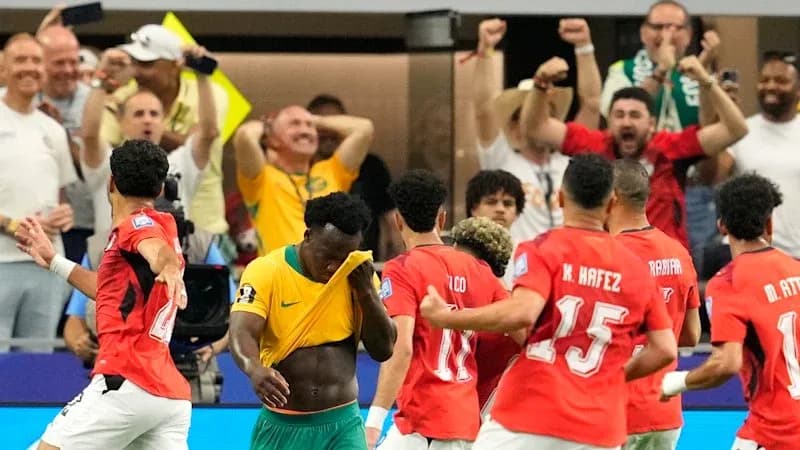
Australia Faces Egypt: A Match of Missed Opportunities
Australia walked off a goal down and boiling with a sense of injustice, but very much alive.
Egypt led 1-0 at the break, nursing a soft opener from a set piece and leaning hard into the dark arts to protect it. The Socceroos, by contrast, had the running, the territory and the better chances. What they lacked was composure in the box and a referee willing to clamp down when it mattered.
A cheap goal, a costly lapse
The damage came from the kind of moment this Australia side usually swallows whole. A routine dead ball, a defensive line a fraction slow to step, and suddenly an Egyptian attacker is being played onside. The finish was simple. The mistake was not.
Inside the dressing room, the message was blunt: this is not how this team defends set pieces. They normally build their identity on those details – the line, the timing, the first contact. Here, they were “a little bit late getting out” and paid the price. One lapse, one strike, and Egypt had something to cling to.
From there, the pattern of the half hardened quickly. Egypt dropped in, tightened the space, and turned every stoppage into an opportunity to breathe and break Australia’s rhythm.
Egypt dig in, Australia push back
For all that, the side that looked like scoring again wore gold.
Once Australia strung together five, six, seven passes, the picture changed. Passing sequences began to tease open pockets of space between Egypt’s lines. Behich surged into the final third, Irankunda buzzed on the right, and the Socceroos’ midfield started to dictate.
One of the best moves came when Behich drove at Hany deep in Egypt’s defensive third. It sparked a sharp spell that ended with a long throw from Circati. The ball pinballed through the crowd – Irvine up, Souttar up, Herrington flicking on – before Irankunda recycled it back to Behich on the edge. The full-back stepped in and let fly. The shot was crisp, low and on target, forcing Egypt’s goalkeeper to scramble down to his right post to parry. A half-chance on paper, a real one in the flow of the game.
Irankunda then almost turned another opening into an equaliser moments later, his constant willingness to run at defenders giving Australia a direct edge Egypt struggled to contain.
Egypt, though, remained dangerous in flashes. Salah, feeling his way through the game with that hamstring in mind, still found moments to remind everyone of his class. He drifted off Souttar’s shoulder, darted into channels, and picked passes that asked questions. One such move saw him roll a short free kick square to Attia, whose long-range drive was struck with venom and precision. Australia’s back post cover held firm, but the warning was clear: switch off for a second, and Egypt would punish them again.
Controversy and a mounting toll
The contest grew more fractious as the half wore on. Egypt’s tackles bit, their reactions sharper still. They milked contact, rolled, stayed down, and made every Australian foul feel bigger than it was. It worked. They slowed the tempo, broke up the rhythm, and constantly dragged the referee into the spotlight.
Australia, for their part, felt the decisions tilt the wrong way. From the touchline, the frustration was obvious. “From what we understand the referee played advantage, but he doesn’t come back and book the player,” came the assessment. “Disappointing, but we’ve got to move on and be better in the second half.”
That theme returned in the box. A looping ball saw an Australian attacker wedge a weak header on target between two defenders. Rabia’s arm made contact with the ball – or, more accurately, the ball made contact with his arm – yet nothing was given. The referee, Nestor, tapped his own arm as if to say he’d seen it and was satisfied.
At the back post, Volpato was hauled down by Havez in the same phase. Again, play continued. No whistle. No penalty. No card.
All this in a half that officially contained only five minutes of added time, despite a three-minute hydration break, a goal, several injuries and repeated Egyptian time-wasting. The sense in the Australian camp was clear: the clock had not been managed with the same intensity Egypt had managed the game.
A brutal blow for Bos
As if the scoreboard and the officiating weren’t enough, Australia suffered a gutting setback just before the interval. Jordan Bos, one of their most dynamic outlets, went down and stayed there. When he finally rose, it was only with the help of two trainers, unable to put any weight on his left foot.
He was carried from the pitch, his night surely over, his tournament in doubt. For a side already chasing the game, losing that thrust on the flank stripped away another weapon.
All to play for
Strip the emotion out of it and the situation remained simple. Egypt had their lead, earned by capitalising on a moment. Australia had the play, the chances, the running, and the sense that more opportunities would come.
“They scored by capitalising on a moment, and the Socceroos too can capitalise on a moment,” was the internal belief. Keep the ball. Build the passing sequences. Find the pockets. Trust that the pressure will tell.
The half ended with Egypt 1-0 up, clinging to their advantage and every second on the clock. Australia walked down the tunnel knowing they had to be cleaner in both boxes – and knowing that if they were, this game was still there to be taken back.




