
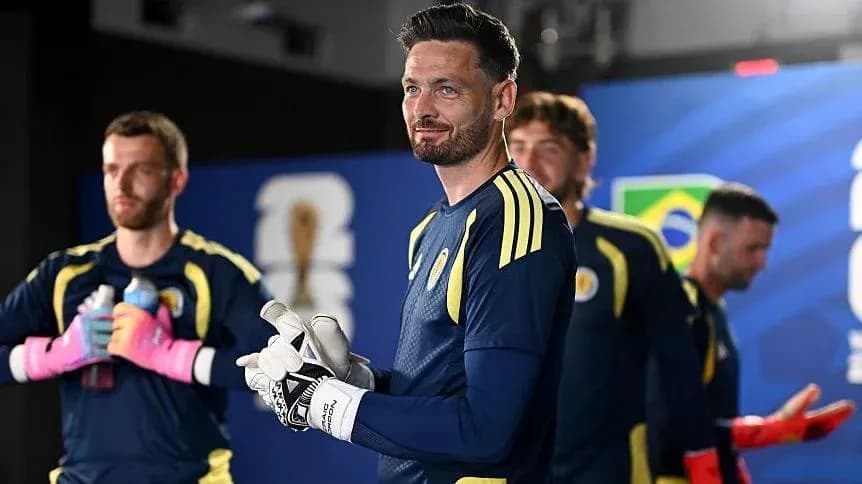
Craig Gordon’s Incredible Comeback: Overcoming Injury at 39
By the time Craig Gordon walked away from international football at a World Cup, his story already belonged in the realm of the improbable. A double leg break at 39 should have been the full stop. Instead, it became a comma.
Former striker Rory Loy, who knows that injury in all its brutality, did not dress it up on the BBC’s Scottish Football Podcast. He called Gordon’s comeback “incredible” – and for once, that overused word fits.
Loy suffered the same break in his early twenties. That matters. At 20 or 23, careers are still being built, bodies still rebound, and the mind leans naturally towards the future. There is time to gamble, time to hurt, time to heal.
Gordon had none of that luxury.
At 39, with a career already packed with Celtic titles, Hearts heroics and the grind of English football at Sunderland, the shin bone “just snaps basically”, as Loy put it. Then comes the long wait for it to knit, the endless rehab, the doubt. The body doesn’t just heal; it changes.
Loy spelled out the aftermath in stark terms. The break forces a complete reset: how you walk, how you move, how you plant your feet, how you dive. Biomechanics are ripped up and rewritten. He needed orthotics in his shoes just to adapt to a new way of moving. Every step becomes a conscious act, not a habit. Every jump, every twist, a question: will it hold?
Now place that reality onto a goalkeeper in his late thirties, already deep into borrowed time in a position that punishes hesitation. Gordon did not just have to get fit. He had to relearn trust – in his leg, in his body, in his instincts.
That, Loy stressed, is where the scale of the achievement really lies. The physical pain is one thing. The psychological toll is another level entirely. Coming back at all is rare. Coming back to play for Scotland at a World Cup, after that kind of break, at that age, is something else.
It speaks to a mindset that refused to accept the obvious ending. Most players in his situation would quietly fade, take the hint, protect what’s left of their body. Gordon went the other way. He pushed through the layers of rehab, the altered mechanics, the mental scars, and forced one last chapter onto his career.
And then there is the simple football truth that underpins all of this: he was still good enough. Not just a sentimental pick, not a mascot in gloves. Loy was clear about that too. Strip away the romance of the comeback and what remains is the level of goalkeeping, the saves that defined him long before the injury and still followed after it.
That is how Craig Gordon leaves the stage with Scotland: not as a cautionary tale about age and injury, but as the keeper who broke his leg, rebuilt himself, and still made it all the way to the biggest tournament of all before finally calling time.




