Colombia's Tactical Mastery in 1-0 Victory Over Ghana
Colombia’s 1-0 win over Ghana at Arrowhead Stadium in this World Cup Round of 32 tie was a textbook example of territorial control and structured pressing translating into a low-risk knockout performance. Nestor Lorenzo’s side imposed their 4-3-3 from the opening minutes, pinning Ghana’s 4-1-4-1 deep and turning long spells of possession into a constant stream of entries around the box. The statistical gap in shots (20–8), possession (61%–39%) and xG (2.18–0.26) underlined how comprehensively Colombia dictated where and how the game was played, even if the final margin remained narrow.
The key tactical hinge came early, and it involved a bold attacking adjustment. On eight minutes, Jhon Córdoba (OUT) was withdrawn, with Luis Javier Suárez (IN) introduced unusually early for a knockout match. Rather than signalling an injury-driven reshuffle, Colombia used the change to sharpen their movements between the lines. Suárez immediately began operating on the shoulder of Ghana’s centre-backs, stretching depth and opening half-spaces for James Rodríguez and Jhon Arias to exploit.
Within this structure, Colombia’s front three and advanced midfielder rotations were central. Luis Díaz held a very wide and high position on the left, forcing Marvin Senaya and then Alidu Seidu to defend large spaces on the outside. On the opposite flank, Daniel Muñoz pushed aggressively from right-back, with Arias often sliding into the right half-space as an interior playmaker rather than a conventional winger. James Rodríguez, nominally part of the front line, repeatedly dropped into the right interior channel to connect with Jefferson Lerma and Gustavo Puerta, forming a 3-2-5 in possession: Johan Mojica, Davinson Sánchez, Jhon Lucumí as the rest defence line; Puerta and Lerma as the double pivot; then a five-man front of Muñoz, Arias, James, Suárez and Díaz.
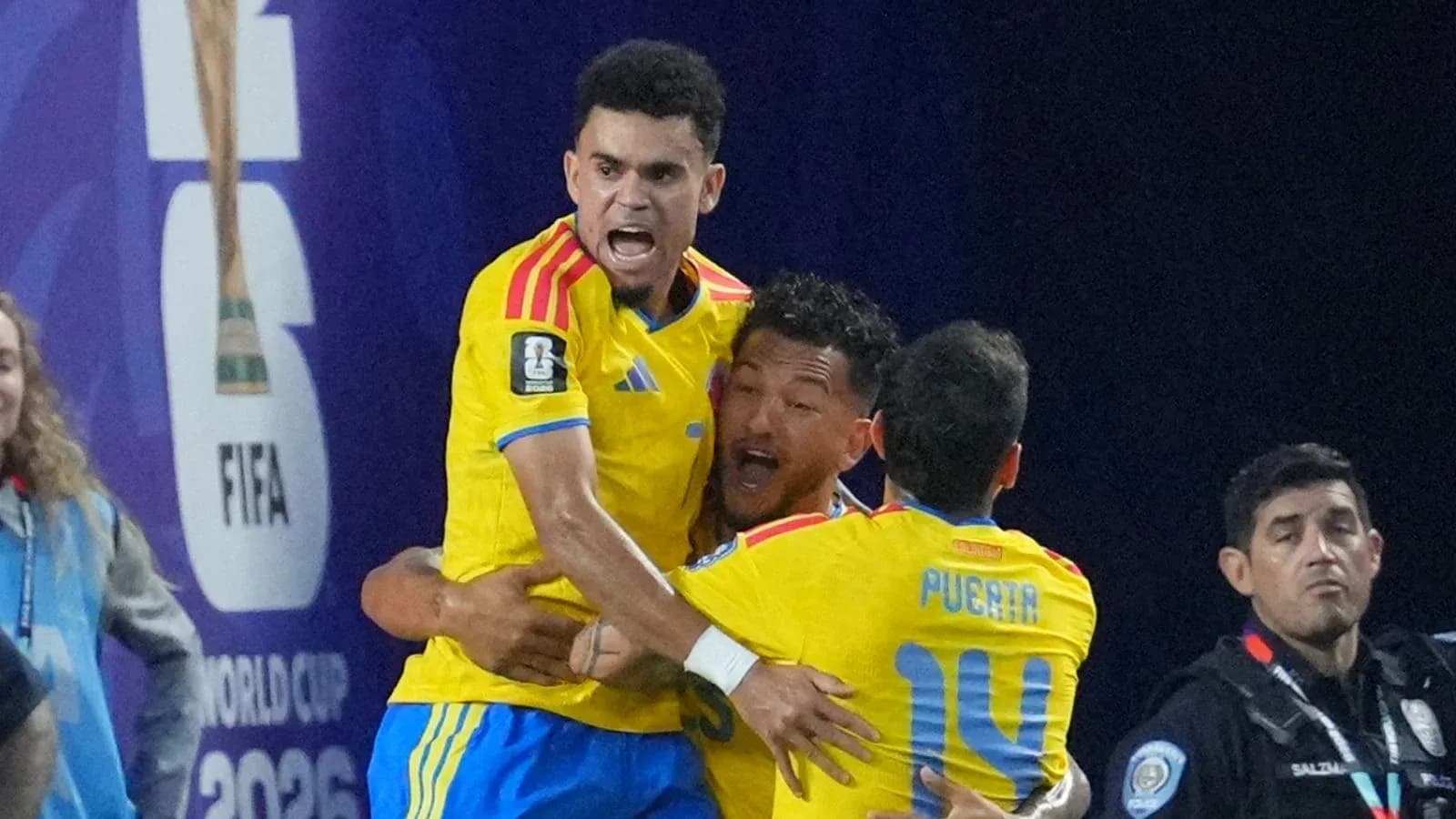
The goal on 14 minutes encapsulated this positional superiority. After Arias had already drawn a yellow card for “Tripping” at 12', he responded by timing his run perfectly from midfield, arriving in the pocket behind Thomas Partey. With Ghana’s single pivot dragged laterally and the back four compressed by Suárez’s depth runs, Arias found space to receive and finish, with Suárez credited for the assist. It was a classic third-man pattern: the early substitution created a more mobile reference point up front, and Colombia immediately cashed in.
Out of possession, Colombia’s 4-3-3 morphed into a compact 4-1-4-1, with Puerta anchoring in front of the centre-backs and Lerma stepping out to press Ghana’s first pass into midfield. The high press targeted Ghana’s full-backs and wide midfielders, particularly Antoine Semenyo and Caleb Yirenkyi, who were forced to receive with their backs to goal. The shot profile tells the story: Ghana managed eight attempts but none on target, with only two efforts inside the box and five blocked. Colombia’s line held relatively high but was well-protected by the work of Sánchez and Lucumí in stepping out to meet Jordan Ayew between the lines, while Muñoz and Mojica were aggressive but disciplined in timing their pressure.
Carlos Queiroz’s 4-1-4-1 for Ghana was designed to offer central stability through Partey as the single pivot and a bank of four ahead of him, but the structure rarely progressed the ball cleanly. With only 376 passes to Colombia’s 586, and an 83% completion rate compared to Colombia’s 91%, Ghana spent long stretches shuttling horizontally or going long under pressure. When Queiroz tried to inject more verticality — bringing on Abdul Fatawu Issahaku for Iñaki Williams at 62' and Elisha Owusu for Kwasi Sibo in the same minute — Ghana did gain a little more presence between the lines, but they still struggled to convert that into penalty-box touches.
The disciplinary pattern also reflected the game’s tactical tension zones. Ghana collected three yellow cards, all in midfield or wide defensive areas: Caleb Yirenkyi for “Holding” at 49', Issahaku for “Unsportsmanlike conduct” at 66', and Seidu for “Tripping” at 76'. Each came as Colombia’s attackers tried to spin away in transition or break the first line of pressure. Colombia’s two bookings — Arias for “Tripping” and Richard Ríos for “Tripping” at 78' — came from counter-pressing situations where they were willing to risk fouls to prevent Ghana from escaping into open field.
A crucial subplot was Colombia’s sustained attacking threat versus Ghana’s last-ditch defending and goalkeeping. Colombia produced 20 shots, with 8 on goal and 4 blocked, many of them generated by quick switches from right to left, isolating Díaz 1v1. The disallowed goal for Díaz at 56', ruled out by VAR for offside, was emblematic: Colombia once again manipulated Ghana’s back line with diagonal runs and early crosses, only for the timing to be marginally off. Even so, the repeated penetration forced Ghana’s defensive block to retreat ever deeper, turning their 4-1-4-1 into a 6-3-1 at times as wide midfielders dropped alongside full-backs.
In goal, the contrast in workload was stark. Camilo Vargas (Colombia) did not record a single save, a direct reflection of Colombia’s territorial control and the effectiveness of their block in forcing all eight Ghanaian shots away from the target. By contrast, Lawrence Ati Zigi (Ghana) made 7 saves and, according to the data, produced 1.92 goals prevented — a figure that matches Colombia’s own goals prevented metric and underlines how often Colombia created high-quality chances. Colombia’s xG of 2.18 against only one actual goal underscores that this was not a narrow game in terms of chance creation; it was a narrow scoreline preserved by Ati Zigi’s shot-stopping and Ghana’s emergency defending in the box.
Colombia’s passing structure was the foundation of their dominance. With 586 total passes and 532 accurate (91%), they circulated the ball with patience, repeatedly recycling through Sánchez and Lucumí to shift Ghana’s block. The high pass accuracy reflects both technical quality and the positional security provided by the 3-2 base in possession. Ghana’s 376 passes, 312 accurate (83%), highlight a more direct, reactive approach, often forced by Colombia’s press rather than by design.
From a statistical verdict, the 1-0 scoreline slightly flatters Ghana. Colombia’s superior xG (2.18–0.26), overwhelming shot volume (20–8) and territorial control, combined with Ghana failing to register a shot on target, paint this as a match where the favourite managed risk expertly. The card count — Colombia 2, Ghana 3, total 5 — aligns with a contest where Ghana’s defensive unit was consistently stressed by Colombian rotations, and Colombia’s midfield occasionally overstepped in counter-pressing. In knockout terms, Colombia showed a mature blend of structure and aggression, while Ghana’s resilience, particularly from Ati Zigi, kept them alive far longer than the underlying numbers suggested.