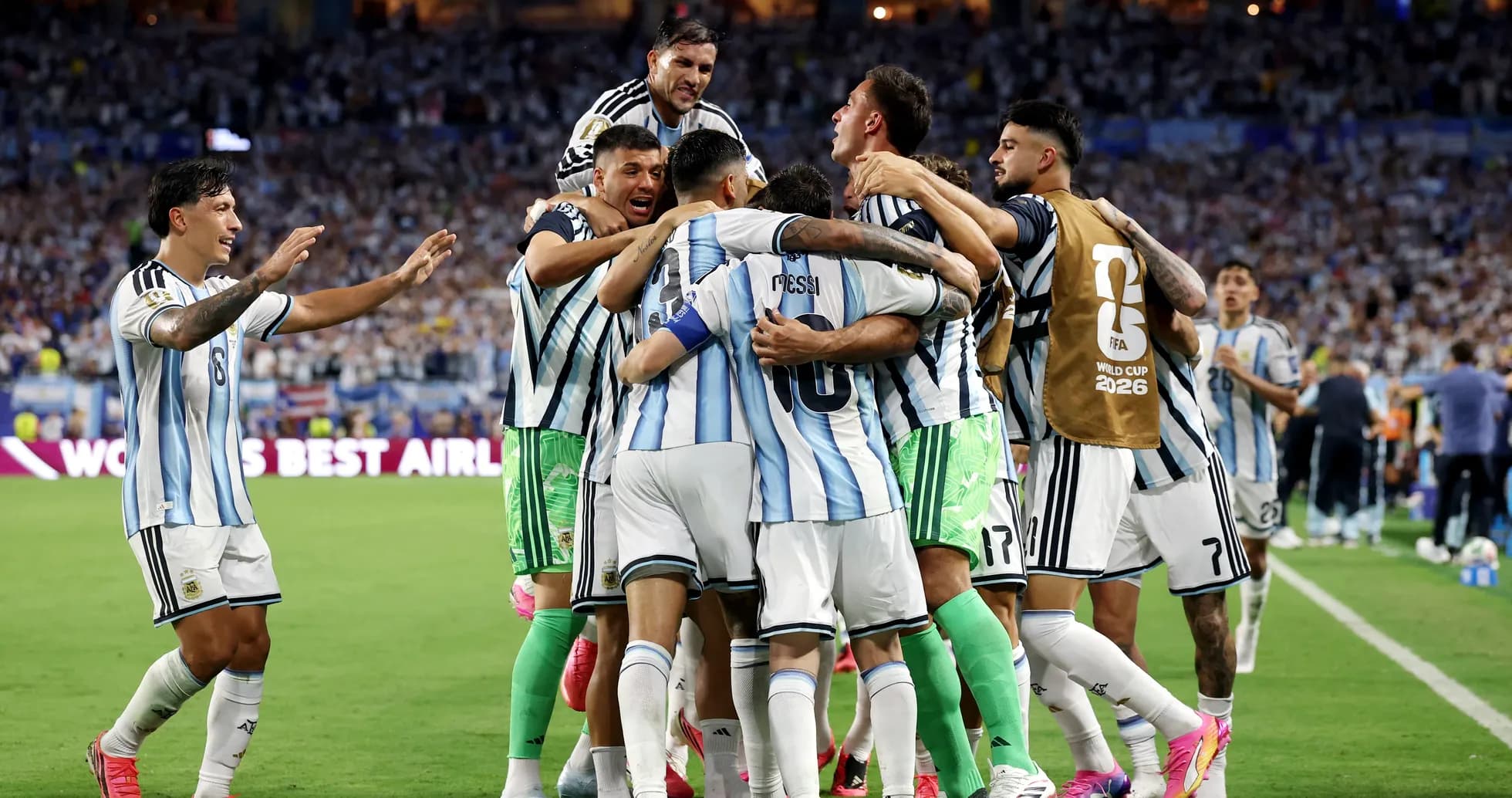
Argentina's Tactical Victory Over Cape Verde Islands in World Cup Round of 32
Argentina’s 2-1 extra-time win over Cape Verde Islands at Hard Rock Stadium in this World Cup Round of 32 tie was a tactical siege that almost slipped away. Across 120 minutes, Lionel Scaloni’s side imposed a dominant positional game, but needed an own goal deep in extra time to finally break Cape Verde’s compact 4-1-4-1 and reach the last 16.
Executive Summary
Argentina controlled territory and possession (64%) from a 4-4-2 base, using their midfield diamond-like rotations to pin Cape Verde back. Cape Verde, under Pedro Leitao Brito, accepted long defensive phases, trusting a disciplined block, transitions through the Duarte–Mendes axis, and a lone forward in Nuno Da Costa to threaten on counters and set pieces. The shot volume (22–16 to Argentina) and xG split (2.16–0.45) underline how one-sided the chance quality was, but Cape Verde’s structure and resilience pushed the game into extra time before Argentina’s pressure finally told.
Scoring Sequence & Disciplinary Log
The game’s first major tactical breakthrough came on 29'. Lionel Messi (Argentina) scored a Normal Goal, assisted by Lisandro Martínez. From a structural point of view, it reflected Argentina’s ability to keep Cape Verde penned in: the centre-backs stepped high, the full-backs were advanced, and Messi dropped into pockets where the 4-1-4-1 screen could not track him cleanly.
Cape Verde’s equaliser at 59' showed their counter-punching design. Deroy Duarte (Cape Verde Islands) finished a Normal Goal, assisted by Ryan Mendes, after Cape Verde finally broke Argentina’s rest-defence line. The 4-1-4-1 became a 4-3-3 in transition, with Mendes exploiting space wide and Duarte arriving from midfield.
At 68', the first card reflected the strain of defending without the ball:
- 68' Kevin Lenini (Cape Verde Islands) — Foul
Argentina’s bench then tried to tilt the game further. At 63', Nicolás González (IN) came on for Thiago Almada (OUT), and Julián Alvarez (IN) came on for Lautaro Martínez (OUT), adding more vertical running around Messi. Cape Verde responded at 67' with Dailon Rocha Livramento (IN) for Nuno Da Costa (OUT) and Jamiro Monteiro (IN) for Laros Duarte (OUT), seeking fresher legs for counters.
Regulation ended 1-1, but extra time opened with a flurry. At 93', Lisandro Martínez (Argentina) scored a Normal Goal, assisted by Alexis Mac Allister, capitalising on sustained pressure and second-ball dominance from set-piece and crossing situations. Cape Verde hit back at 103' when Sidny Lopes Cabral (Cape Verde Islands) scored a Normal Goal with no assist, again underlining their threat when Argentina’s back line had to defend facing their own goal.
Argentina’s decisive moment arrived on 111'. An Own Goal was recorded for Argentina when Diney Borges (Cape Verde Islands) diverted the ball into his own net. Tactically, this was the product of relentless wide overloads and low deliveries into a crowded box, forcing errors from a fatigued defensive line.
The final card of the night came as Argentina managed the closing stages:
- 115' Gonzalo Montiel (Argentina) — Foul
Card totals locked: Argentina 1 yellow, Cape Verde Islands 1 yellow, Total 2.
Tactical Breakdown & Personnel
Scaloni’s 4-4-2 behaved more like a 4-3-1-2 in possession. Enzo Fernández and Alexis Mac Allister formed the central axis, with Rodrigo De Paul often shuttling into half-spaces and Thiago Almada providing width and interior connections. Messi operated between the lines, while Lautaro Martínez stretched depth. This structure allowed Argentina to sustain attacks, reflected in 849 passes, 779 accurate (92%), and 15 shots inside the box.
Out of possession, Argentina defended in a 4-4-2 mid-block, with Messi and Lautaro Martinez screening Cape Verde’s single pivot, Kevin Lenini. Because Cape Verde rarely committed many players forward, Argentina’s centre-backs, Cristian Romero and Lisandro Martínez, could hold an aggressive line, stepping into midfield to keep pressure on the ball and compressing the pitch.
Cape Verde’s 4-1-4-1 was fundamentally about density and discipline. Lenini anchored in front of the back four, with Laros Duarte and Deroy Duarte shuttling to close Messi’s space. Wide midfielders Ryan Mendes and Jovane Cabral dropped deep to form a temporary back six, leaving Nuno Da Costa isolated but ready to run channels when turnovers occurred. Their 476 passes (408 accurate, 86%) show they were not purely reactive; they tried to string attacks together when possible, but their main offensive value came from quick, direct transitions and set-piece situations.
In goal, Emiliano Martínez (Argentina) made 3 saves. The negative goals prevented figure (-0.6) indicates that, relative to the shot quality he faced, he slightly underperformed expectation, though Cape Verde’s xG of 0.45 suggests the danger was limited and mostly from low-probability efforts. At the other end, Vozinha (Cape Verde Islands) made 8 saves. Despite his own negative goals prevented metric (-0.6), he was central to keeping Cape Verde in the game as Argentina piled up 10 shots on target and 7 blocked shots; repeated interventions on crosses and mid-range efforts delayed the decisive blow until extra time.
Substitutions altered the game’s rhythm. For Argentina, Nicolás González’s introduction added width and directness on the left, forcing Cape Verde’s block to shift deeper and wider. Julián Alvarez’s energy increased Argentina’s first line of pressure, limiting Cape Verde’s ability to play out and contributing to the high shot volume. Later, Leandro Paredes (IN) for Rodrigo De Paul (OUT) at 84' brought fresh legs and ball circulation, while Nicolás Tagliafico (IN) for Facundo Medina (OUT) at 86' refreshed the left-back role for the extra-time push. Gonzalo Montiel (IN) for Nahuel Molina (OUT) at 104' was a like-for-like switch to maintain defensive stability and crossing threat on the right in a physically demanding final phase.
Cape Verde’s changes were more about maintaining defensive intensity. Dailon Rocha Livramento (IN) and Jamiro Monteiro (IN) at 67' provided fresh running and some ball security in transition. Hélio Varela (IN) for Jovane Cabral (OUT) and Willy Semedo (IN) for Ryan Mendes (OUT) at 80' kept their wide outlets fresh, while Gilson Tavares (IN) for Kevin Lenini (OUT) and Yannick Semedo (IN) for Deroy Duarte (OUT) at 100' subtly shifted them towards a more front-loaded, riskier shape as they chased a shock progression.
The Statistical Verdict
The numbers support the tactical story of Argentine control against a stubborn underdog. Argentina’s 64% possession, 22 total shots (10 on goal, 7 blocked), and xG of 2.16 point to a side that consistently advanced the ball into dangerous zones and forced Cape Verde to defend deep for long stretches. Their passing volume and accuracy (849 passes, 92%) underpinned a patient, circulation-heavy approach that gradually wore down the Cape Verde block.
Cape Verde’s 16 shots, 5 on target, and xG of 0.45 reveal that while they created moments, they rarely generated high-quality chances. Much of their threat came from distance or semi-chaotic situations rather than sustained positional attacks. Their 8 corner kicks indicate they did manage to reach the final third, but Argentina’s defensive structure largely limited clear looks at goal.
Discipline was balanced (one yellow card each), underscoring that this was more of a positional and physical battle than a bad-tempered one. Ultimately, Argentina’s superior structure, depth from the bench, and ability to maintain attacking pressure across 120 minutes justified their narrow 2-1 extra-time progression, even if the decisive blow came via an own goal rather than a crafted finish.