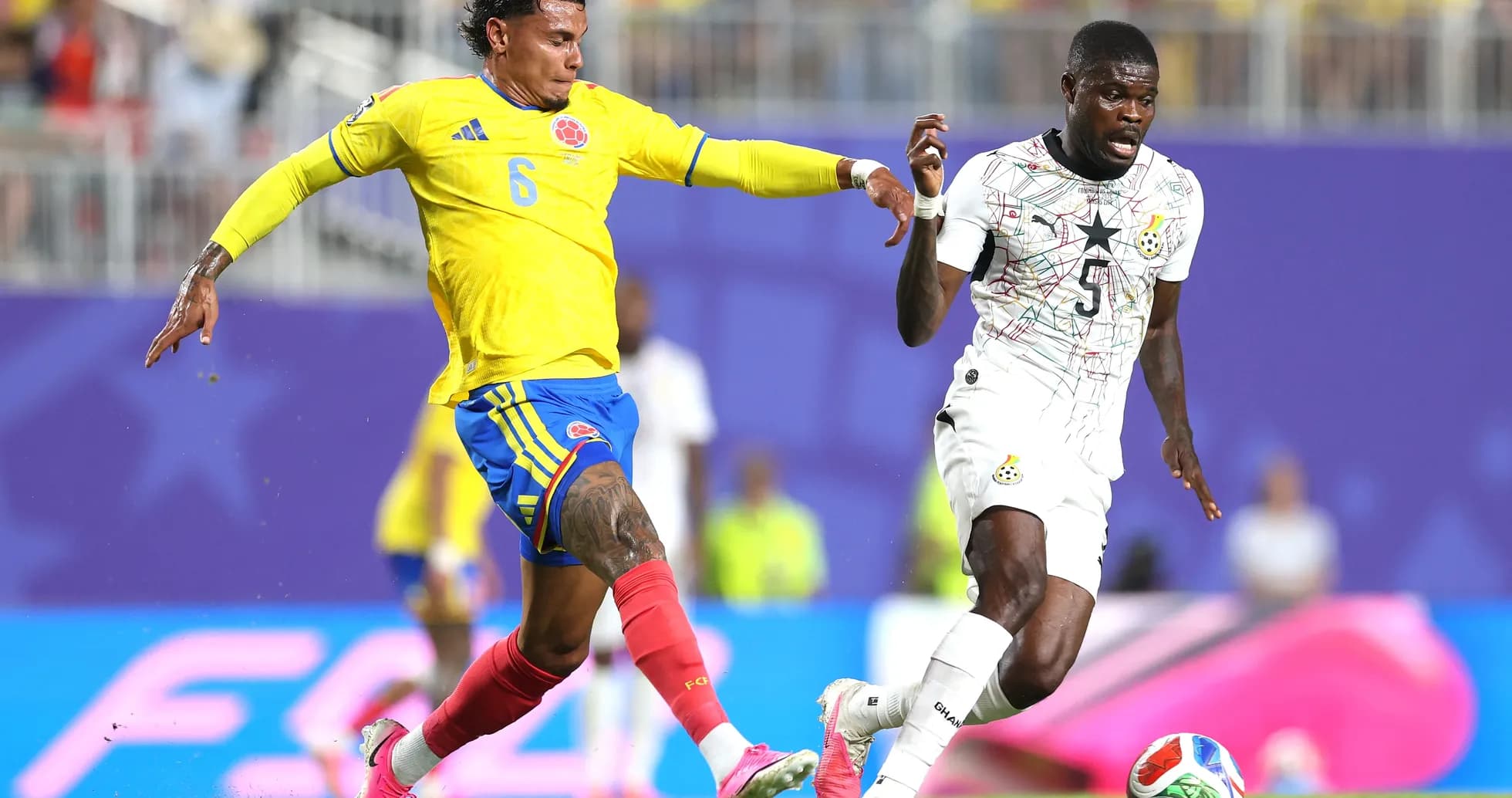
Colombia Defeats Ghana 1-0 in World Cup Round of 32 Clash
Under the Kansas City night sky, Arrowhead Stadium staged a World Cup Round of 32 tie that always felt like a clash of identities as much as of nations. Colombia arrived as group winners from Group K, carrying 7 points and a goal difference of 3 after 3 matches, unbeaten and increasingly sure of their tournament skin. Ghana, third in Group L with 4 points and a goal difference of 0 from their own 3 games, came in as the dangerous outsider: a side with scars from defeats, but also the resilience that comes from surviving a tight group.
The 1–0 full-time scoreline in Colombia’s favour matched the broader shape of their campaign. Heading into this game, they had played 4 matches in total at this World Cup, winning 3 and drawing 1, without a single defeat. Their defensive record was the bedrock: just 1 goal conceded overall, with 0 conceded at home-equivalent venues and 1 on their travels. The numbers painted a clear picture of a team that trusts its structure. On their travels they averaged 3.0 goals scored, while at home they were more controlled at 0.7, combining for 1.3 overall. It is a dual personality: ruthless in transition when space opens, measured and methodical when they must break opponents down.
Nestor Lorenzo’s starting 4-3-3 mirrored that identity. C. Vargas in goal sat behind a back four of D. Munoz, D. Sanchez, J. Lucumi, and J. Mojica, a line built less on flamboyance than on positioning and timing. Ahead of them, the midfield triangle of G. Puerta, J. Lerma, and J. Arias formed Colombia’s metronome, while the front three of J. Rodriguez, J. Cordoba, and L. Diaz supplied the colour and incision.
Ghana, under Carlos Queiroz, set out in a 4-1-4-1 that was clearly designed to compress space between the lines and frustrate Colombia’s playmakers. L. Ati Zigi anchored the side from goal, with a defensive quartet of M. Senaya, D. Luckassen, J. Opoku, and G. Mensah. In front of them, T. Partey operated as the single pivot, screening and shuttling, while the advanced line of I. Williams, C. Yirenkyi, K. Sibo, and A. Semenyo worked either side of the lone forward J. Ayew.
The tactical voids in this tie were less about absences and more about tendencies. There was no formal injury list, no suspensions; instead, the gaps emerged in how each side handled pressure. Colombia’s disciplinary profile hinted at a side that lives on the edge in key phases. Heading into this game, 33.33% of their yellow cards had come between 0–15 minutes and another 33.33% between 76–90 minutes, with an additional 16.67% deep into added time (91–105). They are aggressive in the opening exchanges and again as the clock winds down, often pressing high and counter-pressing with intensity.
Ghana’s card map told a slightly different story. Their yellows were more evenly spread but peaked between 46–60 minutes at 33.33%, with 16.67% in each of the 16–30, 61–75, 76–90, and 91–105 windows. They tend to grow into games, and their fouls often arrive once they try to step higher and disrupt rhythm rather than simply sit in.
This is where the key matchups took shape.
In the “Hunter vs Shield” duel, Colombia’s collective attack – particularly the interplay of J. Rodriguez and L. Diaz – confronted a Ghanaian defence that had conceded 3 goals overall in 4 matches, all 3 of those on their travels, at an average of 1.0 away but 0.8 overall. Ghana had kept 2 clean sheets in total, one at home and one away, but they had also failed to score twice on their travels, underlining how much pressure their back line was often under when the attack misfired.
J. Rodriguez, operating nominally from the forward line but drifting into pockets, was the creative compass. His relationship with J. Lerma and J. Arias was crucial: Lerma’s ability to hold and recycle possession allowed Rodriguez to roam, while Arias offered vertical surges from midfield. Against them, T. Partey was Ghana’s shield, tasked with closing passing lanes into Rodriguez and tracking the late runs of Puerta from deeper positions.
On the flanks, L. Diaz squared off against M. Senaya and J. Opoku’s channel. Diaz’s direct running and willingness to receive wide and drive inside tested Ghana’s lateral compactness. With Ghana’s 4-1-4-1, the wide midfielders I. Williams and A. Semenyo had to double as auxiliary full-backs in long defensive phases, risking fatigue and late fouls in those same periods where Colombia historically ramped up their intensity.
The “Engine Room” battle was perhaps even more decisive. G. Puerta and J. Lerma against T. Partey and K. Sibo formed a shifting square in the centre. Colombia’s season data showed a side comfortable in controlled matches: 3 clean sheets in total, all at home-equivalent venues, and just 1 match overall where they failed to score. Ghana, by contrast, had failed to score twice on their travels and averaged only 0.3 away goals, 0.5 overall. That imbalance meant that if Colombia’s midfield could pin Ghana back, the African side’s counter-attacking threat would be blunted and Ayew increasingly isolated.
Caleb Marfo Yirenkyi was the wildcard in Ghana’s structure. Already among the tournament’s most card-prone players, with 2 yellows in 4 appearances, he brought both energy and risk to the right half-space. His 70 completed passes at 88% accuracy and his tally of 2 successful blocks underlined his dual role: link player in transition and emergency defender when Ghana sank deep. But his 7 fouls committed hinted at the disciplinary tightrope he walks. Against the trickery of L. Diaz and the subtle movement of Cordoba, one mistimed challenge could have tilted the game’s balance.
From a statistical prognosis, Colombia’s edge was clear even before a ball was kicked. Overall they averaged 1.3 goals scored and just 0.3 conceded per match, while Ghana’s overall profile was 0.5 for and 0.8 against. The South Americans’ biggest away win, 1–3, showcased their capacity to punish space, while their tight 1–0 home wins reflected their comfort in grinding out results like the one that unfolded here.
With neither side having taken or missed a penalty in the tournament so far, the margins were always likely to come from open play and set-pieces rather than from the spot. In that context, Colombia’s superior structure, their late-game intensity, and the creative axis of Rodriguez and Diaz provided the sharper tools. Ghana’s 4-1-4-1, disciplined and combative, could slow the tempo but struggled to generate enough threat to overturn the Colombian defensive wall.
Following this result, the narrative holds: Colombia advance from the Round of 32 as a side whose numbers and eye test align – efficient, hard to break, and increasingly ruthless when it matters most – while Ghana leave with the sense of a team whose organisation is sound, but whose attacking ceiling, particularly on their travels, never quite matched the stage.