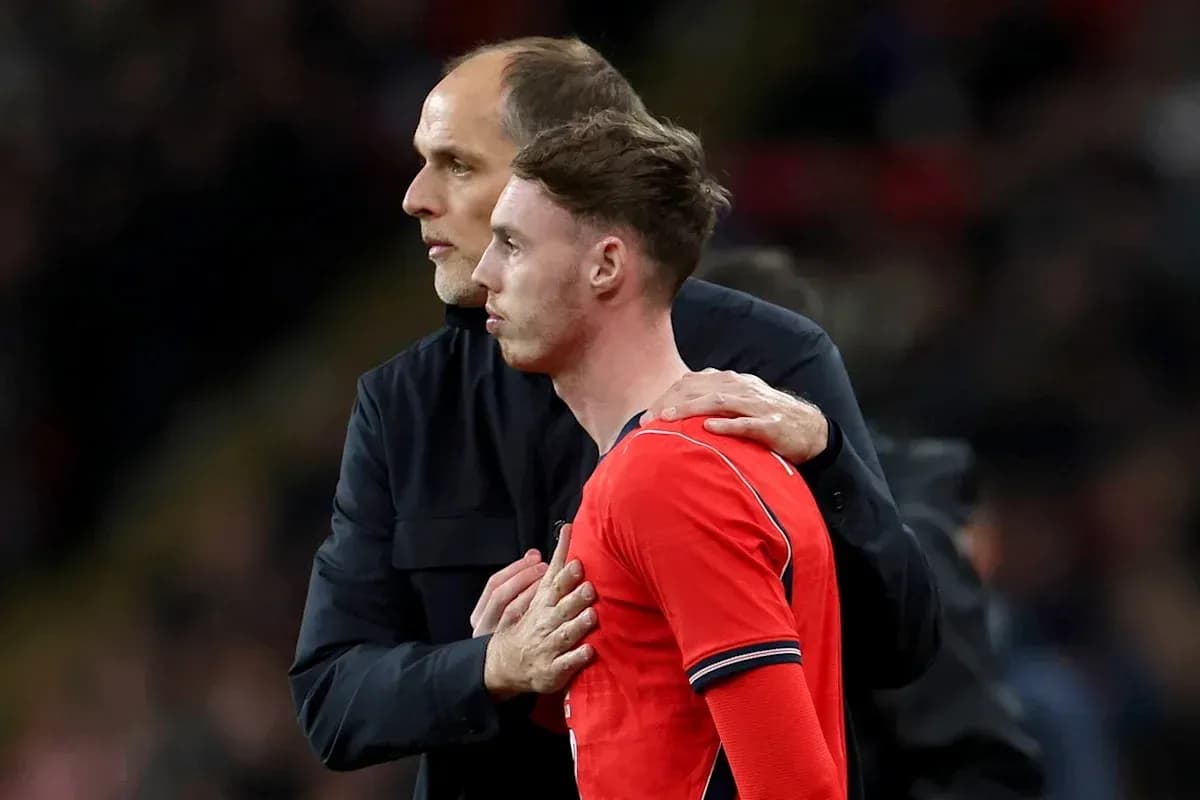
Cole Palmer's Premier League Revival: From World Cup Snub to England's Key Player
Cole Palmer is ripping through Premier League defences again, and the temptation is obvious: rewind two months and ask what on earth Thomas Tuchel was thinking when he left him out of the World Cup.
The evidence has been playing out weekly. The little first-time flick into Joao Pedro against Fulham, followed by that cold, low finish under Bernd Leno. The sudden burst of pace and 20-yard whip past Brighton’s Bart Verbruggen. The way he ghosted to the edges of Hull’s back line, then exploded around them to square for Joao Pedro once more.
This version of Cole Palmer looks undroppable. But this version didn’t exist last season.
The dip that cost him a World Cup
The numbers tell the story of why Tuchel turned away. Palmer had stacked up 42 goal contributions for Chelsea in 2023/24, then another 32 in 2024/25. He was the chaos agent, the problem no defence could quite solve.
Then 2025/26 happened.
His output fell off a cliff: just 14 goal contributions all season, only two of them in the final 12 games. A groin injury disrupted his start and, in truth, he never looked right again. The sharpness dulled. The swagger drained away. The player who had scored four against Brighton the previous year and shredded PSG in the Club World Cup final in New Jersey — the same arena now crowned as a World Cup venue — simply wasn’t there.
Tuchel didn’t ignore that Cole Palmer. That Cole Palmer had vanished.
The England manager still tried to give him a lifeline in March. A chance to rise above his club form. Palmer started against Japan at Wembley and drifted through the game like a man searching for his own reflection. England lost 1-0. Palmer’s trademark glue-like first touch deserted him. His shoulders sagged. He looked like someone who had walked into a room and forgotten why.
So when the World Cup squad was announced and his name was missing, the outrage from the outside never quite matched the reality inside St George’s Park.
Asked this week whether he regretted leaving Palmer at home, Tuchel was blunt.
“No,” he said. “I was very happy with the squad selection. I had a lot of sleepless nights [beforehand]. But I had not one sleepless night about our selection because I was more than seven weeks with this group of players, and they were nothing but fantastic.”
Back in form, back in the squad
Now everything looks different again.
Palmer has forced his way back into the England picture for the 2026/27 Nations League games against Spain, Croatia and Czechia. Not on reputation. On numbers.
“He has his numbers back,” Tuchel said. “He has assists back. He has decisive goals back. So that’s why he’s in the squad, and I think he has a point to prove.”
He has more than that. He has his strut back.
You see it in the way he prowls between the lines, hips loose, scanning for the weak seam in a back four. In the drop of a shoulder that sends a defender off down a dead end. In those deceptive bursts of acceleration that slice through space his languid body language pretends isn’t there.
There is no other player quite like him right now. The long, gangly limbs and sharp elbows somehow always land in perfect sync, like a stick insect with a plan. He doesn’t look like the standard-issue No 10: not the compact, low-centre-of-gravity schemer England have produced for generations.
His football brain feels different too. There’s a fluid, almost un-English improvisation to the way he solves problems mid-move, rerouting in real time as defenders shuffle and close. For an England side that still leans heavily on structure and patterns, that unpredictability is gold.
Beating the competition – with a warning attached
Palmer has not walked back into a vacuum. He has pushed others out of the way.
Phil Foden, bright at the start of the season but sent off in the Manchester derby, has been left out. Fulham’s Joshua King was in the conversation but didn’t make it. Morgan Gibbs-White, outstanding for Nottingham Forest and central to their survival, remains on the outside.
Gibbs-White, Tuchel admitted, was especially unlucky.
“We can see the form that Morgan is in and he ended the season very, very strongly, and was the key player for Forrest to not be relegated. We can see him stepping up now. But it makes no sense to nominate three, four, five No 10s. It just does not help anyone.”
So Palmer is in. But the door is not bolted behind him.
Tuchel made that clear, almost swerving away from the squad discussion just to hammer the point home.
“It is one thing to be nominated, by the way, like with Cole, getting your ticket back in the squad,” he said. “But it’s another thing to perform for England. Especially Cole, he needs to step up when he comes and needs to show these kind of numbers and these kind of performances to get his place, to keep his shirt, to justify the decision.”
Selection is step one. Staying selected is the real test.
The next frontier
For all the noise around his club form, Palmer’s England record is still modest: two goals and one assist in 14 appearances. He could point out that only six of those were starts. He could say rhythm is hard to find when you’re in and out of the XI.
None of that will matter now.
He returns to the national team in the best condition he has been in for a long time: fit, confident, productive, free of the groin problems that haunted him through last season. The World Cup snub still lingers in the background, not as a grievance but as fuel.
Tuchel hinted that this might be the making of him.
“The quality of Cole Palmer, we don’t need to talk about it,” he said. “But [he needs] to show it … There are steps to be taken. The first step is to be nominated. The second step is to fight and perform on the highest level for that shirt.”
The Premier League has already felt the backlash of a year lost. Now comes the real question: can Palmer turn that same edge, that same ruthless creativity, into the heartbeat of his England career?