Canada's World Cup Return: Tactical Insights from the Draw with Bosnia & Herzegovina
Under the Toronto lights at BMO Field, Canada’s World Cup return unfolded as a study in contrast and adjustment. The 1–1 draw with Bosnia & Herzegovina, finished in regular time and locked at 0–1 at half-time before Canada’s second‑half response, leaves Group B finely poised: Canada sit 2nd, Bosnia & Herzegovina 4th, both on 1 point with a goal difference of 0. Following this result, the table says “even”; the tactical story says something more nuanced.
I. The Big Picture – Two 4-4-2s, two very different personalities
Both sides lined up in a 4‑4‑2, but the shapes behaved differently. Jesse Marsch’s Canada used the system as a springboard, with full-backs high and wide midfielders almost as auxiliary forwards. Richie Laryea on the left and Alistair Johnston on the right pushed on from a back four completed by Luc De Fougerolles and Derek Cornelius in the middle, shielding Maxime Crepeau.
Ahead of them, the Canadian midfield band of four had clear roles. Stephen Eustaquio and Ismael Kone formed the central axis: Eustaquio as tempo-setter and first receiver, Kone as the carrier who could step beyond the first line. On the flanks, Tajon Buchanan and Liam Millar were tasked with stretching Bosnia & Herzegovina horizontally, giving Jonathan David and Tani Oluwaseyi room to operate between the lines.
Sergej Barbarez’s Bosnia & Herzegovina mirrored the formation but not the intent. Their 4‑4‑2 was compact, almost old-school in its discipline. Sead Kolasinac, at left-back, was both enforcer and outlet, combining with Amar Memic on that side to offer crossing lanes into the front pair of Ermedin Demirovic and Jovo Lukic. On the right, Amar Dedic stayed a little deeper, forming a conservative triangle with Nikola Katic and Tarik Muharemovic to manage Canada’s right-sided overloads.
Heading into this game, both sides had scored and conceded exactly 1 goal in total, with Canada’s numbers coming at home and Bosnia & Herzegovina’s on their travels. The symmetry in the statistics foreshadowed a contest where margins, not models, would decide the narrative.
II. Tactical Voids and Discipline – Where the cracks appeared
There were no official absentees listed, so the “voids” were structural rather than personnel-based. For Canada, the first-half problem was the gap between midfield and attack. With Bosnia & Herzegovina’s double pivot of Benjamin Tahirovic and Irfan Basic sitting tight, David and Oluwaseyi were often isolated, back to goal, with few third‑man runs from deep. Canada’s 4‑4‑2 at times flattened into a 4‑2‑4 in possession, leaving Eustaquio and Kone outnumbered when Bosnia & Herzegovina broke.
For Bosnia & Herzegovina, the void was higher up. Demirovic and Lukic worked tirelessly, but once the initial counter broke down, there was limited support from wide areas to sustain pressure. The second line stayed conservative, prioritising shape over numbers forward.
Disciplinary trends from the early tournament data underlined the risk profiles. Canada’s yellow cards have been clustered early and just after the interval: 50.00% between 0–15 minutes and 50.00% between 46–60. That speaks to an aggressive start to each half, pressing high and tackling on the front foot. Bosnia & Herzegovina’s bookings are more staggered: 33.33% between 31–45, 33.33% between 46–60, and 33.33% between 91–105, reflecting a side that increasingly fouls as the game grows stretched and emotional.
Individually, the caution list tells its own story. De Fougerolles and Johnston both took yellows, each committing 2 fouls, underlining how much strain Canada’s full-backs were under managing wide transitions. For Bosnia & Herzegovina, Katic, Demirovic and Lukic all saw yellow; Katic’s 2 fouls and 24 duels (15 won) show a centre-back living on the edge to keep Canada at bay, while Demirovic’s 4 fouls hint at a forward line asked to defend from the front, sometimes a step late.
III. Key Matchups – Hunter vs Shield, Engine Room vs Enforcer
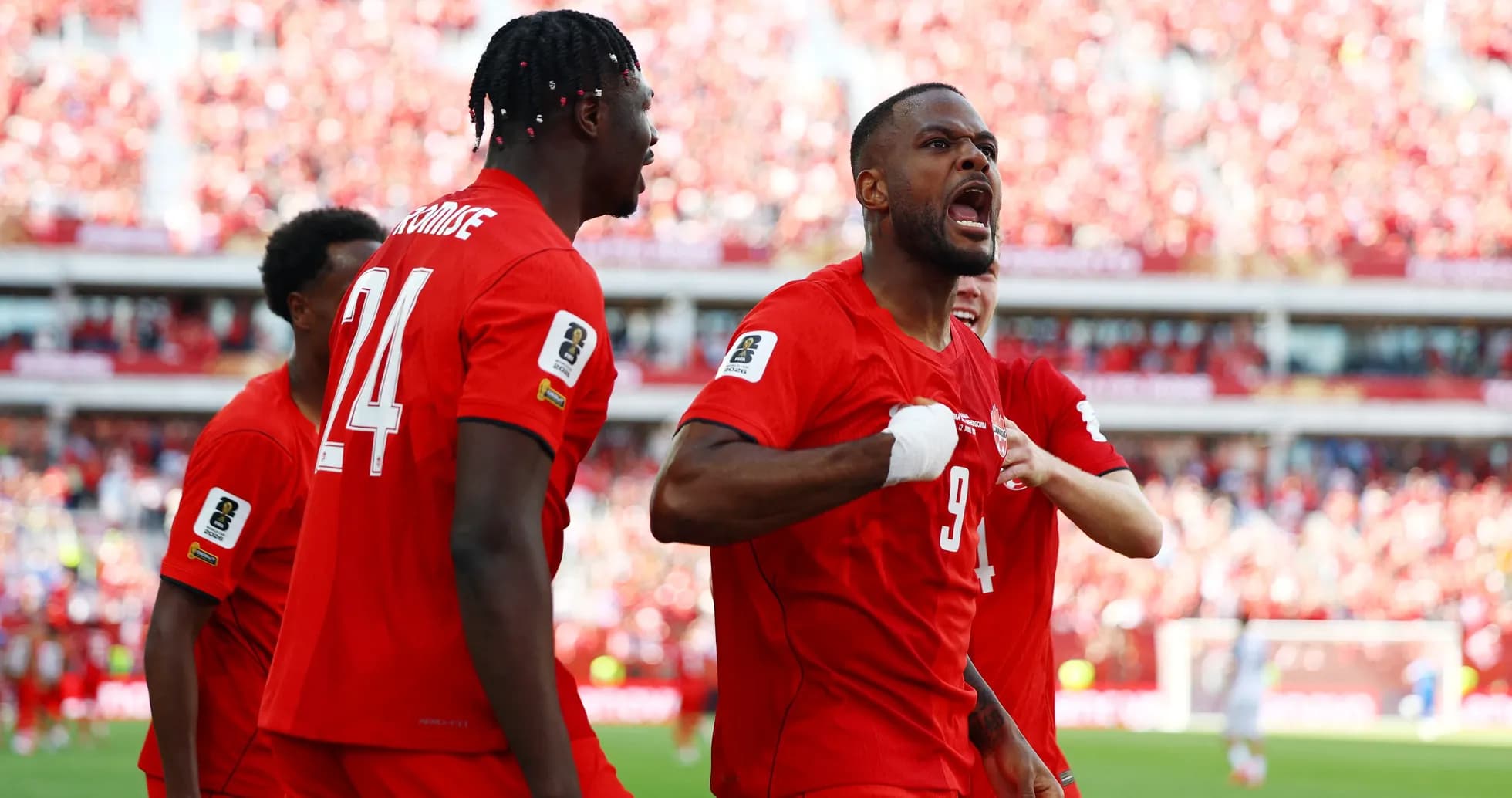
The “Hunter vs Shield” duel emerged clearly in the second half. Cyle Larin, coming from the bench, is already among the World Cup’s top scorers with 1 goal from 1 shot, 1 on target, across 14 minutes. His cameo was the purest expression of penalty-box efficiency: few touches, maximum impact. Against him stood Katic, Bosnia & Herzegovina’s statistical rock. With 5 tackles, 2 blocked shots and 3 interceptions, Katic not only won 15 of 24 duels but repeatedly stepped in front of service aimed at David and, later, Larin. In a microcosm of the match, Larin found just enough space once; for the rest of the evening, Katic’s positioning held.
On the flanks, Kolasinac was Bosnia & Herzegovina’s “Shield with a dagger.” His numbers frame his influence: 21 passes at 71% accuracy, 3 tackles, and 2 blocked shots, plus 1 key pass and 1 assist. He blocked 2 shots, often at critical moments when Canada’s wide players cut inside. His duel with Buchanan and Johnston was one of the game’s defining channels, as Canada tried to overload that side while Kolasinac stepped out aggressively to meet them.
In the “Engine Room,” Eustaquio and Kone faced Tahirovic and Basic. The Canadian pair were tasked with both building and counter-pressing; Bosnia & Herzegovina’s duo with screening and launching. The introduction of Promise David from the bench subtly shifted this balance. Though he did not score, his 1 assist, 1 key pass and willingness to contest 10 duels (winning 3) gave Canada a more vertical reference, allowing Eustaquio to sit a fraction deeper and distribute with greater calm.
IV. Statistical Prognosis – A draw that feels like a framework
Following this result, both teams’ overall numbers are almost eerily aligned: 1 match played, 0 wins, 1 draw, 0 defeats, 1 goal for, 1 against, goal difference 0. Canada at home are averaging 1.0 goal for and 1.0 against; Bosnia & Herzegovina on their travels mirror that with 1.0 and 1.0 respectively. Neither side has a clean sheet, and neither has failed to score.
With no penalties taken and therefore no misses, the margins have come from open play structure and set-piece execution rather than spot-kick variance. Canada’s lack of a clean sheet, combined with yellow-card spikes early in halves, suggests that as they push the defensive line higher to impose themselves, they remain vulnerable to the first ball in behind. Bosnia & Herzegovina’s discipline profile, with bookings spread into the final minutes, hints at fatigue-induced fouls that could, in later group games, tilt tight contests against them.
Projecting forward, the xG story (even if not explicitly quantified here) would likely echo the scoreboard: a narrow Canadian edge in volume, Bosnia & Herzegovina’s edge in clarity of the first-half chances, and parity overall. Canada’s ceiling rises if Marsch can better connect his double pivot to his forwards from the outset, perhaps by starting one of Larin or Promise David to pin centre-backs and free Jonathan David between lines. Bosnia & Herzegovina’s pathway lies in doubling down on their defensive solidity—anchored by Katic and Kolasinac—while finding more consistent support runs beyond Demirovic and Lukic.
As opening chapters go, this was not a declaration of supremacy but a careful laying of foundations. Canada have shown they can change a game from the bench; Bosnia & Herzegovina have shown they can suffer without breaking. In a group where every marginal gain matters, those are two very different, equally valuable truths.