Canada’s 4-4-2 vs Morocco’s 4-2-3-1: Tactical Analysis of the World Cup Match
Canada’s 4-4-2 against Morocco’s 4-2-3-1 at NRG Stadium produced a match where structural ideas were clear, but execution quality sharply diverged in both boxes. Morocco’s 3-0 win in this World Cup 1/8 final was less about volume of chances and more about control of space, tempo, and key moments.
Canada’s shape under Jesse Marsch was aggressive and front‑foot: a flat back four, a hard‑running midfield band of four, and a dual‑forward line of Jonathan David and Tani Oluwaseyi. With 45% possession and 11 total shots (3 on goal), Canada managed to create a reasonable shooting volume, including 7 efforts from inside the box, but the lack of precision in the final action and Morocco’s compactness meant their 0.86 xG never truly translated into sustained threat. The wide midfielders, Tajon Buchanan on the right and Ali Ahmed on the left, were asked to push high in and out of possession, but this left the full-backs, especially Richie Laryea, repeatedly exposed to Moroccan counters and combinations down the flanks.
Morocco’s 4-2-3-1 under Mohamed Ouahbi was built on control and vertical efficiency. With 55% possession and a lower shot count (5 total, 4 on goal), they used the ball with more clarity, reflected in 0.78 xG that they ruthlessly converted into three goals. The double pivot of Ayyoub Bouaddi and Neil El Aynaoui (before Bouaddi’s substitution) provided a stable platform, while the line of three – Bilal El Khannouss, Azzedine Ounahi, and Brahim Díaz – constantly found pockets between Canada’s midfield and defence. Ismael Saibari started as the nominal striker but often dropped to connect play, allowing full-backs Achraf Hakimi and Noussair Mazraoui to provide width and overloads.
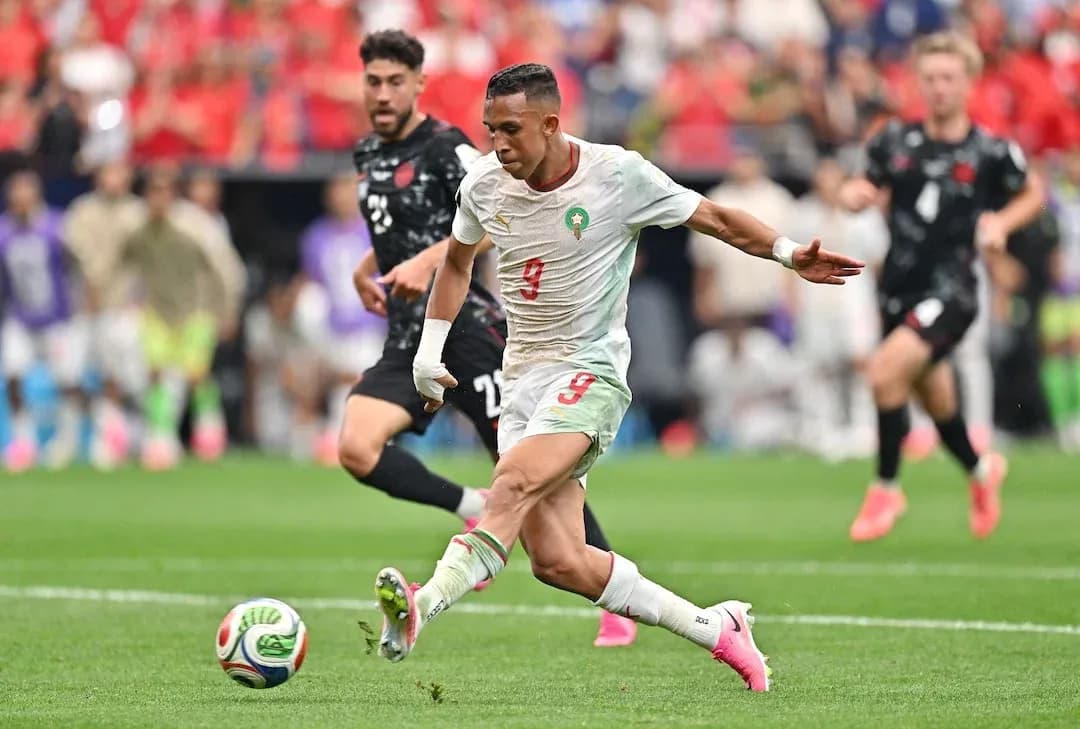
The turning point was the second half, when Morocco began to fully exploit Canada’s stretched lines. Ounahi’s first goal at 50' – assisted by Hakimi – epitomised Morocco’s plan: win the ball, progress quickly through the right side, and find midfield runners arriving from deep against a retreating back line. Canada’s midfield, with Stephen Eustaquio and Niko Sigur centrally, struggled to track these late surges while also dealing with Morocco’s technical circulation. As Canada chased the game, their lines became more disconnected, and Morocco’s attacking midfielders found even more freedom.
Substitutions reinforced the tactical trends. At 22', Soufiane Rahimi (IN) came on for Ismael Saibari (OUT), giving Morocco a more direct, vertical runner on the last line. Later, at 63', Sofyan Amrabat (IN) replaced Ayyoub Bouaddi (OUT), adding a more experienced controller at the base of midfield, while Chemsdine Talbi (IN) came on for Bilal El Khannouss (OUT), keeping fresh legs in the half‑spaces. These changes helped Morocco manage Canada’s growing urgency and maintain counter-attacking threat.
On Canada’s side, the 63' change – Cyle Larin (IN) for Tani Oluwaseyi (OUT) – was a like‑for‑like adjustment aimed at adding penalty‑box presence rather than altering the structure. Later, at 78', Jacob Shaffelburg (IN) for Richie Laryea (OUT) and Promise David (IN) for Ali Ahmed (OUT) pushed even more attacking profiles onto the pitch, effectively turning the wide areas into winger‑dominated channels. At 87', Jayden Nelson (IN) for Tajon Buchanan (OUT) and Jonathan Osorio (IN) for Niko Sigur (OUT) further tilted Canada forward, but by then Morocco were firmly in a low‑to‑mid block, happy to absorb and break.
The second and third Moroccan goals highlighted how this dynamic played out. At 82', Ounahi struck again, this time assisted by Brahim Díaz, who had increasingly dictated transitions by carrying the ball through the middle third and releasing runners at the right moment. Deep in added time at 90+8', Rahimi capped the performance with Morocco’s third, again fed by Brahim Díaz, underlining how Morocco’s attacking midfielders and wide forwards profited from the spaces Canada left as they pushed bodies forward.
Discipline and Fouls
Discipline also shaped the match’s rhythm. There were eight yellow cards in total: Morocco 4, Canada 4. Chronologically, the list is:
- 20' Redouane Halhal (Morocco) — Foul
- 40' Richie Laryea (Canada) — Argument
- 40' Achraf Hakimi (Morocco) — Off the ball foul
- 43' Jonathan David (Canada) — Foul
- 45' Azzedine Ounahi (Morocco) — Foul
- 45+6' Bilal El Khannouss (Morocco) — Foul
- 49' Luc De Fougerolles (Canada) — Foul
- 67' Cyle Larin (Canada) — Foul
Canada’s 24 fouls versus Morocco’s 14 reflect a reactive, often late‑to‑the-ball defensive posture, especially once chasing the deficit. Cards to forwards Jonathan David and Cyle Larin for “Foul” underscore how Canada’s front line resorted to breaking up Moroccan build‑up from behind, rather than pressing in a synchronised manner.
With the ball, the passing data underlines Morocco’s superior control: 472 total passes, 389 accurate (82%), compared to Canada’s 357 passes, 272 accurate (76%). Morocco’s higher accuracy and volume allowed them to dictate tempo and choose when to accelerate. Canada’s more direct approach produced 11 shots and 11 corners, but many of those set‑pieces came from forced, hurried attacks rather than well‑constructed sequences.
Defensively, the contrast in compactness was stark. Morocco conceded 7 shots inside the box but blocked none, relying instead on positioning and lane denial to funnel Canada into less dangerous attempts and poor angles. Canada, by contrast, registered 3 blocked shots, a sign of last‑ditch defending rather than proactive control of the final third. The foul count and card distribution support this picture of a back line and midfield often defending on the edge.
In the end, the xG values (Canada 0.86, Morocco 0.78) show a relatively balanced chance quality on paper, but Morocco’s superior structure, midfield control, and efficiency in exploiting transition moments made the 3-0 scoreline feel tactically coherent. Canada’s aggressive 4-4-2 created volume but lacked the collective precision and rest‑defence needed at this level, while Morocco’s 4-2-3-1, anchored by Ounahi and orchestrated by Brahim Díaz, demonstrated how a team can win convincingly without overwhelming the shot count.