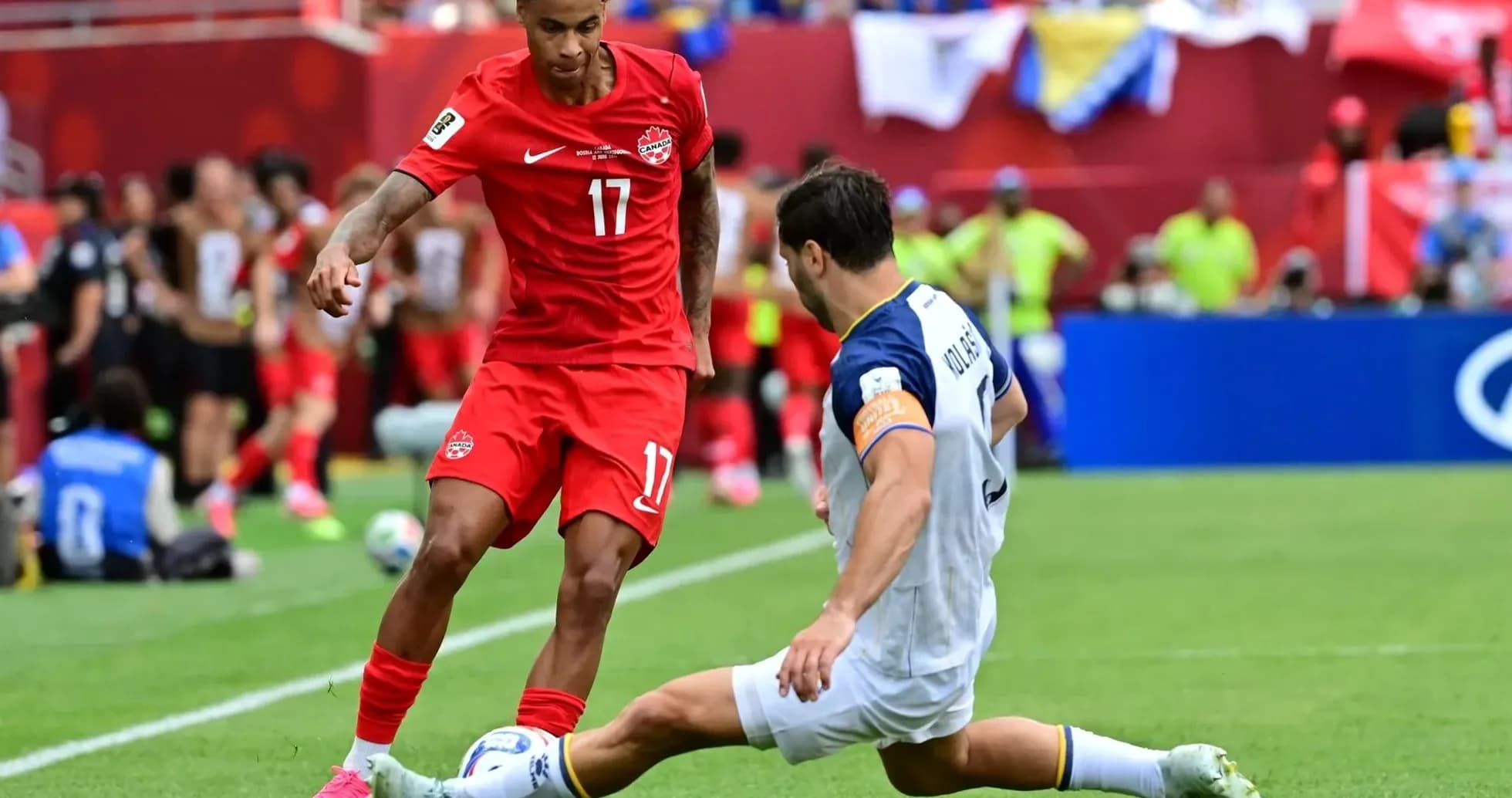
Canada and Bosnia & Herzegovina Draw 1-1: Tactical Analysis
Canada’s 1-1 draw with Bosnia & Herzegovina at BMO Field was a story of territorial dominance versus compact resistance, framed by two contrasting 4-4-2 interpretations and a clear shift in momentum after the hour mark.
Canada, under Jesse Marsch, lined up in a classic 4-4-2 but used it in a front-foot, field-tilting way. With 61% possession and 415 passes (310 accurate, 75%), they built primarily through the full-backs and wide midfielders. Richie Laryea and Liam Millar on the left, plus Alistair Johnston and Tajon Buchanan on the right, pushed high to pin back Bosnia & Herzegovina’s wide midfielders and full-backs. The structure often resembled a 2-4-4 in settled attack, with Derek Cornelius and Luc De Fougerolles holding a high line behind a four-man midfield that tried to overload the half-spaces.
Early on, though, Bosnia & Herzegovina’s 4-4-2 under Sergej Barbarez was more effective. Their block was compact and horizontally tight, with Benjamin Tahirović and Ivan Bašić screening central lanes while the front two, Ermedin Demirović and Jovo Lukić, stayed ready to spring transitions. They were content with 39% possession and 270 passes (172 accurate, 64%), focusing on direct vertical progress rather than sustained circulation. The opening goal at 21' from Lukić, assisted by Sead Kolašinac, encapsulated this: a direct, incisive pattern exploiting Canada’s advanced full-backs and the space behind them.
Defensively, Bosnia & Herzegovina accepted a high foul count (20 fouls, three yellow cards) as the cost of disrupting Canada’s rhythm. Cards for Demirović, Lukić and later Nikola Katić all came for “Foul”, reflecting a strategy of aggressive duels and tactical interruptions, especially as Canada tried to accelerate through the middle third. Their back four, with Kolašinac and Amar Dedić as full-backs, stayed relatively narrow, forcing Canada to circulate wide and then contesting crosses and second balls in the box. That approach limited Canada to 4 shots on goal from 13 total attempts, despite 10 shots inside the box, suggesting Bosnia & Herzegovina were effective at closing down shooting angles late.
Canada’s defensive approach was more about counter-pressing than deep protection. With only 10 fouls and two yellow cards, they tried to win the ball back quickly after losing it rather than breaking up play with repeated contact. However, that front-foot posture left them vulnerable to the kind of direct attacks that led to Lukić’s goal, especially in the first half before they adjusted their rest-defense shape.
Substitutions and Tactical Changes
The game’s tactical hinge came at 61'. Marsch made a triple attacking substitution: Promise David (IN) came on for Jonathan David (OUT), Ali Ahmed (IN) came on for Tajon Buchanan (OUT), and Jacob Shaffelburg (IN) came on for Liam Millar (OUT). These changes injected pace, dribbling and fresh pressing energy into both flanks and the forward line. Promise David’s movement between the lines and into the channels added a different reference point compared to Jonathan David’s more penalty-box-oriented presence.
Bosnia & Herzegovina responded at 62' with their own double change: Samed Baždar (IN) came on for Jovo Lukić (OUT) and Armin Gigović (IN) came on for Ivan Bašić (OUT). Later, at 74', Kerim Alajbegović (IN) came on for Amar Memić (OUT) and Ivan Šunjić (IN) came on for Esmir Bajraktarević (OUT), further tilting their shape toward a deeper, more conservative block with fresher legs in midfield. The late introduction of Dženis Burnić (IN) for Kolašinac (OUT) at 84' reinforced that defensive focus on protecting the wide areas and central box.
From that 61'-62' substitution window onward, the pattern was clear: Canada camped in Bosnia & Herzegovina’s half, Bosnia & Herzegovina defended lower and narrower. Canada’s 9 corner kicks to 4 reflected sustained territorial pressure. The equaliser at 78' was a direct product of the new attacking configuration: Cyle Larin, who had entered at 76' when he replaced Tani Oluwaseyi (OUT), finished a move assisted by Promise David, rewarding Marsch’s decision to refresh his front line. The combination of a classic penalty-box striker with a more mobile support forward finally broke the Bosnian block.
In goal, Maxime Crépeau (Canada) faced 3 shots on goal and made 2 saves, while Nikola Vasilj (Bosnia & Herzegovina) dealt with 4 shots on goal and made 1 save. The negative goals prevented values for both teams (Canada -0.26, Bosnia & Herzegovina -0.26) indicate that each goalkeeper conceded slightly more than the post-shot quality would suggest, reinforcing the sense that the finishing rather than shot volume dictated the 1-1 outcome.
Statistically, Canada’s attacking platform was stronger. Their xG of 1.25 from 13 shots, 10 inside the box, aligned with the eye-test of a side spending long stretches in the final third and forcing Bosnia & Herzegovina to defend crosses and cutbacks. The 4 blocked shots underline how often Bosnian defenders got tight to shooters in and around the area. Bosnia & Herzegovina’s xG of 0.98 from 8 shots (5 inside the box) shows they created fewer but still reasonably dangerous opportunities, primarily through direct play and transition moments rather than long possession spells.
The passing profiles underscore the contrasting game plans. Canada’s 415 passes at 75% accuracy reflect a team comfortable circulating under mild pressure, using width and midfield rotations to probe. Bosnia & Herzegovina’s 270 passes at 64% show more risk in progression and a willingness to go long or vertical early, consistent with their 4-4-2 counter-attacking posture.
Discipline also shaped the tactical landscape. Canada’s two yellows, for Alistair Johnston and Luc De Fougerolles (both “Foul”), did little to alter their approach; they remained proactive without sliding into persistent infringement. Bosnia & Herzegovina’s three bookings, especially Katić’s at 90+3', highlighted the strain of defending deep for long periods and the necessity of stopping late Canadian surges, even at the cost of cards.
Overall, the draw reflects a balance between Canada’s structured, possession-heavy 4-4-2 and Bosnia & Herzegovina’s compact, direct version of the same shape. Canada’s changes and territorial control earned them parity; Bosnia & Herzegovina’s disciplined block and efficient early attacking pattern preserved a valuable point in a high-stakes World Cup group opener.