Brazil vs Norway: Tactical Clash in Round of 16
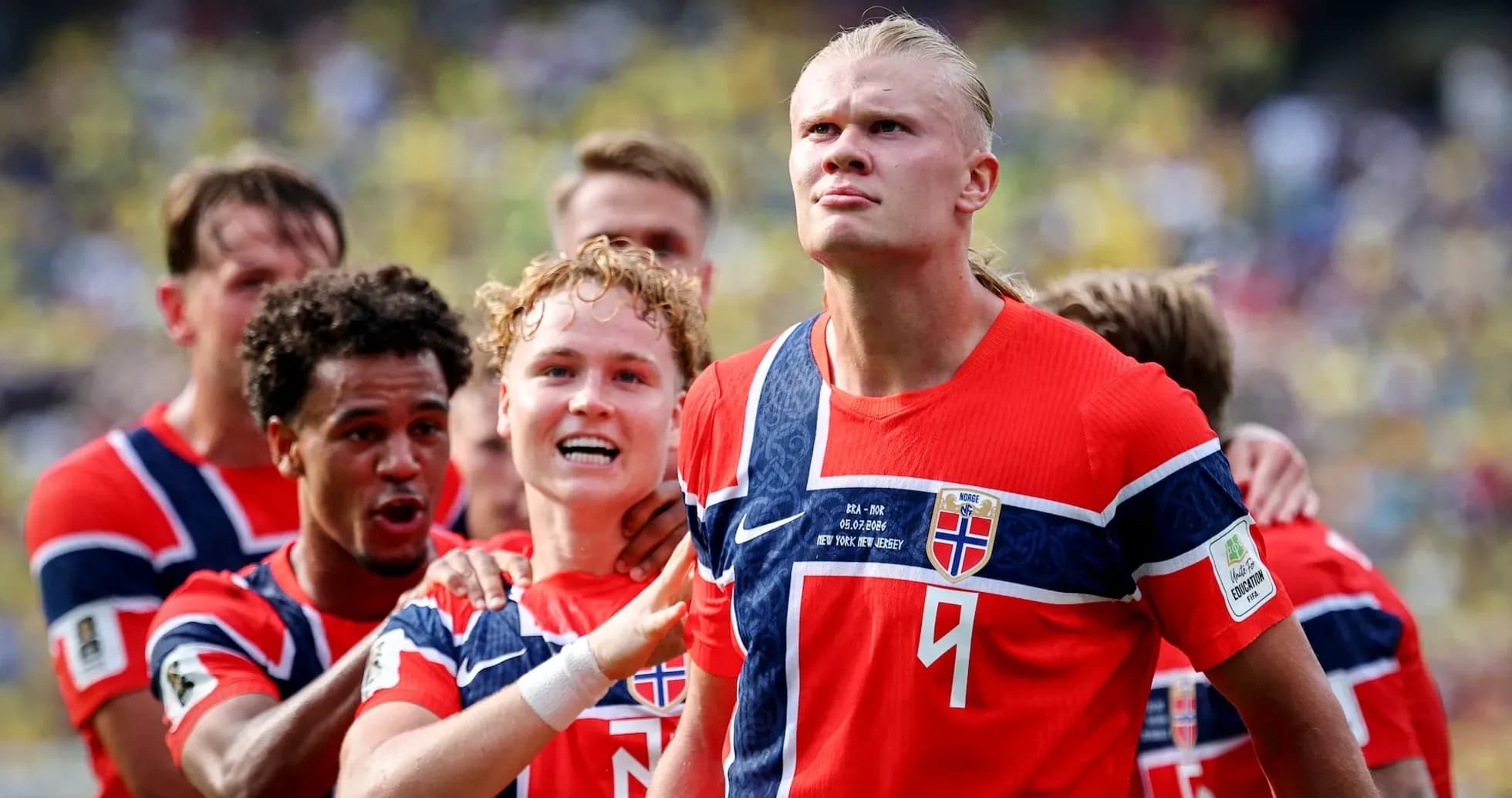
Brazil’s Round of 16 exit at MetLife Stadium was defined by a striking clash of styles: Carlo Ancelotti’s side created the higher-quality chances but were structurally outplayed by a Norway team that controlled space, tempo, and key moments around Erling Haaland.
Norway’s 66% possession and 680 passes set the strategic tone. Stale Solbakken built a patient, circulation-heavy structure with Martin Ødegaard, Sander Berge and Patrick Berg forming a stable midfield triangle in front of a back four that rarely vacated its positions. The aim was clear: use long phases of controlled possession to pin Brazil’s wide players back, prevent transition opportunities for Vinícius Júnior and Matheus Cunha, and ensure Haaland and Antonio Nusa received service in advanced central zones rather than chasing long balls.
Brazil, with only 34% of the ball, were forced into a reactive, transition-based game. Their 14 total shots (10 inside the box) and xG of 2.73 show that when they did break, they carved out very high-quality situations, including two penalties. However, the lack of a coherent pressing scheme against Norway’s build-up meant those situations were too sporadic. The front line rarely locked onto Norway’s first phase, allowing Kristoffer Ajer and Torbjørn Heggem to step out comfortably and feed Ødegaard between the lines.
Early on, the match seemed to tilt towards Brazil’s plan. A VAR-confirmed penalty for Matheus Cunha at 12' and Bruno Guimarães’ missed spot-kick at 14' came from the kind of direct, vertical attacking Ancelotti wanted: quick progression, runners attacking the box, and Norway’s back line briefly exposed. Yet failing to convert that structural advantage on the scoreboard proved decisive; it allowed Norway to remain patient rather than chase the game and open up space for Brazilian counters.
Defensively, Brazil’s back four of Danilo, Marquinhos, Gabriel Magalhães and Douglas Santos were asked to defend long spells without the ball against positional attacks. With only 7 fouls committed, Brazil stayed relatively clean but also lacked the disruptive edge needed to break Norway’s rhythm in midfield. Casemiro and Bruno Guimarães were often stretched horizontally, trying to cover passing lanes into Ødegaard while also tracking Berge’s and Berg’s movements. Norway’s modest shot volume (9 total, 7 inside the box) reflects their patience: they refused low-percentage attempts from distance, instead probing until they could play into Haaland in the area.
In goal, Alisson (Brazil) made 3 saves, while Ørjan Nyland (Norway) produced 4 saves. The goalkeeper data aligns with the tactical picture: Brazil allowed fewer overall attempts but more dangerous ones when their block was broken; Norway, facing more total shots and two penalties, relied on Nyland’s positioning and shot-stopping to keep them in front of the expected goals curve. The goals prevented metric underlines this symmetry: both teams at 0.76, but with opposite narratives—Brazil’s keeper limiting the damage from Norway’s clinical finishing, Norway’s keeper preserving a lead against heavier xG pressure.
Ancelotti’s substitution pattern in the second half showed a clear attempt to rebalance the attacking structure. Endrick (IN) came on for Matheus Cunha (OUT) at 58', adding a more penalty-box-oriented presence. Later, Danilo Santos (IN) for Rayan (OUT) and Neymar (IN) for Gabriel Martinelli (OUT) at 68' shifted Brazil towards a more creative, combination-focused right side, with Neymar dropping between the lines to connect midfield and attack. Éderson (IN) for Bruno Guimarães (OUT) at 79' further freshened central zones, but also slightly reduced Brazil’s control in deeper build-up, leaning more on directness and individual talent.
Norway’s changes were more about maintaining structural integrity than altering their identity. Andreas Schjelderup (IN) for Antonio Nusa (OUT) and Oscar Bobb (IN) for Alexander Sørloth (OUT) at 46' refreshed the attacking band around Haaland while preserving the same positional blueprint: wide forwards tucking inside, full-backs providing width, Ødegaard orchestrating. Fredrik Aursnes (IN) for Julian Ryerson (OUT) at 63' and Leo Østigård (IN) for David Møller Wolfe (OUT) at 90' further solidified Norway’s defensive and midfield density as they protected and then re-established their lead.
The decisive tactical contrast came in the penalty areas. Brazil’s 10 shots inside the box and two penalties reflect a side that repeatedly reached high-value zones but lacked composure and final detail. Norway, with just 7 shots inside the box and an xG of 0.84, maximized almost every clean look they created for Haaland. Their approach was low-volume, high-impact: long stretches of sterile-seeming possession, then sudden, vertical accelerations through Ødegaard into Haaland, who twice converted in critical moments.
Statistically, Brazil’s 329 passes, 279 accurate at 85%, highlight a team forced into shorter, more hurried sequences, often starting from deep and under Norway’s positional pressure. Norway’s 680 passes, 617 accurate at 91%, show a side in full control of tempo, able to reset attacks, pull Brazil’s block from side to side, and manage the game state after scoring.
Ultimately, the statistical verdict underlines a tactical paradox. Brazil “won” the chance quality battle but lost the structural war. Their defensive block allowed too much controlled Norwegian possession, their pressing lacked coherence, and their attacking efficiency deserted them at decisive moments. Norway, by contrast, imposed their possession model, protected their defensive shape, and funneled their limited xG almost entirely into Haaland’s high-probability finishes. In a knockout context, the team that better managed space, tempo, and moments—not just volume of chances—advanced.