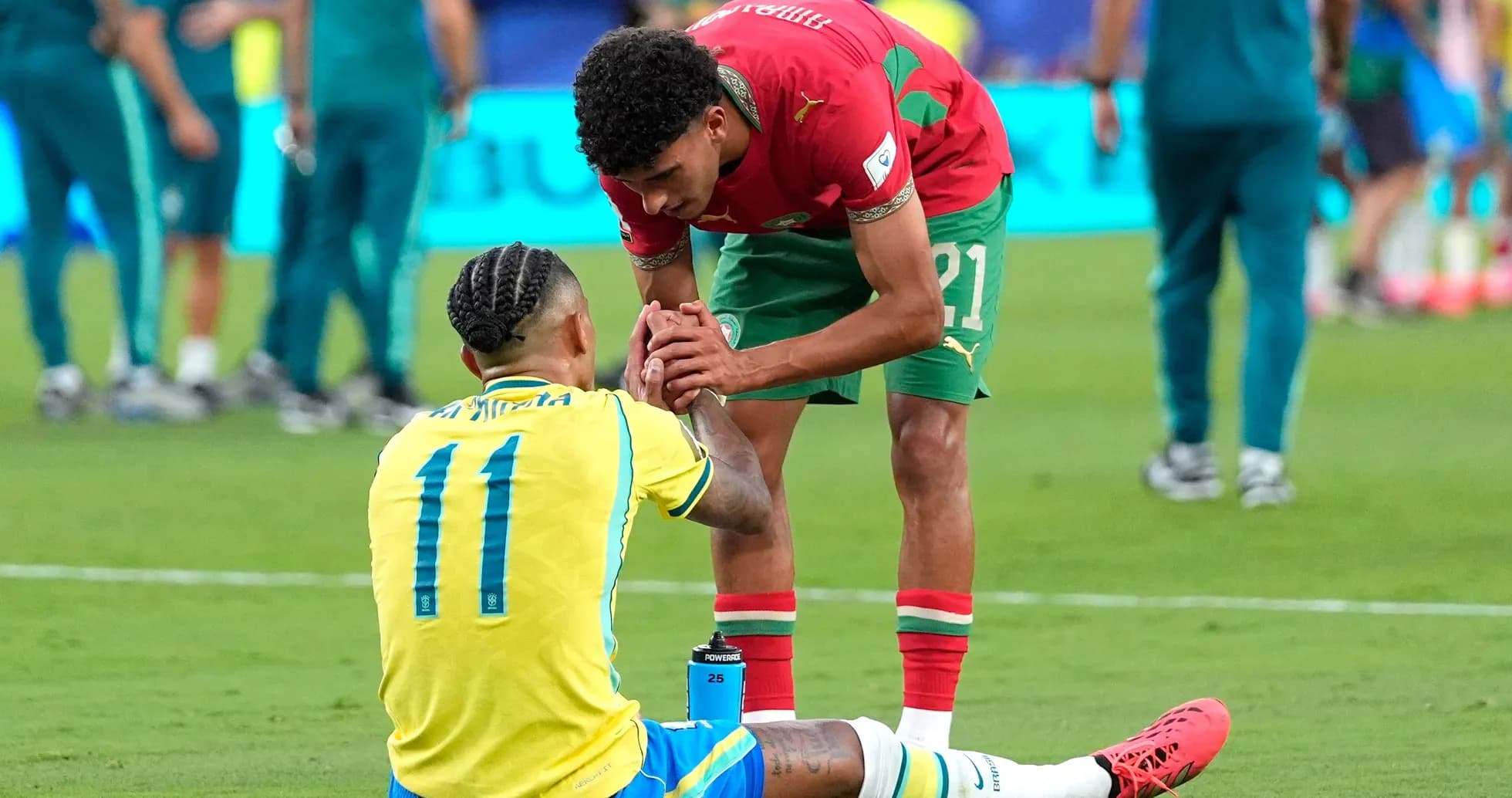
Brazil vs Morocco: Tactical Analysis of a 1-1 Draw
Brazil and Morocco opened their World Cup campaigns at MetLife Stadium with mirrored 4-2-3-1 systems and a 1-1 scoreline that accurately reflected a finely balanced tactical contest. Brazil had marginal territorial and possession control, but Morocco’s structure and transitions repeatedly disrupted Carlo Ancelotti’s side and produced an xG edge (1.28 to 1.24). Both teams showed clear game models: Brazil seeking to dominate through short passing and half-space combinations, Morocco prioritising compactness, vertical breaks and aggressive defending in the last line.
Ismael Saibari’s 21st-minute goal for Morocco, assisted by Brahim Díaz, came from exactly that transition threat: a forward who could stretch the back four and an attacking midfielder arriving between the lines. Brazil’s response on 32 minutes, Vinícius Júnior finishing after a combination with Bruno Guimarães, underlined their own plan to use the left side as the primary creative lane, with the double pivot as the stabilising base.
Team Structures
Structurally, Brazil’s 4-2-3-1 had Alisson in goal behind a back four of Douglas Santos, Gabriel Magalhães, Marquinhos and Roger Ibañez. Casemiro and Bruno Guimarães formed the double pivot, with Vinícius Júnior and Raphinha as wide midfielders, Lucas Paquetá as the central creator and Igor Thiago as the lone striker. In possession, this frequently morphed into a 2-3-5: full-backs stepping high, Casemiro dropping between centre-backs in early build-up, and Paquetá joining the front line between the lines.
Morocco mirrored the base shape but with a different intention. Bono in goal was protected by a line of four — Noussair Mazraoui, Chadi Riad, Issa Diop and Achraf Hakimi — with Neil El Aynaoui and Ayyoub Bouaddi as the double pivot. Ahead, Bilal El Khannouss, Azzedine Ounahi and Brahim Díaz operated as a narrow band of three behind Saibari. Out of possession, this was closer to a 4-4-1-1: El Khannouss often tucked in to form a midfield four, while Díaz floated around the ball to trigger counter-attacks on regain.
Statistical Profile
The statistical profile of the game shows how those ideas played out. Brazil’s 54% possession and 501 total passes (441 accurate, 88%) point to a controlled, ball-dominant approach. Morocco, with 46% possession and 432 passes (375 accurate, 87%), were slightly less ball-heavy but almost as clean technically, confirming that they were not simply a deep-block, clearance side; they could circulate under pressure and reset their shape.
Shot volume was perfectly balanced at 12 attempts each, but the distribution reveals the tactical nuances. Brazil generated 9 shots inside the box and 3 from outside, indicating that their positional play and wide combinations did succeed in penetrating Morocco’s block. However, with only 4 shots on goal and 4 blocked, a good portion of their box entries ended in crowded, low-quality attempts, a credit to Morocco’s compactness and last-ditch defending.
Morocco’s 12 shots split evenly between inside and outside the box (6 and 6), but they managed 2 shots on goal against a Brazil side that generally controlled territory. Their slightly higher xG (1.28 vs Brazil’s 1.24) despite fewer shots on target suggests that when they did create, the chances were clearer — again consistent with a team designed to spring quickly into space rather than patiently chip away at a settled defence.
Double Pivot Battle
The double pivot battle was central. Casemiro and Bruno Guimarães were tasked with both screening transitions and progressing the ball. The two yellow cards for Brazil, both for “Foul” — Casemiro on 37 minutes and Roger Ibañez on 43 — reflect how often they were forced into emergency interventions when Morocco broke the first line. Those bookings also shaped Ancelotti’s second-half plan: at 46 minutes, Danilo (IN) came on for Roger Ibañez (OUT), and Fabinho (IN) replaced Casemiro (OUT). Brazil effectively refreshed the spine of their defensive structure at half-time, aiming for more security against counters and more composure in build-up.
Creative Patterns
On the ball, Brazil’s main creative pattern was the left-sided triangle of Douglas Santos, Vinícius Júnior and Paquetá, with Bruno Guimarães supporting from inside. The equaliser — Vinícius Júnior assisted by Bruno Guimarães — epitomised this: a circulation phase that drew Morocco’s block across, then a decisive action from the left channel into the box. Yet Morocco’s back four, especially Diop and Riad, defended the box aggressively, contributing to their 6 blocked shots and preventing Brazil from converting territorial dominance into a flood of clear chances.
Morocco’s attacking structure hinged on Brahim Díaz’s freedom. Starting as the nominal right-sided midfielder in the 4-2-3-1 band, he frequently drifted inside to overload between Brazil’s lines, linking with Saibari. The opening goal came from this dynamic: Díaz finding space to receive and play forward into Saibari’s movement. After the break, Morocco adjusted their attacking personnel: at 64 minutes, Samir El Mourabet (IN) came on for Azzedine Ounahi (OUT), and Chemsdine Talbi (IN) replaced Brahim Díaz (OUT), trading some creativity for fresher legs and more vertical running to maintain the counter threat.
Later Changes
Later changes further clarified both teams’ intentions. At 61 minutes, Luiz Henrique (IN) came on for Igor Thiago (OUT) and Matheus Cunha (IN) for Lucas Paquetá (OUT), pushing Brazil towards a more direct, forward-heavy look, with additional pace and depth in the front line. On 80 minutes, Danilo Santos (IN) replaced Bruno Guimarães (OUT), signalling a shift towards controlling transitions and preventing late Moroccan breaks rather than pure chance creation.
Morocco’s triple change at 80 minutes — Ayoube Amaimouni Echghouyab (IN) for Bilal El Khannouss (OUT), Anass Salah-Eddine (IN) for Noussair Mazraoui (OUT) — and the later introduction of Soufiane Rahimi (IN) for Ismael Saibari (OUT) at 89 minutes, collectively nudged the team into a more conservative, game-management posture. Fresh full-back legs and a new forward to press and run channels allowed them to protect the draw without abandoning the counter-attacking outlet entirely.
Goalkeeping Performance
In goal, Alisson (Brazil) made 1 save, with 0.46 goals prevented, reflecting a night where he was rarely overworked but still had to handle high-quality moments. Bono (Morocco) produced 3 saves and matched the same 0.46 goals prevented, underlining his importance in preserving the 1-1 scoreline against Brazil’s box pressure and late surges.
Discipline and Conclusion
Discipline tilted slightly towards Brazil: 15 fouls to Morocco’s 14, and the only two yellow cards of the match. This fits the tactical story of a Brazil side repeatedly forced to halt transitions and a Moroccan team whose compactness reduced the need for desperation tackles in dangerous zones.
Statistically, neither side clearly outplayed the other. Brazil’s higher possession, passing volume and box entries show a team capable of controlling games and advancing into dangerous areas, but not yet ruthless in turning structure into shots on goal. Morocco’s similar xG from fewer on-target efforts, plus a superior blocked-shot count and resilient box defending, highlight a side that can absorb pressure and strike with precision. As group-stage openers go, this was a tactically rich draw that confirmed both teams’ identities and left clear areas for refinement before the next round of matches.