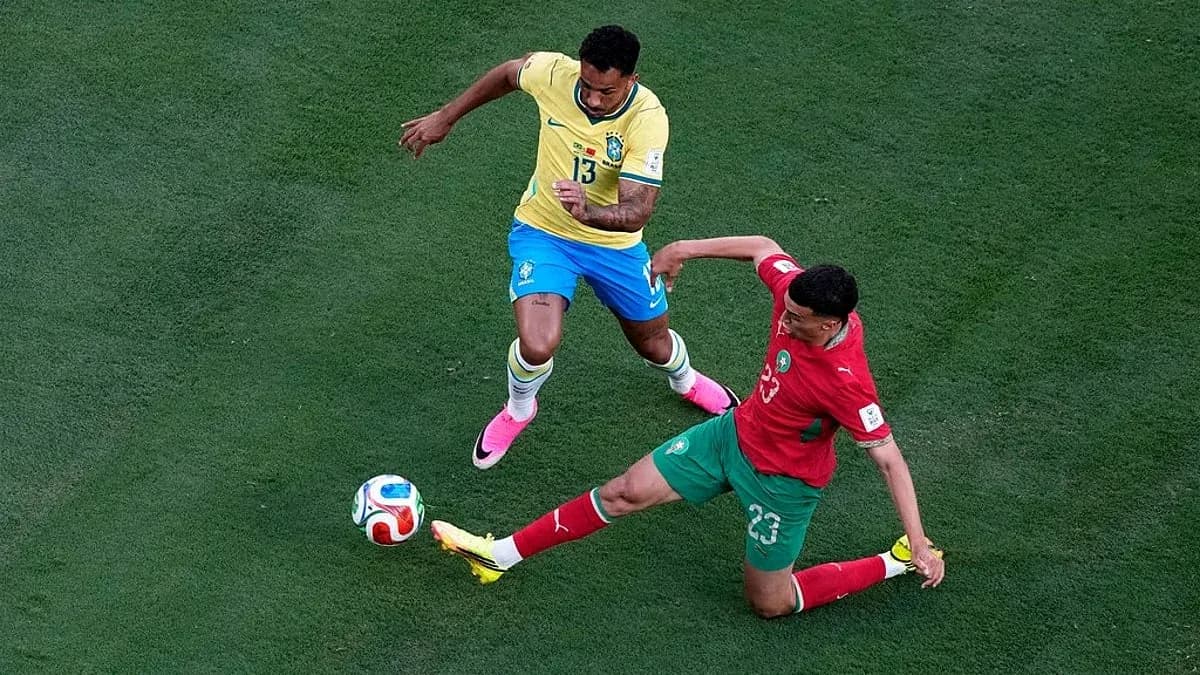
Brazil vs Morocco Match Report: Balanced Draw in World Cup
Brazil 1-1 Morocco at MetLife Stadium leaves Group C finely balanced, with both sides moving to 2 points from two draws and maintaining identical records. Brazil stay second on goal difference behind Morocco, who remain top, as each team’s tally moves to 2 goals for and 2 against, underlining how little separates them early in this World Cup campaign.
Match Report
The game’s first major incident came on 21' as Morocco struck first. A well-timed move through the right half-space ended with a Morocco goal — Ismael Saibari converted from close range (assisted by Brahim Díaz) to make it 0-1, punishing Brazil’s slow defensive rotation.
Brazil responded with greater tempo and were level by 32'. A Brazil goal — Vinicius Junior finished a flowing attacking move (assisted by Bruno Guimaraes), arriving from the left to slot past Bono and restore parity at 1-1.
Brazil’s aggression out of possession started to show in the disciplinary column. On 37', Casemiro (Brazil) — yellow card (Tripping) — was booked for a late challenge as he tried to stop a Moroccan transition. Six minutes later, on 43', Ibanez (Brazil) — yellow card (Tripping) — collected Brazil’s second caution after stepping across his man on the edge of the box, leaving the hosts’ back line walking a tightrope before half-time.
At the interval, Carlo Ancelotti moved quickly to protect his cautioned players and adjust Brazil’s build-up. On 46', Danilo replaced Ibanez (Brazil), a like-for-like defensive change to stabilise the right side. Simultaneously on 46', Fabinho replaced Casemiro (Brazil), freshening the holding role and reducing the risk of a second yellow in midfield.
Brazil continued to seek more vertical threat after the break. On 61', M. Cunha replaced Lucas Paqueta (Brazil), pushing an extra forward profile into the attacking line and altering the shape of the Brazilian press. Just a minute later on 62', Luiz Henrique replaced I. Thiago (Brazil), adding pace and 1v1 ability on the last line as Brazil chased a second goal.
Morocco responded with their own reshuffle on 65', aiming to regain control between the lines and add fresh energy. First, C. Talbi replaced B. Diaz (Morocco), removing the creative ten who had assisted the opener but introducing a more direct attacking option. At the same minute on 65', S. El Mourabet replaced A. Ounahi (Morocco), injecting fresh legs into central midfield to cope with Brazil’s increasing pressure.
As the contest entered its final phase, Morocco focused on defensive solidity and counter-attacking outlets. On 80', A. Salah-Eddine replaced N. Mazraoui (Morocco), a full-back swap to maintain intensity down the flank. Also on 80', A. Amaimouni replaced B. El Khannouss (Morocco), keeping the attacking midfield line fresh for late transitions. Brazil, meanwhile, made their final midfield adjustment at the same moment: on 80', Danilo Santos replaced Bruno Guimaraes (Brazil), a change that slightly reduced Brazil’s progressive passing but offered more legs to guard against Moroccan counters.
The last substitution arrived on 89' as Morocco sought to stretch Brazil in behind on the break. S. Rahimi replaced I. Saibari (Morocco), withdrawing the goalscorer for a fresh forward to chase long balls and press from the front. Despite these late tactical tweaks, neither side could find a decisive second goal, and the match closed at 1-1.
Fixture Statistics & Tactical Audit
- xG: Brazil 1.24 vs 1.28 Morocco
- Possession: Brazil 54% vs 46% Morocco
- Shots on Target: Brazil 4 vs 2 Morocco
- Goalkeeper Saves: Brazil 1 vs 3 Morocco
- Blocked Shots: Brazil 4 vs 6 Morocco
The underlying numbers point to a finely balanced contest, with Morocco marginally ahead on xG (1.28 to 1.24) despite Brazil’s territorial edge and greater share of the ball. Brazil’s attack was more volume-based in terms of efforts on goal (4 shots on target to Morocco’s 2), but Morocco’s shot quality was comparable, reflected in the near-identical xG. Morocco’s higher count of blocked shots (6) underlines a compact and well-drilled defensive block, frequently getting bodies in front of Brazilian efforts. Bono’s 3 saves against Brazil’s 4 efforts on target, compared with Alisson’s single save, suggest Brazil were the more persistent shooters, but not overwhelmingly superior in chance creation. Overall, the 1-1 scoreline aligns closely with the statistical profile: neither side did quite enough in the boxes to justify more than a point.
Standings Update & Seasonal Impact
Both teams entered the match on 1 point with a goal difference of 0 (1 scored, 1 conceded) and extend those patterns after another draw. Brazil move from 1 to 2 points, with their goals for rising from 1 to 2 and goals against from 1 to 2, keeping their goal difference at 0. Morocco follow the same trajectory: from 1 to 2 points, goals for from 1 to 2, and goals against from 1 to 2, also maintaining a goal difference of 0. Morocco remain top of Group C on the existing tiebreak hierarchy, with Brazil second, as both sides consolidate positions already described as advancing to the Round of 32. With each team now on 2 points, the final group match will likely determine whether they progress as group winners or runners-up, with little margin left for error.
Lineups & Personnel
Brazil Starting XI
- GK: Alisson
- DF: Douglas Santos, Gabriel Magalhães, Marquinhos, Roger Ibañez
- MF: Bruno Guimarães, Casemiro, Vinícius Júnior, Raphinha, Lucas Paquetá
- FW: Igor Thiago
Morocco Starting XI
- GK: Bono
- DF: Noussair Mazraoui, Chadi Riad, Issa Diop, Achraf Hakimi
- MF: Ayyoub Bouaddi, Neil El Aynaoui, Bilal El Khannouss, Azzedine Ounahi, Brahim Díaz
- FW: Ismael Saibari
Post-Match Verdict
This was a controlled rather than explosive performance from both sides, with Brazil marginally dominant in territory and passing (54% possession and 501 passes at 88% accuracy) but unable to convert that platform into clear superiority on chance quality (xG 1.24 vs 1.28). Brazil’s attacking structure improved after the early setback, yet their finishing lacked ruthlessness relative to the volume of shots on target (4), while Morocco’s compact defensive shape and high work rate without the ball were underlined by 6 blocked shots and Bono’s 3 saves. Morocco were efficient in transition, generating almost the same expected return as Brazil from fewer shots on target (2), which speaks to the quality of their attacking moments rather than quantity. Tactically, Brazil’s early yellow cards for Casemiro and Ibanez disrupted their defensive rhythm and forced half-time changes that slightly reduced continuity in build-up, while Morocco’s second-half substitutions prioritised defensive stability and counter threat over sustained possession. In the end, a tactically balanced draw reflected two well-organised teams whose structures largely cancelled each other out, leaving Group C finely poised.