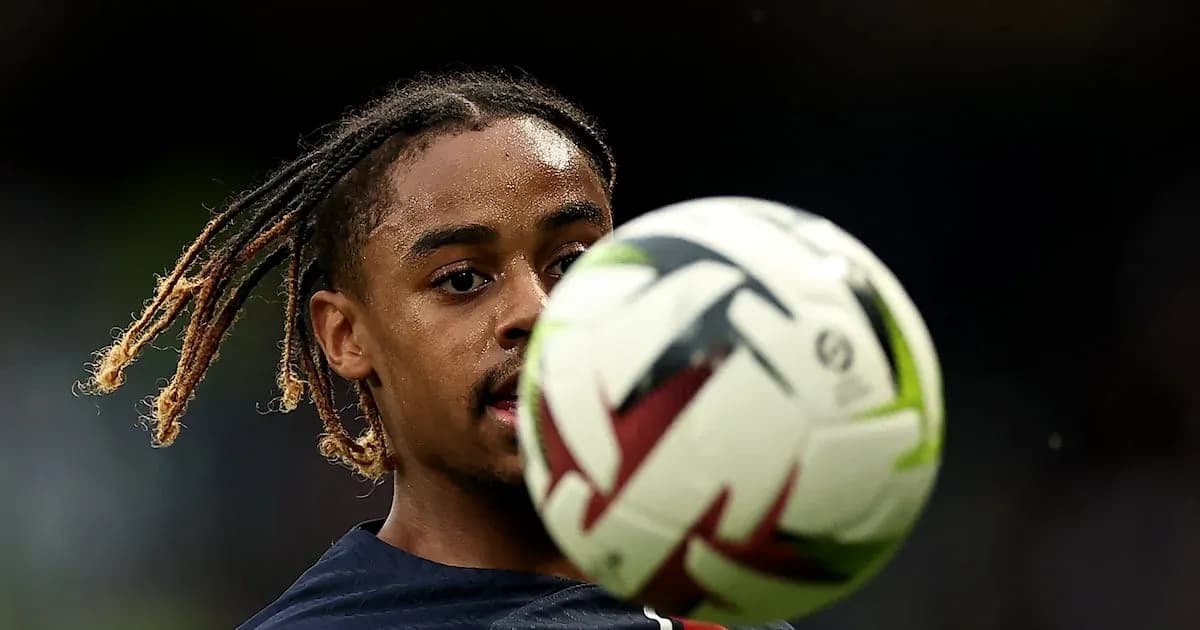
Bradley Barcola: From Lyon Dreamer to Liverpool Record Signing
Bradley Barcola used to talk about Liverpool when he was still a skinny kid at Lyon. Not about PSG, not about Real Madrid. Liverpool.
“As a kid, he always spoke to me about Liverpool,” recalls Amaury Barlet, one of his youth coaches. So when the call finally came from Merseyside this summer, the 24-year-old barely paused. No weighing up options, no drawn-out saga. As he put it in his first interview after completing a £123m (€143m) move to Anfield, he “didn’t ask any questions”.
For Liverpool, it is an era-defining fee. For Barcola, it is the realisation of a teenage obsession.
From late bloomer to record sale
Barcola arrives after three seasons at Paris Saint-Germain, but his story begins at Lyon, the club that shaped him and studied him closely. Each year, returning academy players sit down for interviews, a kind of internal stocktake of ambition and personality. It was in one of those conversations, when he was 15 or 16, that Barlet heard the confession.
“When he was 15, 16, it was his dream [to play for Liverpool],” Barlet says. “Maybe that changed when he was 19 or 20 ...” He pauses. The transfer suggests it never did.
What did change was his status. At PSG, Barcola went from rising star to expensive spare part in a frontline packed with elite names. He started every Champions League game up to and including the last-16 second leg against Chelsea last season, then disappeared from the XI when the stakes rose. He featured in the past two Champions League finals but only from the bench.
Luis Enrique’s decision to start Khvicha Kvaratskhelia ahead of him in the biggest matches was hard to contest. The Georgian’s arrival in January 2025 effectively shoved Barcola down the queue. His limitations across the front line – less convincing on the right, not a natural central forward – narrowed his chances when it mattered most.
Yet his talent kept breaking through. Half of his six goals for France have come on the World Cup stage. He has proved he belongs in the glare.
The timing of his departure suited everyone. A brilliant World Cup in North America inflated his value and helped PSG bank a near €100m profit on a player they signed from Lyon for €45m. He becomes the most expensive sale in the club’s history, surpassing the €90m Al-Hilal paid for Neymar, and a central figure in a summer that brought PSG roughly €350m in player sales – a Ligue 1 record.
Inside the dressing room, he will be missed. Team-mates flooded social media with farewell messages. Crucially, he did not force his way out. Despite his clear desire to join Liverpool, he never downed tools or stirred unrest. His early-season absence from PSG squads, it is understood, was about protecting an asset on the brink of a huge move, not punishing a wantaway forward.
“He’s got good people around him,” Barlet says. He would know. He coached Barcola at under-12 and under-13 level, then again with the under-16s. “His parents always said the same things as us, the coaches ... I know his family. He has the perfect entourage to come through at an academy.”
The evidence is there in the family tree. His older brother Malcolm, now 27, is a professional goalkeeper with Ittihad Tanger in Morocco. Malcolm also came through at Lyon, even if he never made a senior appearance. He blossomed late. By modern standards, Bradley did too.
The boy who took his time
At Lyon, they did not fast-track Barcola. No frantic race up the age groups. No viral clips of a 15-year-old tearing through adults. He stayed with his peers, physically behind the curve, technically ahead of it. He made his first-team debut at 19. Compare that to Rayan Cherki, who broke into the Lyon side at 16, and you see how patient his path was.
“He wasn’t small, but he was ... very fresh,” Barlet says. “He was very thin. He hadn’t yet grown. At under-16s, he played the whole year with us, apart from a couple of games with the under-17s at international level in April-May. He was someone we were waiting to develop on an athletic level.”
Once the growth spurt came, everything accelerated. He debuted midway through the 2021-22 season. One full campaign later, PSG were on the phone, ready to drop €45m.
That late physical development shaped his style. Facing bigger, stronger defenders, he learned to cheat the line, to live on the shoulder.
“Because he was playing against defenders that were stronger than him, he always wanted to get ahead of them,” Barlet explains. “He was very often offside ... he is always someone who has had a habit of making a lot of runs in behind the defence.”
He did not begin as the touchline winger Liverpool fans will see now. “He was a bit of a fox in the box; he scored a lot of goals,” Barlet says. “He scored acrobatic volleys, toe-pokes, left foot, right foot ... it was just his heading that wasn’t necessarily his strong suit.”
The numbers underline his evolution. His standout season came in 2024-25: 21 goals, 21 assists. Yet even with that output, doubts lingered. Pundits picked holes in his finishing, his decision-making, the perceived wastefulness in his game.
One Champions League night against Newcastle in November 2023 became a stick to beat him with. Wasteful in front of goal, he was branded a “little lamb” by a French pundit. The criticism washed over him.
“I didn’t know what was being said about me, but I knew that there would be criticism,” he told Le Parisien. “I don’t pay any attention to it, whether what they say is good or bad.”
He chooses his voices carefully.
“I don’t have many friends. I have very few, in fact, so when they say, ‘You’re doing something stupid,’ it is because they’re right, and if they say that I played well, it’s also because it’s true. I don’t listen to what is said on the outside. To be completely honest, it’s my friends who send me the things [being said] in the media. Sometimes we laugh about it, but it doesn’t go any further than that.”
Loyalty, edge and a move made for Anfield
Those who knew him at Lyon remember a fiercely competitive streak wrapped in a calm exterior. Barlet recalls his tight bond with Castello Lukeba, now at RB Leipzig, and Billy Koumetio, once of Liverpool and now at Charlton.
“He’s a very loyal person,” Barlet says. “When he was young, he had tears in his eyes; he was annoyed when he lost, but he wouldn’t criticise his team-mates. He was more annoyed with himself because he is a real competitor.”
To his old coach, he was “the ideal team-mate” and “endearing”. To Liverpool, he is something more urgent: a solution.
Andoni Iraola has walked into a club with a huge price tag hanging over its newest star and a stuttering start to the season. The combination sharpens the glare on Barcola. He will need the same ability to shut out the noise that sustained him in Paris.
On the pitch, he fits a glaring need. Luis Enrique once called him “one of the best dribblers in Europe”. The Premier League, increasingly obsessed with transition and space, should suit that skill set. Liverpool have laboured against deep defences in recent weeks, short of the kind of one-on-one menace that can unpick a low block or punish teams the moment they open up.
Barcola thrives exactly there, attacking the gaps, breaking lines, turning half-chances into chaos. Liverpool now have a specialist in that art.
Iraola has been clear: he wants his wingers to be “game-changers”. Barcola has spent the past two years auditioning for that role without ever fully owning it. Now, at Anfield, with a childhood dream on his back and a record fee on his shoulders, he finally has centre stage.
What he does with it could shape not just his own career, but the next chapter of Liverpool’s story.