Atletico Madrid Edges Girona 1-0 in Tactical Duel
Atletico Madrid edged a high‑risk, high‑resistance contest 1-0 against Girona at Riyadh Air Metropolitano, a match defined less by territorial control and more by how Diego Simeone’s side managed suffering without the ball. In a La Liga fixture where Girona had the initiative and the better passing rhythm, Atletico’s structure, penalty-box defending and elite goalkeeping turned an xG deficit into three points. The hosts led 1-0 at half-time and preserved that scoreline to full-time, absorbing long spells of pressure but striking with a single, clean attacking pattern that decided a tactically complex game.
Executive Summary
Simeone set Atletico up in a 4-4-2 that played like a compact, vertically aggressive block, willing to concede 53% possession and 25 shots to Girona in exchange for control of central space and counter-attacking lanes. Michel’s 4-2-3-1 for Girona produced superior passing metrics — 475 passes, 427 accurate (90%) — and more shots on goal (11 to Atletico’s 4), but could not find a way past Jan Oblak’s penalty-area command and the disciplined back four. Atletico’s 1-0 win, with only 47% possession and 17 total shots, underlined a game plan built on efficiency in both boxes rather than volume.
Scoring Sequence & Disciplinary Log
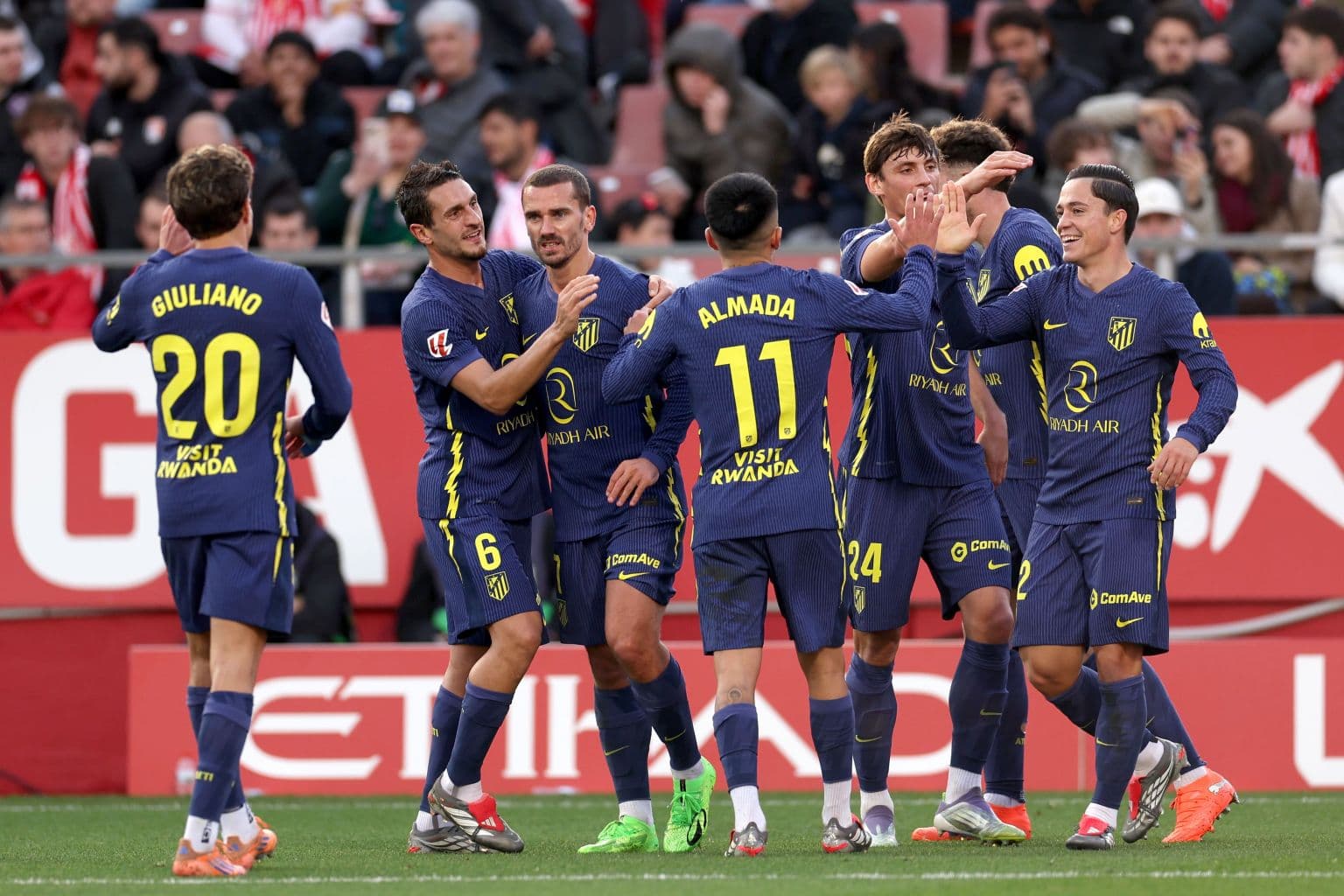
The decisive moment arrived on 21'. Ademola Lookman (Atletico Madrid) finished a “Normal Goal” action, assisted by Antoine Griezmann. The pattern encapsulated Atletico’s offensive idea: Griezmann dropping between the lines from the front two to connect play, then releasing Lookman into a channel where Girona’s high defensive line was exposed. It was Atletico’s clearest attacking sequence and, ultimately, their only goal, but it was enough.
From that point, the match became a test of Atletico’s defensive resilience and Girona’s ability to convert territorial dominance into clear chances. Girona pushed their full-backs high and used Viktor Tsygankov as a reference to pin Atletico’s back line, but Atletico’s compactness inside the box repeatedly forced shots from less-than-ideal angles despite the visitors’ 14 attempts inside the area.
Discipline followed a tight, physical pattern but remained under control. Atletico Madrid collected both of the match’s yellow cards; Girona received none. The chronological disciplinary log is:
- 23' Robin Le Normand (Atletico Madrid) — Foul
- 85' Javi Morcillo (Atletico Madrid) — Foul
Total cards: Atletico Madrid 2, Girona 0, overall 2. Both bookings reflected Atletico’s readiness to break Girona’s rhythm when their block was stretched, especially in transition or when Girona attempted to overload wide zones.
Tactical Breakdown & Personnel
Atletico’s 4-4-2 was built on a narrow, hard-running midfield and a back four that defended the box rather than the halfway line. Jan Oblak in goal was the central figure of this design: 11 goalkeeper saves and 0.61 goals prevented underline how much of Girona’s xG (2.18) was neutralised by his positioning and reflexes. He played as a traditional shot-stopper more than a sweeping distributor, reflecting Atletico’s preference for clearances and second-ball contests over patient build-up.
In front of him, M. Ruggeri and M. Pubill held the full-back zones but rarely advanced simultaneously, prioritising defensive stability. R. Le Normand and D. Hancko protected the central corridor, focusing on duels in the box and aerial clearances. Le Normand’s booking on 23' for Foul came from a calculated intervention to halt Girona’s progression, emblematic of Atletico’s willingness to trade fouls for regained structure.
The midfield four were the tactical hinge. G. Simeone and A. Baena operated from the flanks but often tucked inside to form a dense second line with Koke and O. Vargas, shrinking the spaces between lines where Girona’s 4-2-3-1 typically thrives. Koke’s role as a stabiliser was visible in Atletico’s passing profile: 425 total passes, 359 accurate (84%). The team accepted a lower pass volume than Girona but maintained enough accuracy to escape pressure and find Griezmann between the lines.
Up front, A. Griezmann and A. Lookman were less a traditional strike pair and more a flexible front two. Griezmann dropped into the right half-space to link with midfield, while Lookman attacked depth. The 21' goal — Griezmann assisting Lookman — was the purest expression of that structure: win the ball, find Griezmann in a pocket, then exploit the space behind Girona’s advanced defensive line.
Simeone’s substitutions reinforced this tactical narrative. At 46', Thiago Almada (IN) came on for Giovanni Simeone (OUT), adding more ball retention and carry from midfield while keeping the wide block intact. On 61', Alexander Sorloth (IN) replaced Alex Baena (OUT), shifting Atletico towards a more direct outlet up front, and Javi Morcillo (IN) came in for O. Vargas (OUT), freshening legs in the middle to maintain pressing intensity. On 63', Clement Lenglet (IN) came on for Ademola Lookman (OUT), effectively moving Atletico into a more conservative posture, with added defensive height and box protection to close out the game.
Girona’s 4-2-3-1, with Paulo Gazzaniga in goal, aimed at controlled possession and structured pressure. Gazzaniga faced only 4 shots on goal, making 3 saves, and his 0.61 goals prevented mirrored Oblak’s figure, underlining that the goal he conceded was more about defensive exposure in front of him than goalkeeping error. Girona’s back four — A. Moreno and A. Martinez wide, Vitor Reis and A. Frances centrally — pushed high to compress the field, while the double pivot of A. Witsel and I. Martin tried to dictate tempo.
Michel’s in-game changes sought more direct threat and central penetration. At 56', Cristhian Stuani (IN) came on for B. Gil (OUT), adding a penalty-box target. Simultaneously, F. Beltran (IN) replaced A. Witsel (OUT), injecting mobility and vertical passing from deep. On 63', Claudio Echeverri (IN) came on for J. Roca (OUT), a move aimed at adding creativity between the lines, and at 77', D. Lopez (IN) replaced A. Martinez (OUT) to refresh the left defensive channel. These changes increased Girona’s volume of attacks but ran into Atletico’s reinforced low block and Oblak’s form.
The Statistical Verdict
From a statistical lens, Girona’s overall form in this match — 53% possession, 25 total shots, 475 passes with 427 accurate (90%) — suggests a side that controlled territory and tempo. Their xG of 2.18 indicates they generated enough chances, on paper, to score at least once, but Oblak’s 11 saves and 0.61 goals prevented shifted the outcome decisively in Atletico’s favour.
Atletico’s numbers tell the story of a team that maximised moments. With 17 total shots (4 on goal), 9 corners, and an xG of 1.94, they were not purely reactive; they created a similar quality of chances but from fewer, more selective attacks. Their defensive index in this match — low foul count (7), only 2 yellow cards, and strong penalty-box protection — aligned with Simeone’s traditional identity: concede space, never concede the box. Girona, card-free with 9 fouls, maintained discipline but lacked the final incision. In the end, Atletico Madrid’s 1-0 win at Riyadh Air Metropolitano was a textbook example of tactical suffering, elite goalkeeping, and clinical exploitation of the game’s key attacking moment.