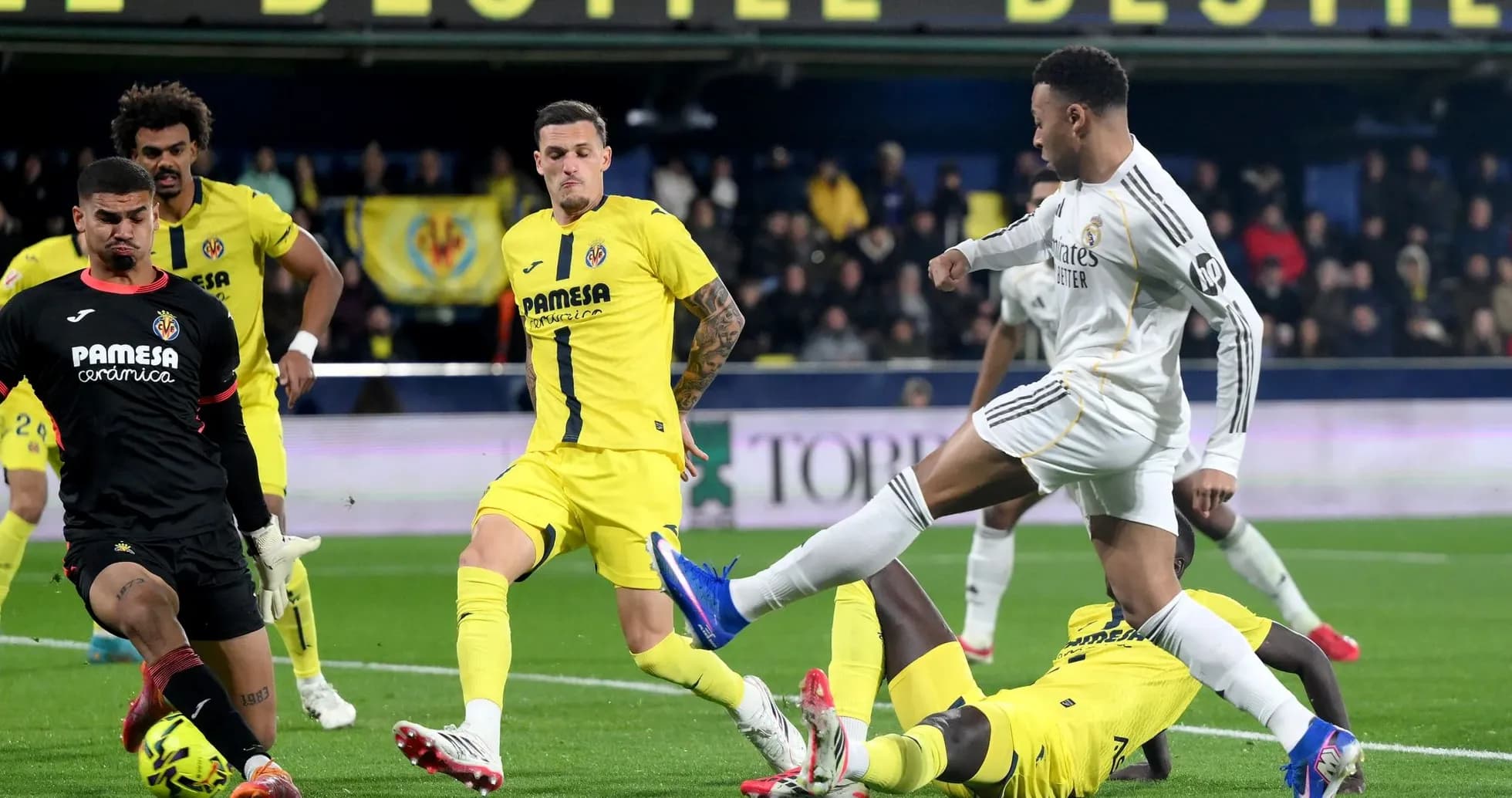
Athletic Club vs Celta Vigo: Tactical Analysis of 1-1 Draw
Athletic Club and Celta Vigo shared a 1-1 draw at Estadio de San Mamés in a match where structure and defensive discipline ultimately outweighed attacking efficiency. The scoreline mirrors the tactical storyline: Athletic’s territorial and chance creation dominance against Celta’s compact, low-volume but highly controlled defensive game. With 58% possession, 26 total shots and xG of 2.53, Ernesto Valverde’s side built a sustained siege but were repeatedly frustrated by a Celta block anchored by Ionuț Radu’s goalkeeping and a disciplined 3-4-3 out of possession that often resembled a 5-4-1. Celta, with only 3 shots and xG of 0.15, leaned fully into a minimalist, counter-punch approach after their early lead.
Opening Exchanges
The game’s tactical axis was defined in the opening exchanges. Claudio Giraldez’s 3-4-3 immediately sought to exploit Athletic’s advanced full-backs. On 4 minutes, that plan paid off: Celta Vigo’s front line, with W. Swedberg, F. Jutgla and B. Iglesias, attacked the space behind Yuri Berchiche and A. Gorosabel. A quick vertical progression through midfield found I. Moriba between the lines; his ability to receive under pressure and play forward was crucial. Moriba slipped a decisive ball into Swedberg, who finished clinically for 0-1. It was a textbook early transition: three passes, direct depth, and exploiting Athletic’s high defensive line before their rest-defense structure had settled.
Inverted Pattern
From there, the pattern inverted. Athletic’s 4-2-3-1 became a territorial machine. Inigo Ruiz de Galarreta and M. Jauregizar (from the base of midfield) orchestrated circulation, while I. Williams, U. Gomez and A. Berenguer formed a narrow, aggressive line of three behind Gorka Guruzeta. The full-backs, Gorosabel and Berchiche, pushed high to pin Celta’s wing-backs S. Carreira and Javier Rueda, forcing Celta into a deeper 5-4-1 without the ball. Athletic’s 19 shots inside the box underline how frequently they managed to access the penalty area through wide overloads and second balls.
Celta's Defensive Strategy
Celta’s response was to compress central zones and accept crosses. Their back three of M. Alonso, Y. Lago and J. Rodriguez rarely stepped out; instead they defended the width of the box, trusting the midfield line to absorb lateral circulation. The lack of Celta corner kicks (0) and their mere 3 total shots show how little they committed numbers forward once ahead. Their offensive plan became almost exclusively about first and second-phase transitions: winning duels in midfield, then quickly seeking Swedberg or the forwards in channels. However, with only 1 shot inside the box, Athletic’s central defenders Yeray Alvarez and Aymeric Laporte largely controlled the depth, recovering well after the early lapse.
Half-Time Changes
The key structural shift came at half-time. At 0-1 and with 58% possession already trending in their favour, Valverde introduced R. Navarro (IN) for U. Gomez (OUT) at 46', looking for more direct 1v1 threat and sharper final-third decision-making from the right half-space. Simultaneously, Giraldez replaced Javier Rueda (OUT) with O. Mingueza (IN), a move aimed at freshening the right side defensively and adding better distribution under pressure.
Athletic's Equaliser
Athletic’s equaliser on 52' encapsulated their wide overload strategy. With sustained pressure pinning Celta deep, Yuri Berchiche advanced high on the left, combining with the inside players before delivering the decisive action. His assist found I. Williams, whose timing and movement between the lines had been a persistent problem for Celta. Williams’ finish for 1-1 was the logical outcome of repeated attacks through that corridor: Berchiche pushing S. Carreira back, Williams attacking the half-space, and Guruzeta occupying the central defenders to open a finishing lane.
Celta's Tactical Response
Celta’s double change on 59' – I. Aspas (IN) for B. Iglesias (OUT) and P. Duran (IN) for F. Jutgla (OUT) – signalled an attempt to regain some counter-attacking punch and ball retention higher up. Aspas’ introduction was clearly about giving Celta an outlet who could hold the ball and win fouls to relieve pressure. Yet the statistical reality (only 3 shots, 0.15 xG) indicates that Athletic’s counter-press and rest-defense structure, with Galarreta anchoring and the centre-backs aggressive on first contact, largely neutralised those intentions.
Second Half Adjustments
As the second half wore on, Valverde rotated his attacking pieces to maintain tempo rather than change structure. A. Rego (IN) replaced M. Jauregizar (OUT) on 71', keeping the double pivot intact but adding fresh legs in circulation and counter-press. On 82', N. Serrano (IN) for A. Berenguer (OUT) and M. Sannadi (IN) for G. Guruzeta (OUT) refreshed the front line, with more vertical runs and penalty-box presence. Finally, at 86', Izeta (IN) for I. Williams (OUT) slightly altered the profile of the right-sided attacker, but the underlying 4-2-3-1 remained constant: full-backs high, wingers tucking in, and the second striker-type forward attacking central spaces.
Celta's Late Changes
Celta’s later changes followed a similar logic of energy and defensive consolidation. H. Alvarez (IN) for W. Swedberg (OUT) on 74' removed their goal-scorer but added fresh legs for pressing and tracking back on the flank. In stoppage time at 90+1', M. Vecino (IN) replaced F. Lopez (OUT), bringing an experienced, defensively oriented midfielder to help close out central spaces and manage the final wave of Athletic pressure.
Discipline and Tactical Dynamic
The discipline profile underpinned the tactical dynamic. Celta Vigo received 2 yellow cards: at 10', Javier Rueda — Foul, and at 42', Ionuț Radu — Time wasting, reflecting both early duels in wide areas and a deliberate game-management approach before half-time. Athletic Club also collected 2 yellows: at 38', Yuri Berchiche — Foul, and at 68', Aymeric Laporte — Foul, both tied to aggressive defending as they sought to recover the ball quickly after turnovers. The card symmetry (2-2, total 4) did not reflect an even contest in territory but rather the intensity with which both sides defended key zones.
Statistical Verdict
From a statistical verdict, the numbers reinforce the tactical reading. Athletic’s 26 total shots (9 on goal, 19 inside the box) against Celta’s 3 (2 on goal) illustrate a one-sided chance creation profile. Their 525 passes, 445 accurate (85%), compared to Celta’s 391 passes, 309 accurate (79%), show a home side comfortable in structured possession against a compact block. The xG gap – 2.53 for Athletic versus 0.15 for Celta – underlines that Valverde’s plan generated enough quality to win the match outright.
Yet Celta’s defensive execution, anchored by Radu’s 8 saves and 1.33 goals prevented, matched Athletic’s attacking volume. Conversely, Unai Simon faced just 2 shots on goal, making 1 save, with 1.33 goals prevented on Athletic’s side of the ledger, indicating that the early concession was more about structural exposure than repeated defensive failures. In the end, Athletic’s high-possession, high-shot 4-2-3-1 produced territorial dominance but only one breakthrough, while Celta’s conservative 3-4-3/5-4-1 hybrid and elite goalkeeping secured a valuable away point that their attacking output alone did not merit.