Arsenal Aiming for Historic Eighth Win Against Brighton
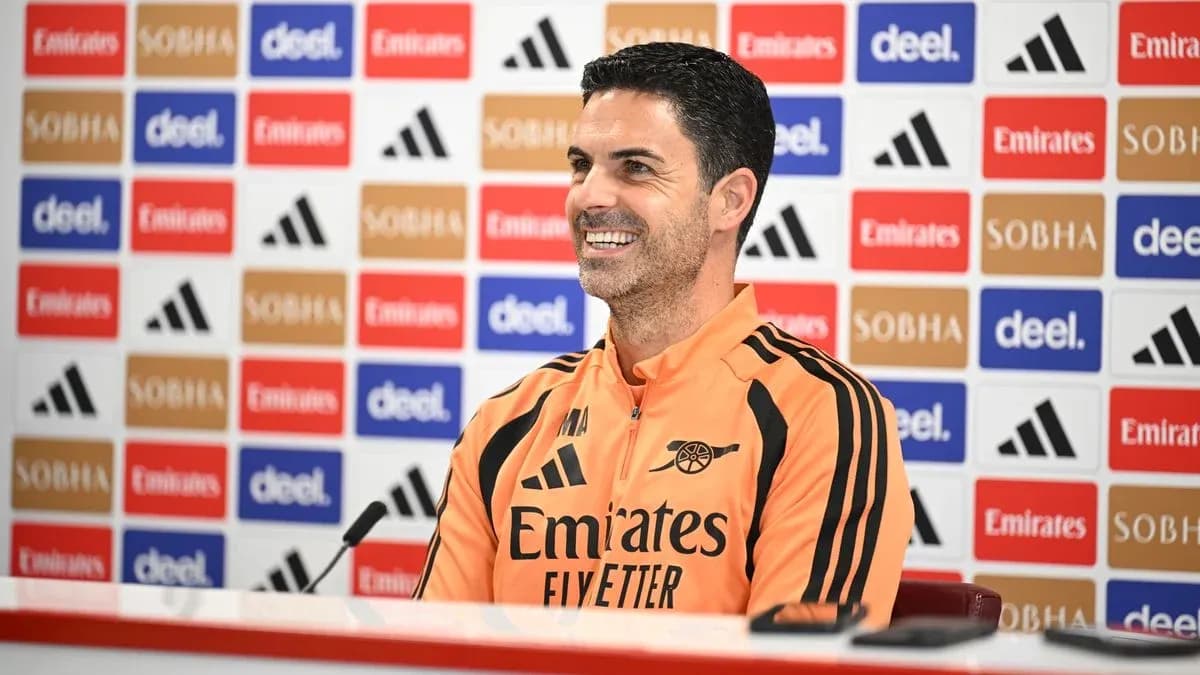
Mikel Arteta walked into the room smiling, but the questions waiting for him were anything but light. Brighton away, eight wins on the spin on the line, refereeing rows still simmering, contract talk, youth development, and the form of stars and starlets alike. Arsenal might be flying, but there is no shortage of noise around them.
Timber, Hincapie, Mosquera, White: squad close to full strength
Team news came first, as always. Ben White?
"All good," Arteta said. Another training session was scheduled for the afternoon, but the tone was upbeat. That optimism extended to Jurrien Timber, Cristhian Mosquera and Piero Hincapie.
"They are willing to be part of it," he explained. Arsenal will put them through one more session before making final calls, but the manager is clearly expecting to travel to Brighton with a near-complete group.
This will be Arsenal’s fourth consecutive away game. The schedule has been brutal, yet Arteta likes what he’s seen.
"The team has responded so well," he said. "Playing with such dominance, it doesn't really matter if we play at home or away; we want to be the same team."
Three away wins already. Brighton is the last stop on this particular road trip.
‘I’m here to defend my club’ – Arteta on referee influence
Jamie Carragher’s claim that Arteta is becoming a “Don” like Sir Alex Ferguson in terms of influence over referees was put directly to him. The comparison didn’t land.
"A what?" Arteta asked, before being told Carragher meant a “boss”.
He pushed the idea away. "I'm here to try to give my opinion, to defend my club, to give the very best to our players," he said. He accepted that he will make mistakes in how he expresses that, but insisted he aims to be “as fair as possible”.
The fallout from Sunderland and the conversations with Pro Ref remain a live topic. Has the club heard back?
"This is a conversation that will remain private as usual," he replied. No public airing, no theatrics.
Manchester United have received an apology for a recent decision. Would he like one?
"It's not about the apology," Arteta said. "It's just agreeing that the decision should have been different or not. Maybe they have a different opinion and try to improve and move forward together."
For him, the key is the wider debate. "We discuss many topics in this room," he added. "It's everybody's duty to try to improve the game, and that's what we're here for."
Brighton, Fabian’s apology and the chance at a historic start
Fabian’s previous criticism of Arsenal’s style and time-wasting after a win at Brighton in March was revisited. Arteta confirmed the Brighton man had apologised, and his respect was clear.
"I have huge respect for Fabian, what he's done and what Brighton has done as a club. It's just remarkable," he said. "Tomorrow is going to be a beautiful game to watch, I'm sure."
Beautiful or not, it could also be historic. If Arsenal win, it will be eight wins from eight in all competitions, something the club says hasn’t happened since 1903.
Arteta did not indulge the nostalgia. "We've got a really tough opponent tomorrow so we're going to have to earn the right to win the game," he said. The record is a by-product, not the objective.
"We know how complicated it is to win a football match at this level," he added later. Seven straight victories already tell their own story, especially coming straight off a World Cup winter. "We had a bit of luck as well," he admitted, but the attitude from day one impressed him. Now they want “another one for sure tomorrow”.
Talk of Invincibles inevitably followed. Five league wins from five has triggered early-season excitement. Arteta shut that down instantly.
"We just have enough on the plate today to prepare the game against a really good Brighton tomorrow," he said. "We know how tough that's going to be and then the right to win it, that's it."
Contract calm: ‘We are all very much aligned’
Arteta’s own future is never far from the agenda. The club want him to sign a new deal. The fans want it. He was asked bluntly if he will sign during the upcoming international break.
"I think we are all very much aligned," he said. "Whenever the time is right, we'll get that done. There is nothing to be concerned about."
Two years ago, his previous extension was announced around this stage of the season. Any significance in the timing this time?
"I don't know if the time will be the same or different," he replied. The important part, in his eyes, is shared ambition. "Whenever we have time, we'll get that resourced."
A new-look international break and the strain on squads
This Brighton game is the final one before the new, longer international break. The format has changed, and nobody yet knows how it will feel in practice.
"Let's see, it's something that we'll have to experience," Arteta said. He pointed out how differently national teams are handling it, from big squads staying in Europe to others travelling the world for two and a half weeks.
For him, communication is everything. "It's going to be really important to have good communication with them so they understand where our players are, what we expect, what they expect as well. And work together, that's the best way always."
Could the longer blocks actually help club momentum compared with the old pattern of stop-start breaks?
"Let's see, let's see how it pans out," he repeated. For now, it’s an unknown.
Leadership in real time: Gabriel, Salmon and the split-second that matters
One of the more striking recent moments came in the cup, when Gabriel sprinted straight over to Marli Salmon after a mistake, lifting the 16-year-old’s confidence in an instant.
"You cannot cause that. You have it, or you don't," Arteta said. That kind of leadership, he believes, is instinctive. "It's just a very emotional reaction when you're in the middle of the game, and I absolutely loved it because we've all been there."
He knows what that means for a teenager. "The confidence that it gives to a 16-year-old to go again and deliver in the next action, it's huge." For Arteta, it symbolised the bond inside this squad.
Bruno Guimaraes: left, right, middle – and everywhere in between
Bruno Guimaraes’ role was another tactical thread. At Newcastle he has largely operated on the right side of midfield. Does Arteta see him differently?
"He can play on the left, on the right, in the middle, he can rotate from there," came the answer. The manager praised his dynamism and versatility, stressing it will depend on “what we need on the day”, the other midfielders around him and the opponent.
"He can deliver great moments in any position," Arteta said. The message was clear: Bruno is a system player, not a fixed point.
David Raya’s rise: from non-league to “one of the best”
The story of David Raya was framed as a modern football fairytale. From non-league to Premier League, and now, in some eyes, the best goalkeeper in the world and a Golden Glove contender.
"That's a great story," Arteta said. For him, Raya’s journey is a blueprint for any young player dreaming big. "I'm always maintaining that will, that motivation and that enthusiasm that it can happen."
He highlighted how connected the football world is now. One game, one scout, and a career can change in two or three years.
Raya’s mentality stands out most. "Obviously, he has tremendous quality, but he has overcome a lot of difficulties and a lot of challenges to reach this point," Arteta said. It wasn’t smooth even when he arrived at Arsenal. "He really has to dig in and improve himself."
Arteta was quick to praise goalkeeping coach Iñaki and the staff around Raya, but he did not shy away from the scale of the signing.
"He's been a tremendous signing. There's no question about that," he said. Whether he’s the best signing is “just an opinion” and not something he dwells on, but he did add: "I think he has elevated the team, the club to a different level and now we need to maintain that level."
Viktor’s challenge and the search for rhythm
Attention turned to Viktor, who faces one of his former clubs this weekend and has yet to fully ignite in the Premier League.
Arteta rejected the idea that the forward is struggling for confidence. "Especially in the Premier League, he hasn't played that many minutes," he pointed out. Viktor started in Napoli last week and delivered “a good game”.
"It’s about moments as well," Arteta said. His job, he feels, is to surround Viktor with support and belief. "We know the player that we have, the capacity that he has to score goals and what he can give to the team."
He reminded reporters that adaptation is a two-way street. "The team is doing certain different things this season as well," he said. "It's a bit of both… that's a constant evolution, player and team." His responsibility is to “find those connections and that level of confidence for the player to give his best for the team.”
Could a spell with Sweden be the spark? Graham Potter has suggested a change of environment might help, and Arteta has seen that before.
"Especially for a striker, you know what, they need minutes and they need goals," he said. With Brighton up next, he hopes Viktor can find exactly that.
Youth strategy: recruiting the best, keeping the best
Arsenal’s youth strategy has shifted into sharper focus. Per Mertesacker has moved on, Pascal has stepped in, and the club has invested in young talents such as Victor in January and Andria Bartishvili more recently.
"Well, it's together as a club," Arteta said of the broader plan. If Arsenal want to sustain their current level, they must have a pathway “already in-house”. That means the academy and youth teams must be stocked with elite talent.
"They need to be one of the best in the world at recruiting," he said – both domestically and abroad. Only then, he believes, do they give themselves the best chance to keep this project at the top.
That’s not simple. Several promising youngsters have moved on over his near seven years, while others like Max Dowman and Marli Salmon have stayed and signed new deals.
"That is challenging because there are a lot of parties there," Arteta admitted. The system itself creates difficult moments when big decisions must be made. The club’s wishes do not always prevail. "Sometimes not only what we want to do is what the player or the agent or the family wants to do at times as well."
Still, the intention is unwavering. "We're going to try, for sure, to keep the best talent in-house."
Max Dowman: knocking on the door the right way
Max Dowman’s performance at Ipswich Town, capped with two goals, has sharpened the focus on his next steps. Is he banging on Arteta’s door for a starting spot?
"That's the best way to knock on the door: to do it on the pitch, not in the office," Arteta said. When a player delivers in matches and in training “every single day”, the manager runs out of arguments. The teammates start demanding he plays.
"What Max did the other day, alongside all the players as well that they haven't played that many minutes, it was really impressive," he added.
Arteta also stressed how Max has grown as a person. Being around senior professionals has changed him.
"When you see how those players behave daily, the level of attention they put to any detail, the way they look after themselves, the standard that they set, if you become part of that environment, that's only going to raise your level," he said. Once that standard becomes normal, "then you will hit another level, because then you will be able to add to that, and that's where Max is at the moment."
Eze, Tzolis and the left flank puzzle
With Martinelli and Trossard gone, Eze has taken all his minutes this season on the left wing. Arteta sounded completely at ease with that.
"He's always played there," he said. "His biggest moments in his career and the highlights of his career have come" from that side. Eze can shift into different spaces, but the left channel is where he has consistently produced match-winning moments for previous clubs.
He now shares that lane with Tzolis. How does Arteta decide which one suits a particular game?
Form, opponent, relationships within that unit. "There are a lot of factors," he said. The choice is tactical, not sentimental.
Ezri Konsa and Gabriel: a partnership that clicked overnight
Ezri Konsa’s display against Sunderland, in a bruising battle with Brobbey, underlined why Arsenal moved for him. Arteta had heard glowing reports before the transfer. Daily contact has only reinforced them.
"When you have it daily, you just realise the magnitude of the player that we signed," he said. But it’s not just the football. "The way he presents himself, the way he's able to connect with people immediately" has struck the manager.
The link with Gabriel has been instant. "When you see those two in the corridors talking, the way they interact with each other, it seems like they've been here for a long, long, long time together," Arteta said. He views that central partnership as “extremely important” for what Arsenal want to be.
On the pitch, Konsa’s attributes and quality, Arteta believes, “really make us better”.
Arsenal head to Brighton chasing an echo from 1903, with their manager calm about his contract, protective of his players, and relentless about standards. Eight wins from eight would send them into a new-look international break with momentum humming. The real question now is simple: how long can this surge last once the games start coming back in waves?