Argentina Advances in World Cup Round of 32 Against Cape Verde
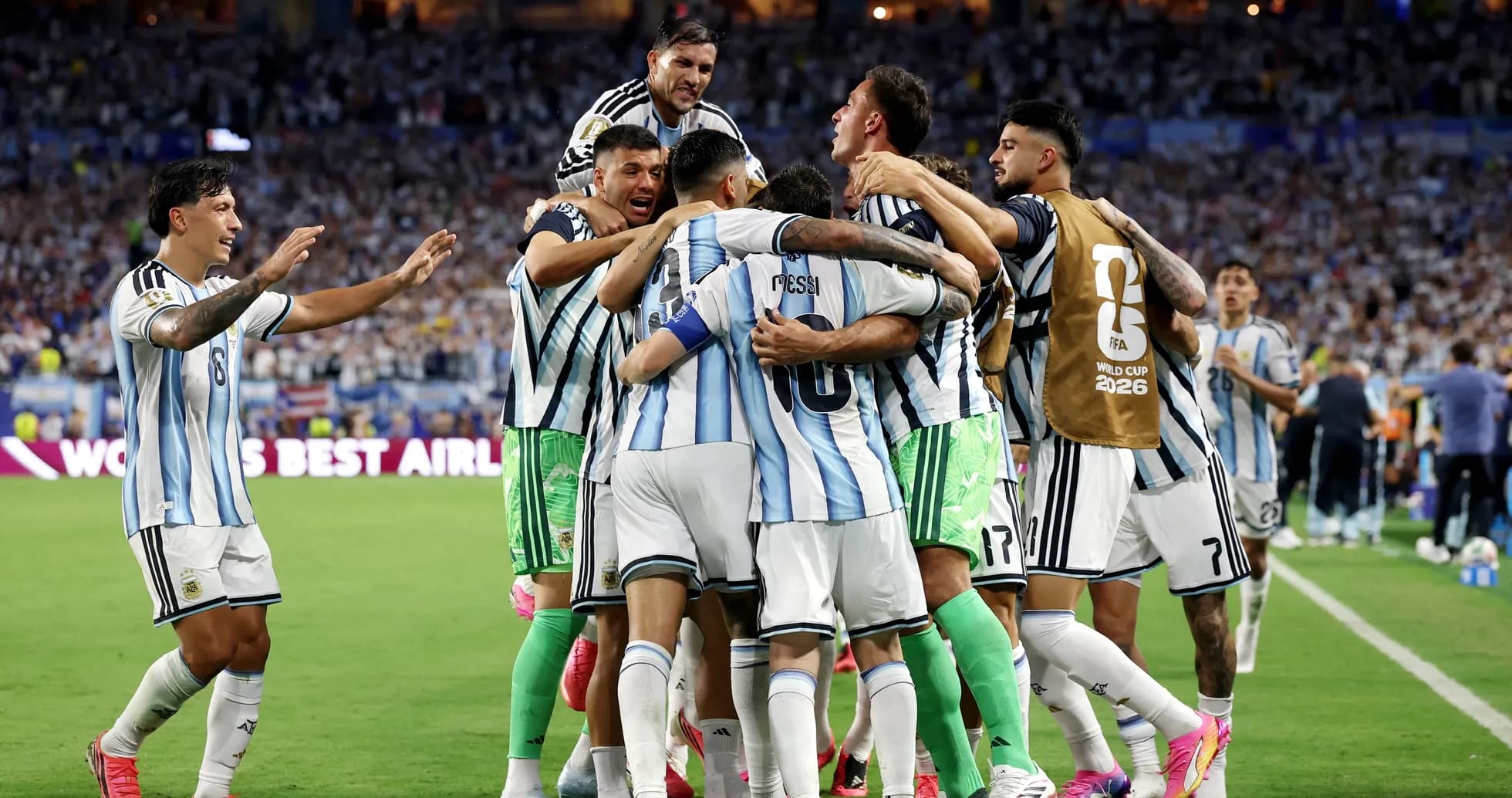
Hard Rock Stadium in Miami hosted a World Cup Round of 32 tie that felt less like a routine knockout and more like a test of Argentina’s tournament identity. After 120 minutes and a 2–1 scoreline after extra time, the holders advanced, but Cape Verde Islands forced them to reveal both their structural strengths and their lingering vulnerabilities.
I. The Big Picture – Two Pathways Converge
Heading into this game, Argentina arrived as the World Cup’s form team. They had taken 9 points from 3 group matches, top of Group J, with a total goal difference of 7 built on 8 goals scored and just 1 conceded. Across the tournament so far, they had played 4 fixtures in total, winning all 4, with 3 played at their designated “home” status and 1 as “away”. In total this campaign, Argentina’s attack had been relentless: 11 goals in total, with an average of 2.7 at home, 3.0 on their travels, and 2.8 overall. Defensively, they had conceded only 3 in total, averaging 0.7 at home and 1.0 away, 0.8 overall.
Cape Verde Islands came from a very different road. Second in Group H with 3 points from 3 draws, they reached the Round of 32 without a single win, their total record reading 0 wins, 3 draws, 0 defeats in the group. Across 4 fixtures in total this tournament, they still had no victory: 3 draws and 1 defeat, with 4 goals scored and 5 conceded. On their travels they had found some attacking rhythm, averaging 1.3 goals away and 1.0 in total, but they also allowed 1.7 goals away and 1.3 overall. This was a team living on a knife-edge of narrow margins, built on resilience rather than dominance.
II. Tactical Voids and Discipline
There were no listed absentees, so both coaches could lean fully into their preferred structures. Lionel Scaloni doubled down on continuity: Argentina lined up in the now-familiar 4-4-2, a shape they had already used in 4 matches this tournament. Pedro Leitao Brito matched them with Cape Verde’s staple 4-1-4-1, also deployed in all 4 of their fixtures.
Argentina’s disciplinary profile hinted at a side that comes alive in the darker, more stressful moments of a match. In total this campaign, all their recorded yellow cards had clustered late: 33.33% between 76–90 minutes, another 33.33% between 91–105, and 33.33% between 106–120. This is a team that tends to push the line when fatigue sets in and stakes rise, a trait that can be interpreted as competitive edge or creeping desperation.
Cape Verde’s card map was the mirror image. They started hot. A striking 40.00% of their yellow cards came in the opening 0–15 minutes, another 20.00% between 16–30, and 20.00% between 61–75, with a final 20.00% between 91–105. The pattern suggests an underdog willing to set the tone physically from the first whistle, then reassert aggression in key second-half and early extra-time phases.
One more critical note on Argentina’s season-long profile: from the spot, they have been fallible. In total this campaign they had 2 penalties, scoring 1 and missing 1, a 50.00% conversion rate. The marquee name at the heart of that story is L. Messi, who in this World Cup had missed 1 penalty. In a knockout tie that went to extra time, the mere shadow of a potential shootout would have carried that psychological weight.
III. Key Matchups – Hunter vs Shield, Engine Room Battles
The headline duel was always going to orbit around L. Messi. The tournament’s leading scorer heading into this clash, he had 7 goals in total from 4 appearances, with a stellar rating of 9.28. He had taken 22 shots, 15 on target, and created 10 key passes from 141 total passes at 80% accuracy. He was both finisher and architect, and in Scaloni’s 4-4-2 he started as a nominal forward but roamed into the half-spaces to knit Argentina’s attacks.
Cape Verde’s shield against that gravitational force was their compact 4-1-4-1, anchored by K. Lenini as the single pivot in front of the back four. Behind him, the defensive line of S. Lopes Cabral, D. Borges, R. Lopes, and S. Moreira was tasked with staggering their positions to deny Messi the classic diagonal drives from right half-space to central edge of the box. The danger for Cape Verde was that their structure could be stretched by Argentina’s dual-forward threat: L. Martinez (shirt number 22) working off Messi’s movements, and the wide midfielders R. de Paul and T. Almada stepping inside to overload central lanes.
In the engine room, E. Fernandez and A. Mac Allister formed Argentina’s central axis. Their role was twofold: circulate quickly enough to pull Cape Verde’s midfield band of four—R. Mendes, L. Duarte, D. Duarte, and J. Cabral—out of shape, and counter-press aggressively when possession was lost to suffocate transitions towards N. Da Costa up front.
For Cape Verde, the counter-punch was clear. With N. Da Costa as a lone forward, their best route was quick vertical progression from L. Duarte and D. Duarte, using J. Cabral’s mobility between the lines. The 4-1-4-1 can morph into a 4-3-3 in possession, and the plan was likely to exploit any gaps behind Argentina’s full-backs, particularly when N. Molina and F. Medina advanced.
IV. Statistical Prognosis – Margins, xG Logic, and Extra-Time Truth
Even without explicit xG figures, the season data paints the expected balance of chances. Argentina’s overall scoring average of 2.8 goals per match, combined with conceding just 0.8, points to a side that typically generates significantly higher-quality opportunities than they allow. Cape Verde’s 1.0 goals for and 1.3 against in total suggest a team that lives closer to parity in chance quality, often dragged into tight, low-margin games.
Overlay that with card timing and you see the critical intersection: Cape Verde’s aggression in the first 15 minutes against an Argentina side that tends to keep its disciplinary powder dry early. The underdog’s best window to disrupt was right from kick-off. Conversely, Argentina’s late yellow-card surge hints at a team that continues to push forward and press even deep into extra time, trusting their superior attacking profile to eventually break resistance.
The match narrative—1–1 after 90 minutes, 2–1 after 120—fits the statistical script. Cape Verde had enough defensive structure and discipline to drag the tie beyond regulation, but Argentina’s superior attacking volume, embodied above all by Messi’s output and the constant threat of L. Martinez, was always likely to tilt the expected goals balance their way over 120 minutes.
Following this result, Argentina’s perfect record in total remains intact, their 4-4-2 identity reinforced rather than reinvented. Cape Verde exit with their tournament story defined: tactically coherent, defensively stubborn, but ultimately a step below the ruthless efficiency required to survive a knockout duel with the world champions.