
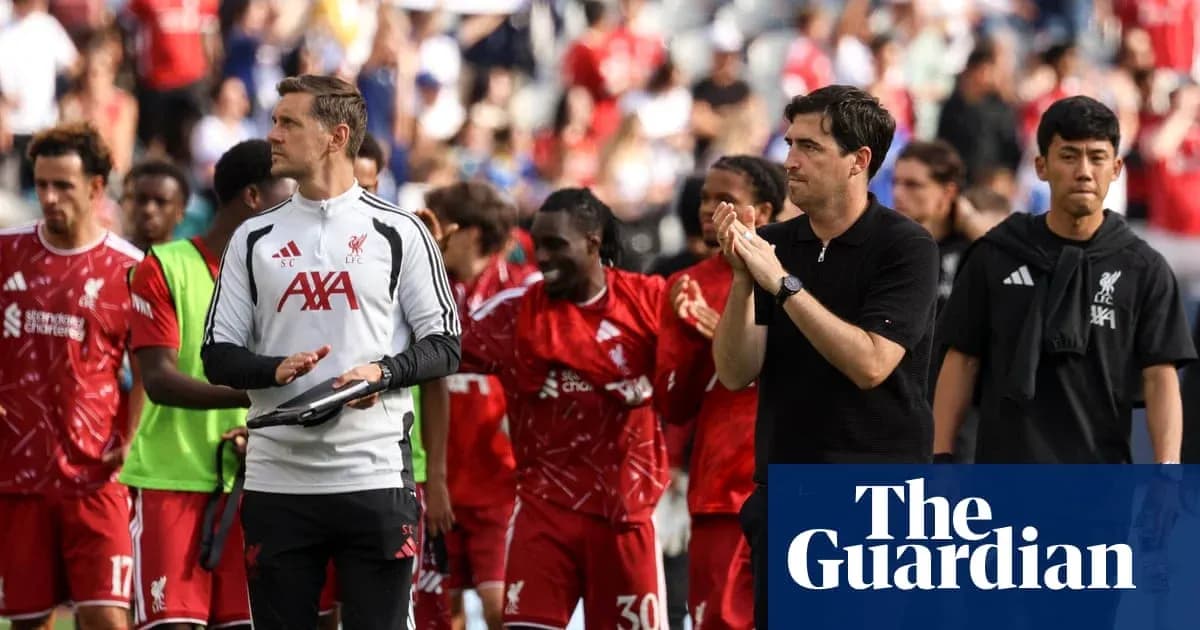
Andoni Iraola's Liverpool: Lessons from the US Tour
Andoni Iraola’s first real look at Liverpool came not under the grey skies of Merseyside, but under stage lights in Nashville, New York and Chicago. Two wins, one defeat, a handful of warnings and a few clear promises. Pre‑season rarely tells the whole story. This one did enough to hint at the size of the job.
A demanding idea, and a ticking clock
The 4-2 defeat by Leeds at Soldier Field underlined both sides of Iraola’s Liverpool. For 45 minutes, with senior names on the pitch and the press co-ordinated, his front-foot, high-intensity blueprint crackled into life. Liverpool hunted in packs, squeezed the pitch and moved the ball with purpose. It was their sharpest half of the tour.
Then the familiar shadows crept back in.
Set-piece frailty, lapses in concentration, the kind of cheap concessions that haunted last season – all resurfaced once the changes rolled in. For Iraola, it was a reminder that a new idea doesn’t overwrite old habits overnight.
The context matters. He has not yet coached Virgil van Dijk, Cody Gakpo, Alisson, Alexis Mac Allister or new signing Víctor Muñoz. He has not even met some of them. They will walk back into the AXA Training Centre on Wednesday after a delayed start to pre-season, Mac Allister granted extra time off after his World Cup exploits.
There are fewer than three weeks before Liverpool open their Premier League campaign away at Newcastle. Only two friendlies remain, a double-header against Como at Anfield. Iraola admitted he cannot simply click his fingers and find a finished product on day one. The football he wants – aggressive, vertical, relentless – demands conditioning, cohesion and repetition. Time is the one thing he does not have in abundance.
A coach who needs help from above
Across the Atlantic, Iraola worked with a stripped-back group. Eight first-team players were absent on post-World Cup breaks. Six more were missing through injury, with Joe Gomez’s latest setback arriving on US soil. Fourteen players who would normally orbit the starting XI were nowhere near it.
Even if everyone were fit, the gaps in the squad are obvious.
Mohamed Salah’s departure was confirmed in March, with talks over ending his contract early starting even earlier. Five months on, Liverpool still have no replacement for one of the most decisive forwards in their history. The right flank, once the most predictable part of the team sheet, is now a question mark.
Conor Bradley’s serious knee injury strips depth from right-back. There is genuine optimism around Jérémy Jacquet and Giovanni Leoni – the latter has returned from an ACL injury looking like he has lived in the gym – and the 18-year-olds Ifeanyi Ndukwe and Mor Talla Ndiaye impressed in the US. But potential does not win you points in the Premier League on its own.
Liverpool remain short of top-level experience in central defence. Ndukwe, for all his promise, cannot even feature this season because of post-Brexit work permit rules. Gomez, with his injury history, has to be treated as a bonus when available, not a cornerstone of a four-man centre-back rotation.
Iraola spoke openly about his preference for wingers who can operate on both sides and swap flanks mid-game. The idea fits his aggressive, unpredictable attacking model. Yet the reality is stark: even if Liverpool complete a deal for Bradley Barcola from Paris Saint-Germain, the right side of the team looks fragile without Salah and with the current defensive uncertainty behind it.
The new head coach has brought a clear identity. Now he needs the recruitment department to match his ambition.
Nyoni steps out of the shadows
If the tour forced Iraola to lean on youth, it also gave him one standout reward.
Among the youngsters – Ndukwe, Talla Ndiaye, Lewis Koumas, Kieran Morrison, Luke Chambers – one name pushed itself to the front of the queue: Nyoni.
The 19-year-old spent last season on the fringes of Arne Slot’s squad. Rio Ngumoha, the winger alongside him in that group, made 19 Premier League appearances, including five starts. Nyoni’s contribution was limited to six league cameos from the bench. He looked like a player waiting for his moment.
In the US, he grabbed it.
Nyoni looked instantly in tune with Iraola’s instructions. He found forward options early, often and under pressure. When space closed, he created his own with subtle movement and sharp body angles, always looking to break lines rather than settle for the safe pass.
His involvement in Florian Wirtz’s goal against Leeds summed up his tour. The pass in the buildup – weighted, disguised, threaded between lines – was the sort of contribution that changes a manager’s depth chart. It was not a flash in isolation; it was consistent with his performances across the three games.
After the Leeds match, Nyoni said he knew he had to improve this summer. On this evidence, he has done exactly that. He returns to Merseyside no longer as a promising squad option, but as a player firmly in Iraola’s first-team plans.
Jones at a crossroads
While one midfielder surged forward, another stalled.
Curtis Jones is entering the final 12 months of his Liverpool contract. Inter, the Italian champions, have registered their interest. This was a tour that could have strengthened his hand, either for a new deal or for a high-profile move abroad.
Instead, it raised questions.
On the pitch, Jones struggled to adapt to Iraola’s demands for a central midfielder. Where Nyoni and Dominik Szoboszlai looked comfortable playing quickly and vertically, Jones often appeared caught between roles. His second-half outing against Leeds was particularly unconvincing, lacking the sharpness and clarity Iraola wants in the middle of the pitch.
His reaction to not receiving the captain’s armband against Wrexham did him even fewer favours. When Szoboszlai passed it to Kostas Tsimikas instead of Jones, the 25-year-old’s irritation was obvious. It was not an isolated decision either. In the opening game against Sunderland, when Gomez went off, the armband again went to Tsimikas – a reserve left-back who spent last season on loan at Roma.
For a boyhood Liverpool supporter and one of the more senior figures on the tour, the snub was always going to sting. Jones, Szoboszlai and Tsimikas all worked hard to play down the incident in the days that followed, and social media inevitably blew it up beyond its actual size. Still, the image lingered.
In Chicago, Iraola spoke at length about the importance of the collective, about building a group that runs on shared responsibility rather than individual ego. Against that backdrop, Jones’s visible frustration jarred. With his contract running down and competition for midfield places increasing, his future feels more open than ever.
Szoboszlai steps into the spotlight
If there was any doubt about who carried Liverpool’s flag across the US, Szoboszlai removed it.
With Salah, Andy Robertson, Van Dijk and Alisson all absent, the Hungary captain became the face of the tour. Every appearance, every touch, every sprint drew a roar. The cameras followed him, the fans waited for him, and he handled it all with the ease of a player fully aware of his status.
The acclaim mattered less to Iraola than what happened behind closed doors. On the training pitches, Szoboszlai set the standard. His work rate, intensity and focus gave a young and patched-up squad a clear reference point. For a new head coach trying to establish authority and identity, that kind of internal leader is priceless.
Fresh from signing a new five-year contract, the 25-year-old looks perfectly placed to step into one of the vice-captain roles vacated by Salah and Robertson. He already acts like a pillar of the dressing room. The armband, in some form, feels like a natural next step.
Liverpool fly back from America with a defeat in their luggage, a few bruises and a long list of tactical details to refine. They also return with a clearer picture: a demanding coach who knows what he wants, a squad that still needs surgery, a young midfielder who has announced himself, and a senior one who faces a defining season.
The question now is simple: will the club move as decisively off the pitch as Iraola wants his team to move on it?




