Alaves Upset Barcelona 1-0 in Tactical Showdown
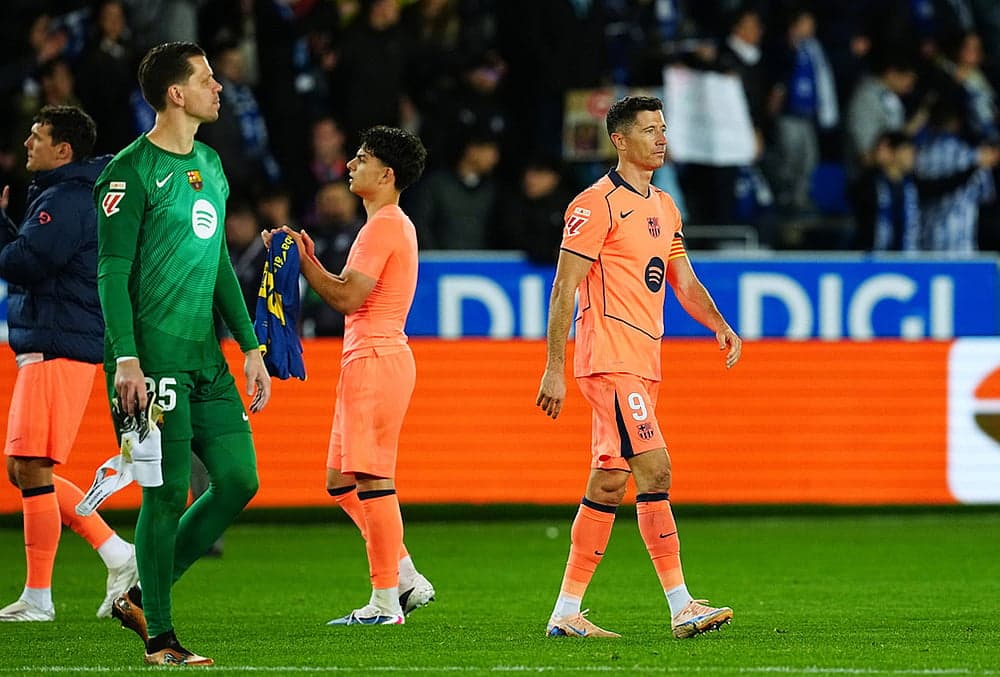
Estadio Mendizorrotza under floodlights, a champion-elect brought to a halt. Alaves 1–0 Barcelona, a narrow scoreline that felt like a tactical manifesto from a side fighting on the margins of La Liga against a machine that has spent the season overwhelming almost everyone in its path.
I. The Big Picture – A clash of identities
Following this result, the league table tells the scale of the upset. Alaves sit 16th with 40 points and a goal difference of -12, built on a season of grinding margins: 10 wins, 10 draws, 16 defeats across 36 matches, with 42 goals scored and 54 conceded overall. At home they have been stubborn rather than spectacular, with 7 wins from 18 and a perfectly balanced return of 24 goals scored and 23 conceded at Estadio Mendizorrotza.
Barcelona arrive as the antithesis. Top of La Liga on 91 points, they have bulldozed the season with 30 wins in 36 games and a towering goal difference of 59, scoring 91 and conceding only 32 overall. At home they have been perfect – 18 wins from 18 – and even on their travels they have looked dominant, winning 12 of 18 away with 37 goals scored and 23 conceded.
Yet here, in a regular-season Round 36 fixture, the script broke. Alaves, more accustomed to 4-4-2 and 4-1-4-1 this season, doubled down on survival instincts and structural discipline, rolling out a 5-3-2 under Quique Sanchez Flores. Barcelona, under Hansi Flick, stayed loyal to their season’s core identity: a 4-2-3-1 that has underpinned 26 league outings, designed to suffocate opponents with high pressing and layered attacking rotations.
II. Tactical Voids – Absences that reshaped the game
The absences mattered, especially for Barcelona. Flick had to navigate without Lamine Yamal (thigh injury), Raphinha (suspension for yellow cards), and Frenkie de Jong (coach’s decision), plus another squad member left out by choice. That stripped Barcelona of two of their most direct wide threats and one of their key press-resistant midfield controllers.
Without Lamine Yamal’s 16 goals, 11 assists and relentless 1v1 dribbling, and without Raphinha’s 11 goals and 3 assists, Barcelona’s right side lost its usual chaos and verticality. The onus fell heavily on Dani Olmo, Marcus Rashford and Robert Lewandowski to stitch together the final third. Olmo, one of La Liga’s premier creators with 8 assists and 7 goals, had to drop deeper to help build play; Rashford, usually a devastating runner, was asked to provide more connective tissue between lines; Lewandowski became the lone reference point, often isolated between Alaves’ three central defenders.
Alaves were not untouched either. Lucas Boyé, their 11-goal forward and a crucial outlet in transition, missed out with a muscle injury, while F. Garces was suspended. Deprived of Boyé’s ability to hold up play and win duels, Sanchez Flores leaned into a more collective, attritional model: Toni Martínez and I. Diabate up front as runners and press triggers rather than classic target men.
Disciplinary trends also framed the risk profiles. Across the season, Alaves show a late-game spike in yellow cards, with 21.74% of their cautions arriving between 76–90 minutes and another 16.30% in stoppage time (91–105). Barcelona, by contrast, collect most of their yellows in the 46–60 minute window (28.33%), reflecting the intensity of their early second-half press. This match followed that pattern in spirit: Alaves walked the tightrope late, Barcelona pushed and probed as the clock ticked, but the hosts’ discipline held just enough.
III. Key Matchups – Hunter vs Shield, Engine Room vs Enforcer
Hunter vs Shield was written through Robert Lewandowski against a defensive unit that has conceded 23 at home in 18 matches, averaging 1.3 goals against per home game. Alaves’ 5-3-2 placed V. Koski, N. Tenaglia and V. Parada as the central spine in front of A. Sivera, with A. Rebbach and A. Perez as wide defenders. The line was narrow, compact, and unapologetically deep.
Lewandowski’s season – 13 league goals, 2 assists – has been defined by clever movement and penalty-box craft, but here the supply lines were choked. With Barcelona missing their most dangerous right-sided creators, the crossing volume lacked its usual precision. The back five tracked Lewandowski’s blind-side runs, and whenever he did receive, Antonio Blanco and J. Guridi collapsed space from midfield, forcing him away from central shooting zones.
In the Engine Room, it was Antonio Blanco versus Barcelona’s double pivot of M. Casado and M. Bernal, with Olmo drifting inside. Blanco’s league profile is clear: 2936 minutes, 91 tackles, 52 interceptions, 9 yellow cards – the archetypal enforcer. He anchored the central three, stepping out to disrupt Olmo between the lines and screening passes into Rashford’s feet.
Barcelona’s creative triangle – Olmo, Rashford, and the roaming R. Bardghji – tried to overload half-spaces, but every time they found a pocket, Blanco or Guridi arrived to snap at heels. The 5-3-2 compressed the central lane so thoroughly that Barcelona were repeatedly pushed wide, where Rebbach and Perez could engage without exposing the box.
At the other end, Toni Martínez embodied Alaves’ counterpunch. With 12 goals and 3 assists this season, he is more than just a runner; he wins duels, presses aggressively and can finish under pressure. His partnership with Diabate was less about long spells of possession and more about punishing the rare moments when Barcelona’s high line overcommitted. One such transition produced the decisive first-half goal, sending Alaves into the break 1–0 up.
IV. Statistical Prognosis – How the numbers tilt the rematch narrative
Following this result, the macro-numbers still favour Barcelona in any future meeting, but the tactical blueprint is now clear.
Barcelona’s season-long attacking profile remains terrifying: 2.5 goals per game overall, 2.1 on their travels, with only one away match all season where they have failed to score. They have kept 15 clean sheets, including 5 away, and conceded just 0.9 goals per game overall. Their penalty record is flawless this campaign – 7 taken, 7 scored, 0 missed – a reminder that any foul in the box is almost automatically punished.
Alaves, by contrast, live on thin margins: 1.3 goals scored and 1.3 conceded at home on average, 4 clean sheets overall and 10 matches in which they have failed to score. Their defensive resilience is more about structure than dominance; they bend often, and in total they concede 1.5 goals per game.
If we frame an Expected Goals outlook for a hypothetical rematch, Barcelona’s volume of chances and historical scoring rate would likely generate the higher xG, perhaps in the 1.5–2.0 range, even away. Alaves, built around counters and set pieces, would probably sit closer to 0.7–1.1 xG, reliant on efficiency rather than volume.
But this night at Mendizorrotza showed the path: a five-man back line, Blanco’s ferocity in the engine room, Martínez’s tireless running, and a willingness to suffer without the ball. Against a Barcelona missing Lamine Yamal, Raphinha and Frenkie de Jong, that was enough to turn the league’s most dominant attack into a frustrated, one-dimensional siege.
The numbers still say Barcelona win this game most days. The story of this 1–0 says that, in the right structure and with the right sacrifices, Alaves can bend probability to their will.