
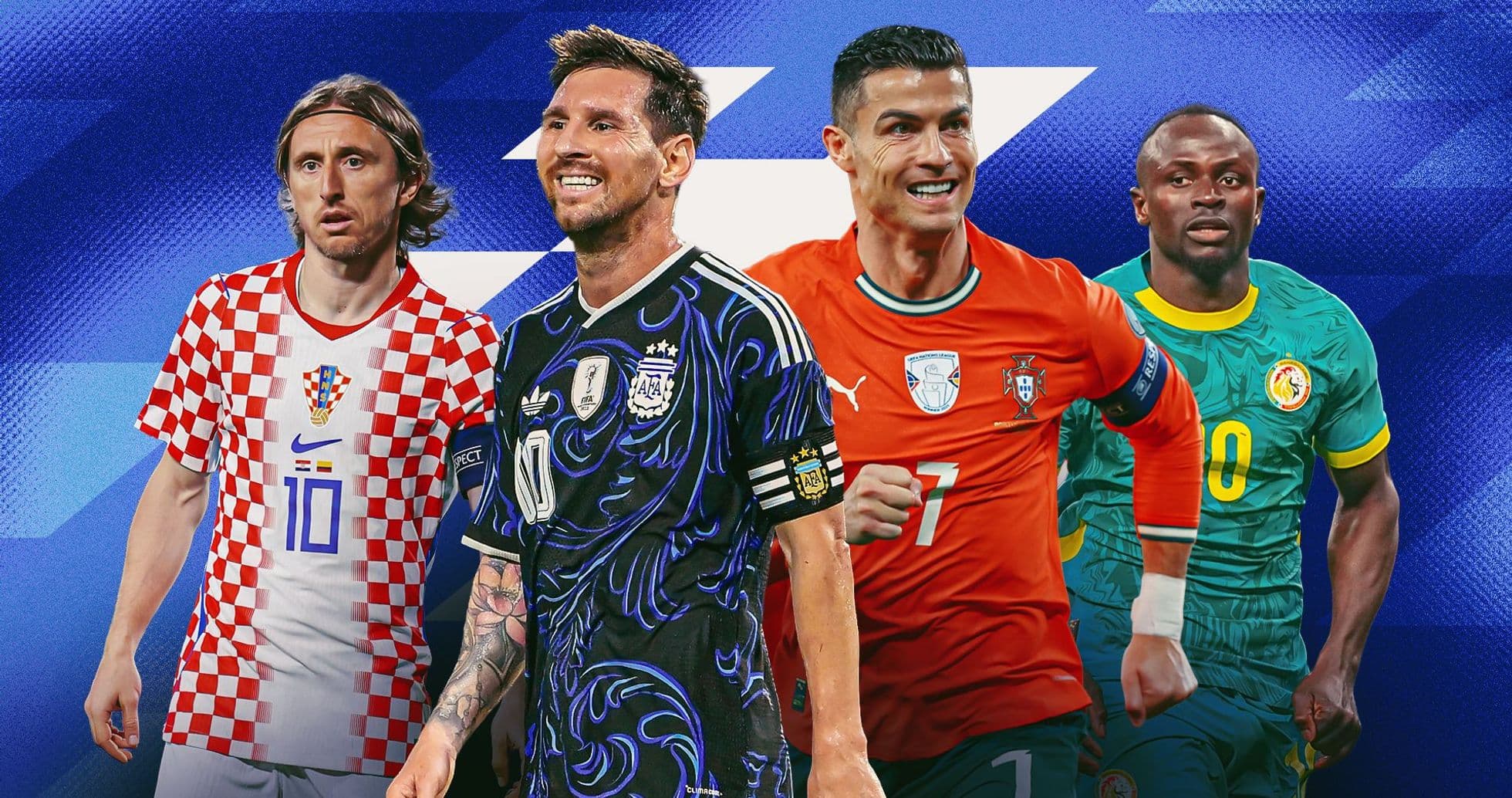
World Cup 2026: A Final Chance for Football Legends
The World Cup has always been a stage for dreamers. This one might be remembered for goodbyes.
Across North America, a generation that defined modern football is preparing for one last tilt at immortality. Some have already climbed the mountain. Others are still staring at the summit, knowing this is their final chance.
Messi and Ronaldo: The Last Chapter
Lionel Messi will arrive on the brink of 39, lighter on his feet, heavier with history. He has already done the impossible once, dragging Argentina to glory in Qatar and finally lifting the trophy that shadowed his entire career. Since then he has traded European pressure for Miami sunsets, managing his body in MLS without ever dimming the genius.
He still turns games with a single touch, still sees passes others his age would struggle to even imagine. The questions now are physical, not technical: can he survive an expanded tournament, long travel, and the furnace heat of a North American summer? Logic says no. Messi’s career has never really cared for logic. A record-breaking sixth World Cup awaits, and nobody expects him to slip quietly into the night.
Cristiano Ronaldo will be 41. If he lifts the trophy with Portugal, he becomes the oldest World Cup-winning player in history. That alone underlines the scale of his obsession. His World Cup record lags behind his legend: no goals in knockout rounds, no final, no defining tournament moment to match his club career.
Yet he refuses to fade. In Saudi Arabia with Al-Nassr he continues to score relentlessly, still built like a sprinter, still talking as if retirement is a distant rumour. Portugal no longer need to lean solely on him – Rafael Leao, Pedro Neto, Goncalo Ramos and a loaded supporting cast are ready – but Roberto Martinez has chosen to keep Ronaldo at the centre of his plans. Sixth World Cup. Last shot. The stage he has chased his entire life, one final time.
Ochoa and Neuer: Goalkeepers Who Won’t Go Away
Messi and Ronaldo were always coming. Guillermo Ochoa was not.
Mexico’s cult hero, the man who has been saving impossible shots at World Cups for 20 years, looked done. One appearance for El Tri since March 2024, no real expectation he would be anywhere near Javier Aguirre’s squad. Then Angel Malagon tore his Achilles in March and the door swung open.
At 40, with over 150 caps and a career that has bounced through Spain, Italy, France, Portugal, Belgium and, most recently, AEL Limassol in Cyprus, Ochoa is back for a sixth World Cup. He has hinted this will be his last act. For a country co-hosting the tournament, it feels right that the man who became a World Cup ritual returns for one final curtain call.
Germany have their own blast from the past. Manuel Neuer had stepped away from international duty after Euro 2024, one of several veterans to draw a line under a turbulent era. But injuries to Marc-Andre ter Stegen and doubts over Oliver Baumann’s form forced Julian Nagelsmann into a bold decision: call Neuer back.
At 40, after another strong season with Bayern Munich, Neuer will play his fifth World Cup and has already been confirmed as Germany’s No.1. For a nation desperate to avoid a third straight group-stage exit, the old guard in goal is back in charge.
Modric, Dzeko and the Reluctant Farewells
Luka Modric’s game has always been about timing. Now he is racing against it.
He will arrive at 40, still orchestrating, still gliding, still refusing to surrender his place at the heart of Croatia’s story. He carried them to the final in 2018, then to third place in 2022. Since leaving Real Madrid for AC Milan last summer, he has sought minutes and sharpness, not glamour, in order to stretch his career just that little bit further.
This will be his fifth World Cup. By then he should become only the fourth player in history to reach 200 caps – assuming Messi, on 198, gets there first. Modric will not care about the order. He will care about one more deep run.
Edin Dzeko might have thought his World Cup chapter closed years ago. Bosnia and Herzegovina had not returned since 2014, qualification campaigns repeatedly ending in frustration. Then came one more surge. One more rallying cry from their captain. A play-off win over Italy. A 40-year-old centre-forward back on the biggest stage.
Dzeko is about to pass 150 caps and has already scored more than 70 goals for his country. At Schalke, he helped fire the club back into the Bundesliga, proving he can still bully defences. His career deserved more major tournaments than it got. North America offers him a final, fitting platform.
Asia and Africa’s Icons Near the End
Some farewells may be more tentative, but no less emotional.
Son Heung-min turns 34 in July. He remains the beating heart of South Korean football, the captain and symbol of a nation that obsesses over every touch he takes. The workload has been immense. He has already stepped away from European football to join LAFC in MLS, a sign that he is managing the final phase of his career carefully. By the time 2026 ends, he may feel he has given everything he can to the national cause.
Mohamed Salah is a few days older than Son and carries a similar burden. For Egypt, he has been everything: scorer, creator, talisman, lightning rod. This time he at least has more help, with Manchester City’s Omar Marmoush leading a better supporting cast, but the Pharoahs will still turn to Salah when the pressure tightens.
His Liverpool form has dipped sharply over the last year, and his only previous World Cup, in 2018, was scarred by that shoulder injury in the Champions League final. For a player of his stature, the absence of a defining World Cup is a glaring gap. With a move to Saudi Arabia likely after leaving Anfield, this tournament feels like the last realistic shot at carving his name into the global stage in the way his talent demands.
Sadio Mane knows that feeling. He turned 34 before the tournament and has been at the core of Senegal’s golden era. He scored the decisive penalty to win the 2021 Africa Cup of Nations, then dragged the Lions of Teranga to back-to-back World Cup appearances, even if injury cruelly kept him out in 2022.
His transfer to Al-Nassr has taken him out of the weekly European spotlight, but never dulled his commitment to Senegal. He still wears the armband, still sets the standard. With Ismaila Sarr and Illiman Ndiaye maturing around him, his experience could be the difference between a respectable showing and a deep run.
Riyad Mahrez completes a trio of African Champions League and Premier League winners nearing the end. At 35, the Algerian winger still hypnotises defenders with that first touch and those drifting runs in from the right. For all his brilliance, he has only played in one World Cup, back in 2014. Algeria have missed every edition since.
This summer offers him a rare second chance. Now with Al-Ahli in Saudi Arabia, his club career is winding down, but his ability to light up a game in an instant remains. Algeria will hope he saves one last masterpiece for the world’s biggest stage.
Europe’s Generals on Borrowed Time
Kevin De Bruyne arrives under a cloud of doubt. His first season at Napoli has been shredded by injuries, fuelling fears that his body, at nearly 35, is finally rebelling against years of relentless intensity.
When he is fit, he still operates on a different plane: the passes that split defences, the shots from distance that change games, the tempo he dictates almost by will. Belgium’s much-hyped Golden Generation is fading fast, but De Bruyne remains the conductor. Rudi Garcia’s squad is transitioning, younger, less star-studded. Yet if De Bruyne can stay healthy, Belgium become dangerous again, lurking in the shadows rather than on the posters.
Virgil van Dijk will turn 35 during the tournament. Centre-backs can age gracefully; Van Dijk has mostly done so, anchoring a Liverpool side that terrified Europe. For years, some strikers openly tried to avoid his side of the pitch, unwilling to test his timing and power.
The last season has been more uncertain. On Merseyside, whispers have grown that he has lost a step, that his anticipation is not quite as razor-sharp. The Netherlands still build around him. This is likely his second and final World Cup, one more chance to show that, even if the aura has dulled, the authority has not.
James, Neymar and the Players Who Owe the World Cup Everything
James Rodriguez owes his entire career to one World Cup. In 2014 he stunned the planet, scoring outrageous goals, playing with joy and freedom that earned him a move to Real Madrid and a place in tournament folklore.
Since then, injuries have chipped away at his rhythm. He has hopped between clubs, most recently Minnesota United in MLS, using short stints to maintain fitness while saving his best for Colombia. He turns 35 in July. For Colombian fans, his presence is non-negotiable. A final World Cup for one of the competition’s most iconic faces feels like football closing a loop.
Neymar’s road to 2026 has been chaotic. Brazil’s all-time leading scorer tore his ACL in October 2023 and vanished from the international scene. Carlo Ancelotti took over the national team and left him out, and it looked as though Neymar’s World Cup story had ended with a whimper.
Then injuries struck Brazil’s forward line. Ancelotti reached for the phone. Neymar, now back at Santos, made the squad. The reaction in Brazil was instant and wild.
What role he can actually play is another matter. He picked up yet another injury just days after his call-up and still has to prove his fitness. His body is clearly rebelling. The idea of him lasting until 2030 is fantasy. This is his last chance to chase the sixth star Brazil crave, the trophy that has eluded a player once tipped to rule the sport.
Kane and England’s Quiet Countdown
Not everyone in this group is clinging to the game. Harry Kane might be at his absolute peak.
At 32, fresh from a season in which he scored over 60 goals for Bayern Munich, he stands as England’s all-time leading scorer and one of Europe’s deadliest finishers. Physically, he looks built to keep going. There is a believable path to the 2030 World Cup.
Yet the calendar matters. England will co-host the 2028 European Championship, a home tournament that could offer the perfect stage for Kane to sign off internationally in front of his own fans. If that happens, 2026 becomes his final World Cup, the last time he leads the Three Lions into global battle.
The same logic could apply to others. Jordan Pickford, John Stones, perhaps even Marcus Rashford might eye 2028 as a natural endpoint, a final bow on home soil after one more World Cup push.
Across continents, the pattern repeats. Legends stretching their careers, chasing closure, or simply refusing to accept that the game moves on without them. North America will not just host a World Cup. It will host the last stand of a generation that changed football.
How many of them will leave with the ending they’ve spent their lives chasing?




