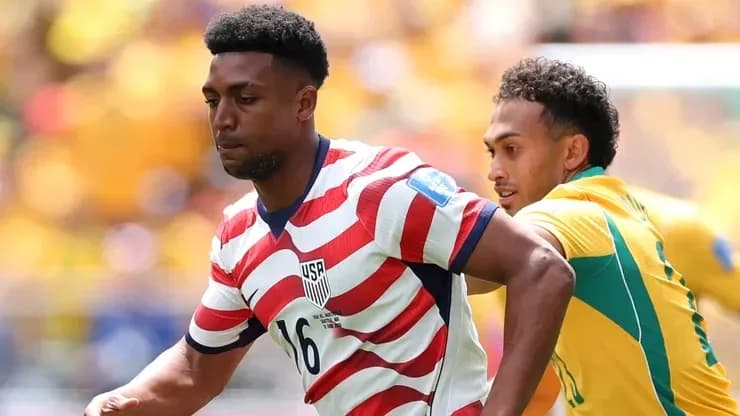
United States Leads 2-0 at Halftime Against Australia
The United States walked into halftime at Lumen Field with a 2–0 lead over Australia and, more importantly, with the look of a team that knows exactly what it’s doing at this World Cup.
For a while, it didn’t feel that way. The opening exchanges were even, both sides probing, both midfields snapping into tackles without quite finding the final ball. Australia tried to settle, to slow the tempo, to drag the game into their rhythm.
Then the American press bit.
The breakthrough came in the 11th minute, born from relentless pressure rather than a moment of individual genius. Folarin Balogun drove dangerously into the box, forcing panic in the Australian back line. Defender Cameron Burgess, under heavy strain, turned the ball into his own net. Not pretty, but brutally effective. Team USA didn’t care how it went in. They had their lead.
From that point, the pattern hardened. The United States started to dictate everything: the tempo, the territory, the duels. Their movement off the ball began to stretch Australia in all directions, opening lanes down both flanks and dragging the Socceroos into uncomfortable spaces.
All of this without Christian Pulisic.
If there were doubts about how the U.S. attack would function in the absence of their injured star, the first half went a long way toward answering them. Weston McKennie stepped up as the heartbeat in midfield, driving play, snapping into second balls, and setting the tone with his intensity. Out wide, the Americans repeatedly found joy, turning the wings into launchpads rather than safety valves.
Australia tried to respond on the counter. There were a few half-chances, some promising breaks where a cleaner final pass might have tested the U.S. back line. But each time they looked ready to spring, the pace and aggression of the Americans closed the door. The Socceroos weren’t just second-best in the duels; they were often a step late in reading the danger.
The pressure eventually told again, this time just before the interval.
Sergino Dest sparked the move, surging forward and igniting another sweeping attack. The ball broke to Alex Freeman, who finished the action by finding the back of the net. For a moment, confusion reigned. There had been contact with an Australian defender, and players on both sides glanced anxiously toward the officials.
VAR stepped in, checked the tangle, and confirmed what the U.S. players already believed. Goal. The decision unleashed a roar around Lumen Field, American fans celebrating not just a second strike but the sense that this game, and maybe this group, was tilting their way.
Australia, by contrast, trudged toward the tunnel looking shell-shocked. They had chased, they had battled, they had tried to counter, but they rarely carved out truly clear openings. The U.S. had smothered them with pace, with energy, with the kind of intensity that wears on legs and minds as a tournament rolls on.
At 2–0, the scoreline reflects more than a couple of key moments; it reflects control. Team USA has put itself in a commanding position heading into the second half, with a chance not just to see out a win, but to make a statement about how far this side can go in 2026.